

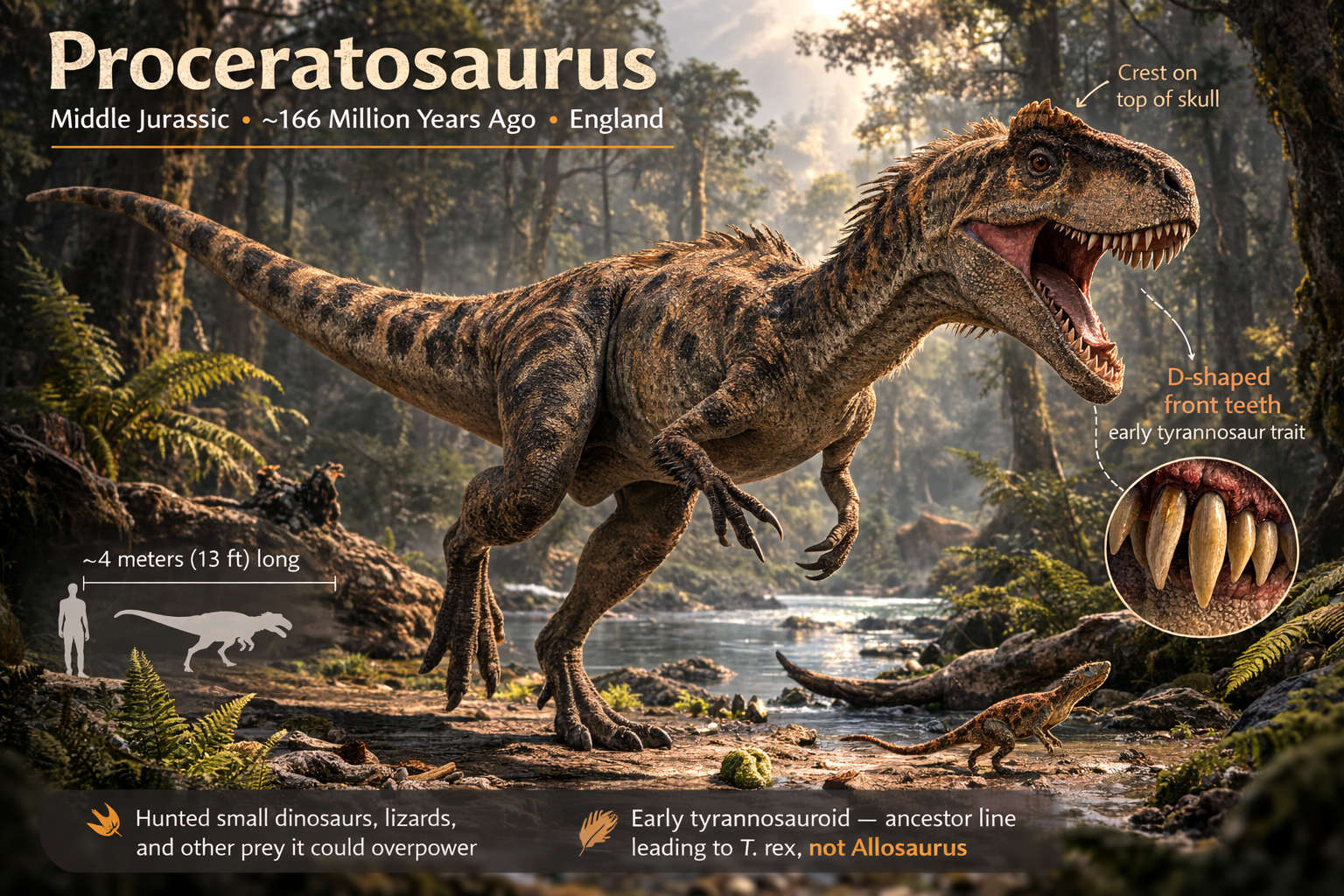
Proceratosaurus was a small early tyrannosauroid that lived in Middle Jurassic England, about 166 million years ago. It was not a giant like later tyrants. Estimates put it at around 4 meters (13 feet) long, making it a relatively modest predator for its time. It likely hunted small animals it could overpower—smaller dinosaurs, lizards, and other available prey—rather than dominating the landscape as a top super-predator. What makes it especially interesting is its skull: it had an early tyrannosaur-style tooth pattern, including the telltale D-shaped front teeth, and a crest on top of the skull, showing that some classic tyrannosaur traits were already taking shape very early.
Its deeper ancestors lie within the broader coelurosaur branch of theropods, not in the line of Allosaurus. That old childhood idea made sense because both animals were meat-eating theropods, but modern classification separates them. Allosaurus belongs to the allosauroid/carnosaur side of theropod evolution, while Proceratosaurus sits on the tyrannosauroid line that eventually leads toward T. rex. In other words, Allosaurus was not a direct-line ancestor of tyrannosaurs. It was more like a large predatory cousin from another major branch. That matters because it helps us see that similar-looking giant hunters can arise on different branches of the dinosaur tree.
Its descendants tell a much bigger story. For tens of millions of years, tyrannosauroids were mostly small, lower-level predators living in the shadow of larger carnivores such as allosaurs and their relatives. Only later, after those older giant hunter lines declined, did tyrannosaurs expand into the apex-predator role. From early forms like Proceratosaurus came a long and branching tyrannosaur story that eventually included animals like Dilong, Yutyrannus, Gorgosaurus, and finally T. rex. So T. rex was not the beginning of the tyrant story. It was the late, oversized finale of a line that had been evolving for over 100 million years.
