

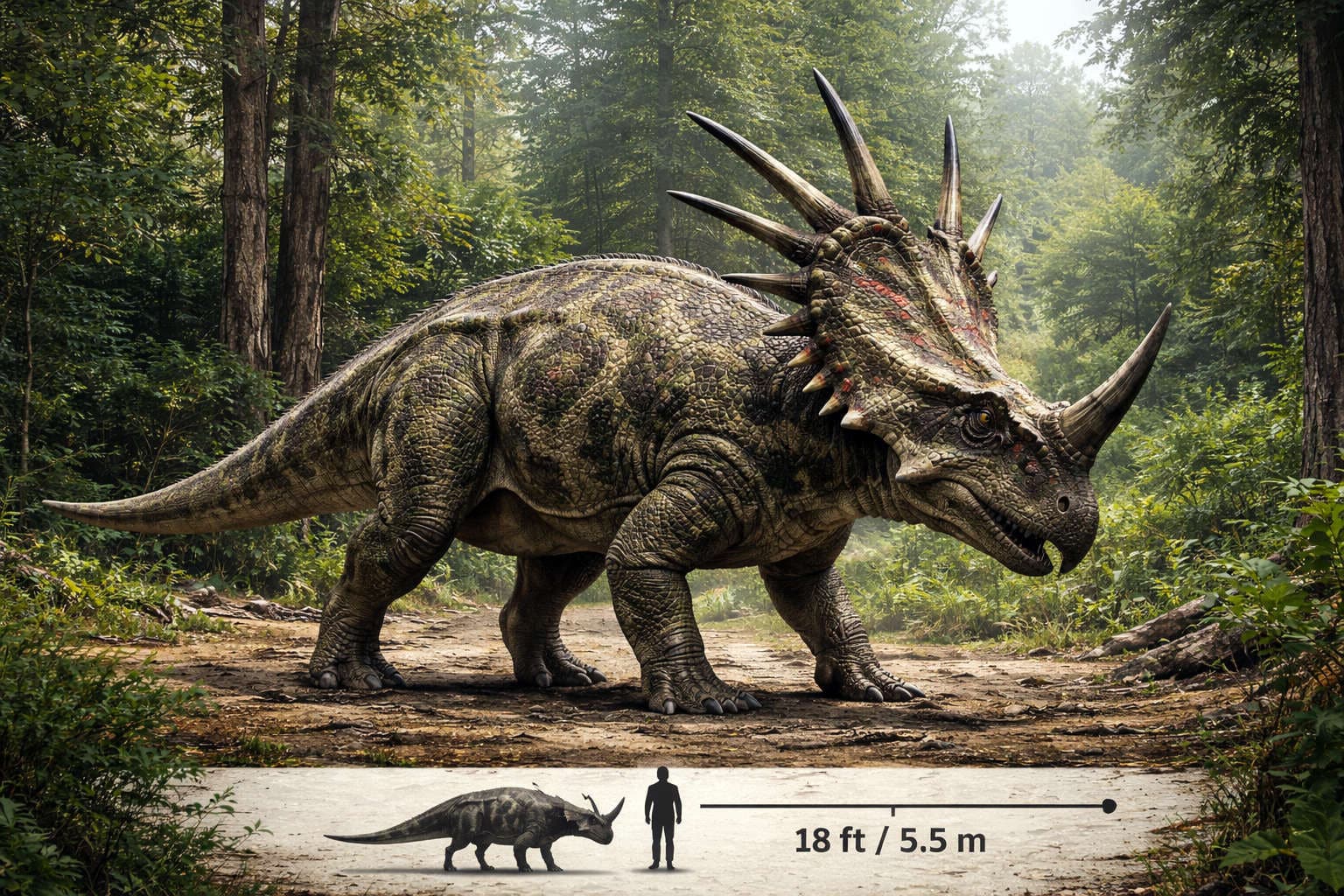
Styracosaurus lived in western North America, especially in what is now Alberta, Canada, about 76 to 75 million years ago during the Late Cretaceous. It was a large plant-eater, roughly 5.5 meters long, with a heavy four-legged body, a parrot-like beak, and shearing teeth for cutting tough vegetation. What made it unforgettable was its head: a long nose horn and a dramatic frill lined with long spikes, giving it one of the most striking faces in all of dinosaur history.
It relates to Triceratops as a close horned cousin, but not as a direct ancestor. Both were ceratopsids, yet they belonged to two different major branches within that family. Styracosaurus was a centrosaurine, a group that tended to emphasize the nose horn and elaborate frill ornamentation. Triceratops, by contrast, was a chasmosaurine, a branch better known for longer brow horns and a different frill shape. So the two dinosaurs shared the broader horned-dinosaur body plan, but they represent two distinct lines within the later ceratopsid story.
The centrosaurines seem to have died out about 68.5 million years ago. While that seems relatively close to the final dinosaur extinction at 66 million years ago, the reality is that 2.5 million years is a very long time. The same time as the evolution of ancient humans.
Styracosaurus itself lived well earlier, in the Campanian, and centrosaurines are chiefly known from that earlier slice of the Late Cretaceous, while the very latest horned dinosaurs near the K–Pg boundary are chasmosaurines such as Triceratops. So as best we know, the spiky-nosed centrosaurine line did not make it to the very end. Their branch faded out earlier, leaving the last chapter of large horned dinosaurs to their chasmosaurine cousins.
