

Kardashev scale: Type I | Type II | Type III
Renewable and clean power output equals our star: I have redefined Type II to shift away from merely capturing the Sun’s energy to utilizing energy sources that produce power equivalent to that of our star. This adaptation moves away from reliance on technologies like the Dyson Sphere and opens the possibility for advanced methods.
Since Einstein’s equation E=mc2 means energy is matter and matter is energy, at this stage we have the ability to go back and forth effiently enough to produce energy equivalent to our Sun. This might mean significant evolving and scaling up of atomic energies, such as fusion energy, antimatter, and the theoretical harnessing of dark energy, which remain largely speculative but represent the frontier of cosmic energy management. Another potentioal path is stellar harvestors. They would function outside of Earth’s orbit and capture and produce renewable energy equivalent to the Sun.
According to the original definition, a Type II civilization represents a monumental leap in technological and energy management capabilities, where a civilization harnesses all the energy output of its parent star. This achievement would likely involve constructing megastructures such as a Dyson Sphere, a theoretical construct designed to encompass a star entirely, capturing most or all of its energy output.
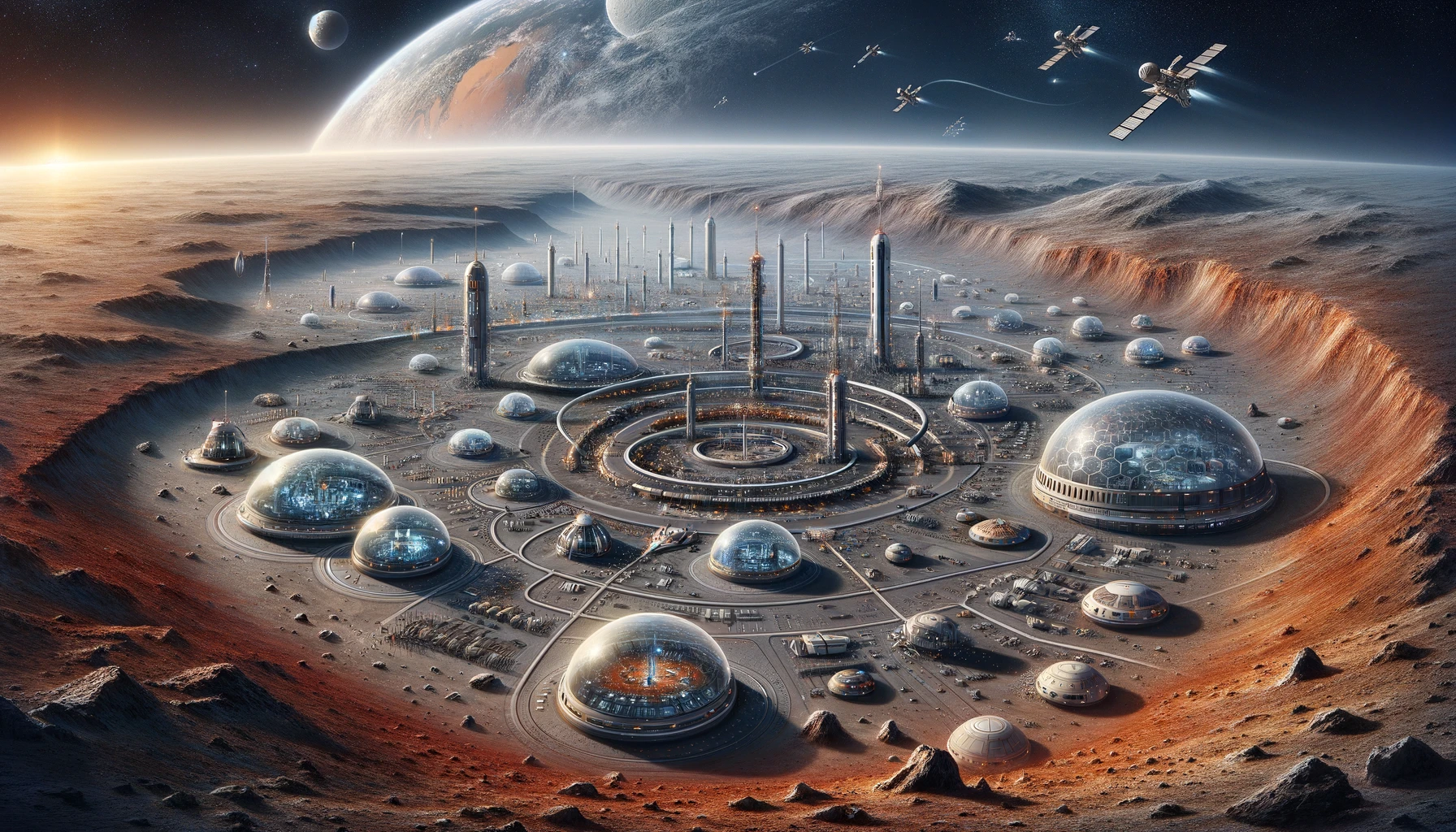
Reach: Homo sapiens spread throughout the solar system, making full use of all planets, moons, and major asteroids, as well as the space between them. This includes exploiting all orbital and revolving forces, surface areas, and populations living underground and under-sea on planets, moon, and larger asteroids. While a broad consensus among human factions maintains genetic consistency across most of the population, renegade groups have diverged, embarking on their own evolutionary paths.
Effects: With energy at planetary levels essentially free, humanity could experience a revolution in its living standards, work, and exploratory capabilities. With this level of access to energy, the entrepreneurial innovation of humanity’s creativity aided by robotics and AI appears nearly unlimited. This abundance of energy would likely spur massive innovations, reshaping economic structures and creating industries that seem like science fiction today. The possibility of interstellar spacecraft and space stations floating in space outside Earth’s orbit, and potentially outside the reach of the solar system. This level of access to energy could extend humanity’s reach beyond our solar system, drastically changing our understanding of space and our place within it.
Furthermore, the widespread availability of such energy could significantly reduce global inequalities, laying the groundwork for a more equitable distribution of resources. As societies become more interconnected through advanced space travel and communication technologies, we might see the emergence of a unified global or even interstellar cultural identity.
Estimates: While traditional estimates for achieving Type II status suggest tens of thousands of years, or even much longer to build a Dyson sphere, focusing on producing equivalent energy rather than capturing all of a star’s output could potentially shorten this timeline to thousands of years. This optimistic scenario relies on exponential advancements in robotics, AI, and energy technologies.
