

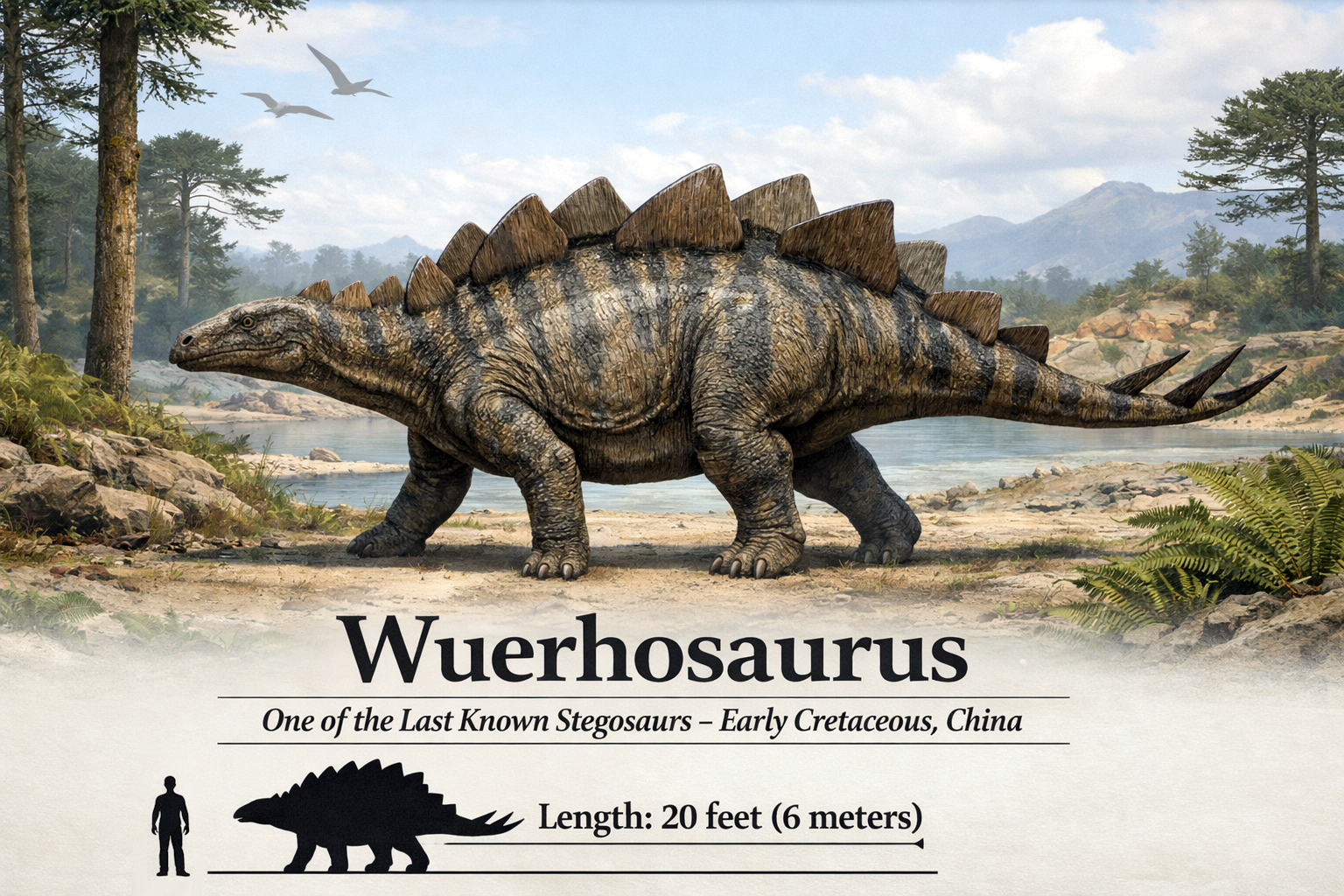
Wuerhosaurus was a late Early Cretaceous stegosaur from what is now northwestern China, with fossils known from Xinjiang and related material from Inner Mongolia. It lived roughly 135 to 125 million years ago, making it one of the youngest known stegosaurs. Unlike the taller, more dramatic image many people carry of Stegosaurus, Wuerhosaurus seems to have been a broader, lower-slung animal, likely adapted for feeding on low-growing plants. It still had the classic stegosaur look—plates along the back and a spiked tail—but it appears to have carried that old design in a somewhat flatter, heavier form.
Behind Wuerhosaurus stood a much wider stegosaur story. Earlier stegosaurs had spread across parts of North America, Europe, Africa, and Asia, and over time they explored a range of sizes and plate arrangements while keeping the same basic blueprint: small heads, arched backs, back plates, and a defensive tail. Some were taller and more iconic, like Stegosaurus. Others were built differently, showing that even within one recognizable body plan, evolution kept experimenting. Wuerhosaurus was one of the final echoes of that long, successful branch.
The frustrating truth is that late stegosaur fossils are scarce, which makes their ending harder to reconstruct than the endings of some other dinosaur groups. A few fragmentary finds hint that stegosaurs may have lingered later in the Cretaceous than once thought, but the mainstream view is still that no definitive stegosaur evidence is known from deposits close to the K–Pg boundary. In other words, stegosaurs seem to have disappeared tens of millions of years before the asteroid impact ended the non-avian dinosaurs.

