

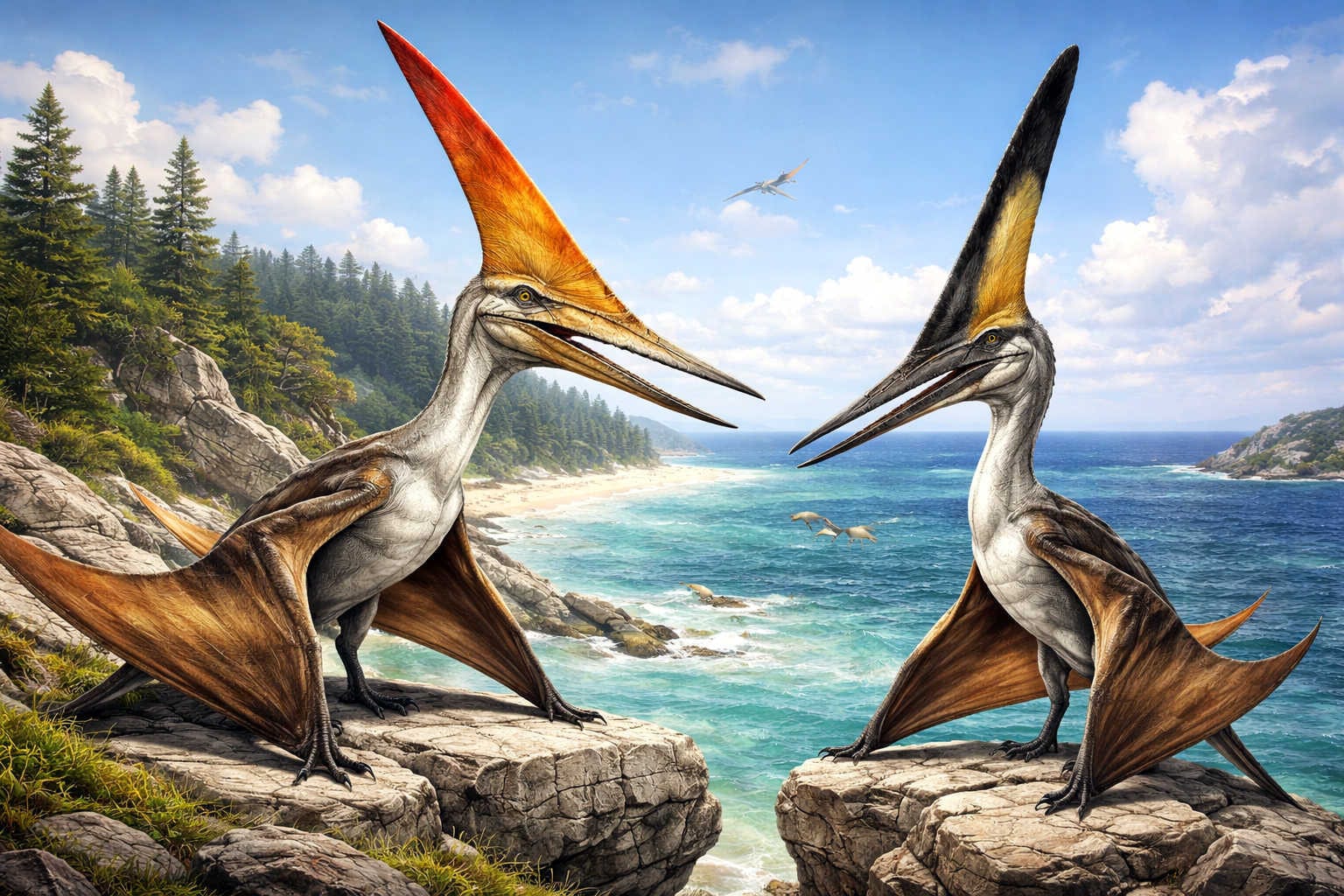
Pteranodon was a large, toothless pterosaur of Late Cretaceous North America, best known from the shores of the Western Interior Seaway. It had a long beak, a dramatic head crest, narrow wings built for soaring, and strong sexual dimorphism, with males larger and more extravagantly crested than females. The two commonly recognized species, P. longiceps and P. sternbergi, seem to differ mainly in crest shape, with sternbergi tending toward a taller, more upright crest and longiceps a longer, more backward-swept one. These were not dinosaurs, but highly specialized flying reptiles, likely spending much of their lives gliding above coastal waters and feeding largely on fish and other marine prey.
Its deeper ancestry reaches much farther back. Pterosaurs as a whole originated near the dinosaur line within Ornithodira, and the more advanced pterodactyloids—the shorter-tailed, long-skulled branch that includes Pteranodon—were already established by the Jurassic. Research on early pterodactyloids suggests that this advanced branch likely originated in terrestrial environments, long before some of its descendants, like Pteranodon, became famous as giant marine soarers. Within that later pterodactyloid history, pteranodontids emerged as one Cretaceous branch, with early records appearing before classic Pteranodon itself.
What happened next is important. Pteranodon itself did not continue to the very end of pterosaur history. It disappeared in the Late Cretaceous, while other pterosaur branches carried on after it. So later pterosaurs were not its direct descendants in the simple storytelling sense; they were better thought of as cousins on nearby branches of the larger pterosaur family tree. By the final chapter of pterosaur history, other advanced forms such as nyctosaurids and azhdarchids were still around, and pterosaurs as a whole lasted until the K–Pg extinction about 66 million years ago.

