
Phil • Cr. Think • Science • Hist • …
TST PRACTICE

The Philosophy Website

Natural Philosophy Term

Karma

☐ Read
☑ Read
You’ve read this 0 times.
You’ve listened to this 0 times.
Tue 23 Jun 2026
Published 3 months ago.
Updated 3 months ago.
Related Terms
Daoist Natural Alignment
Confucian Role Ethics
Dichotomy of Control
Authentic Self
Group Ethics
Two Tables of the Ten Commandments
Share :
Email
Print

Karma

In TST Philosophy, Karma belongs within Ethics and Take Control as a common floor for understanding cause and effect in moral life. The basic idea is simple: actions ripple. What you do does not stop at the edge of your body. Your choices enter relationships, families, institutions, ecosystems, memories, habits, and futures. Karma helps you notice that your actions become part of the world others must live in.

Karma is a traditional term with deep roots in Hindu thought, and it also appears in other Eastern traditions. Hinduism itself is not one narrow system. It is a vast family of philosophies, practices, stories, schools, and spiritual paths. Some traditions understand karma religiously, involving moral causality, rebirth, liberation, and cosmic order. TST does not need to reject those views or require them. It can honor them while still using karma as common ground.

TST does not support the naked use of fear-based ethics. It is not enough to say, “Do this or you will be punished,” or “Avoid that or bad karma will get you.” Fear can motivate behavior, but fear alone does not build moral understanding. The solution is simple: give the reason underneath it. Explain the harm. Explain the ripple. Explain why the act matters. If karma teaches that actions have consequences, TST asks us to understand those consequences, not merely fear them.

On common ground, karma means cause and effect. A kind act can ripple through trust. A cruel word can ripple through memory. A habit can shape a future. A careless choice can damage a relationship or environment. This is not mystical bookkeeping; it is the practical truth that actions have consequences, and consequences often travel farther than we can see.

In TST Holistic Eudaimonia, karma also helps celebrate the ripples into the void. You may not control where every ripple goes, but your life still sends something forward. Your choices can become memory, repair, courage, kindness, wisdom, harm, healing, or momentum. Karma reminds you that what you do matters because it joins the stream of reality.
— map / TST —

TST Tracker
✓ Reading recorded.
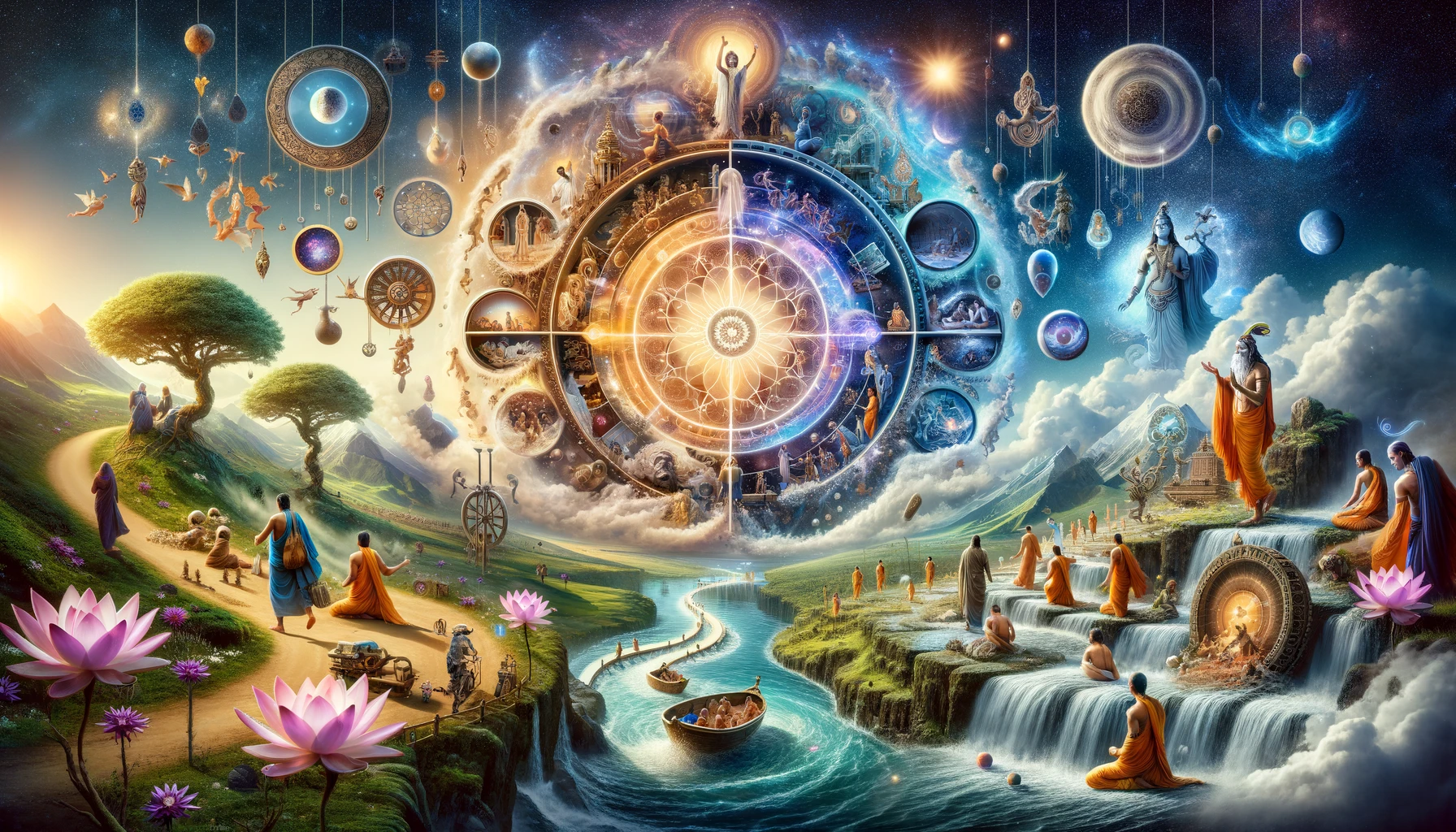
The good intent of Karma is intended to bring fear of a bad future life after death. It is the spiritual concept of actions and their consequences. One performs good deeds in this life in hopes of a better next life. Within Dharma, the cycle of Samsara, and Lord Krishna from the Bhagavad Gita guide the actions with a divine presence. The focus is on good intent within the framework of Karma.
Michael Alan Prestwood
Author & Natural Philosopher
Prestwood writes on science-first philosophy, with particular attention to the convergence of disciplines. Drawing on his TST Framework, his work emphasizes rational inquiry grounded in empirical observation while engaging questions at the edges of established knowledge. With TouchstoneTruth positioned as a living touchstone, this work aims to contribute reliable, evolving analysis in an emerging AI era where the credibility of information is increasingly contested.
The Prestwood Column
Menu
September 2026
Column Research….
1. Timeline Story
Hume’s Is–Ought Problem
2. Linked Quote
“I meet with no proposition that is not connected with an ought, or an ought not.”
3. Science FAQ »
Can science prove flourishing should be our goal?
4. Philosophy FAQ »
What is the difference between a normative aim and a normative directive?
5. Critical Thinking FAQ »
Is flourishing for all just utilitarianism?
6. History FAQ!
What is the history of the idea of flourishing in philosophy?
Bonus Deep-Dive Article
TST Normative Ethics: Flourishing as a Philosophical Goal

Comments

Join the Conversation! Currently logged out.
NEW BOOK! NOW AVAILABLE!!

30 Philosophers: A New Look at Timeless Ideas

by Michael Alan Prestwood
The story of the history of our best ideas!
Scroll to Top