
Phil • Cr. Think • Science • Hist • …
TST PRACTICE

By Philosopher Michael Alan Prestwood

FAQ

Why is speculation false in a logical setting?

☐ Read
☑ Read
You’ve read this 0 times.
You’ve listened to this 0 times.
Wed 21 Oct 2026
Published 21 minutes ago.
Updated 12 seconds ago.
Related FAQs
Is science tainted by bias?
What is the TST Ethical Roadmap?
How do slippery slope arguments manipulate people?
Does the absence of evidence prove anything?
How does the Idea of Ideas handle counterfactuals?
What is the difference between a heuristic and a cognitive bias?
Share :
Email
Print

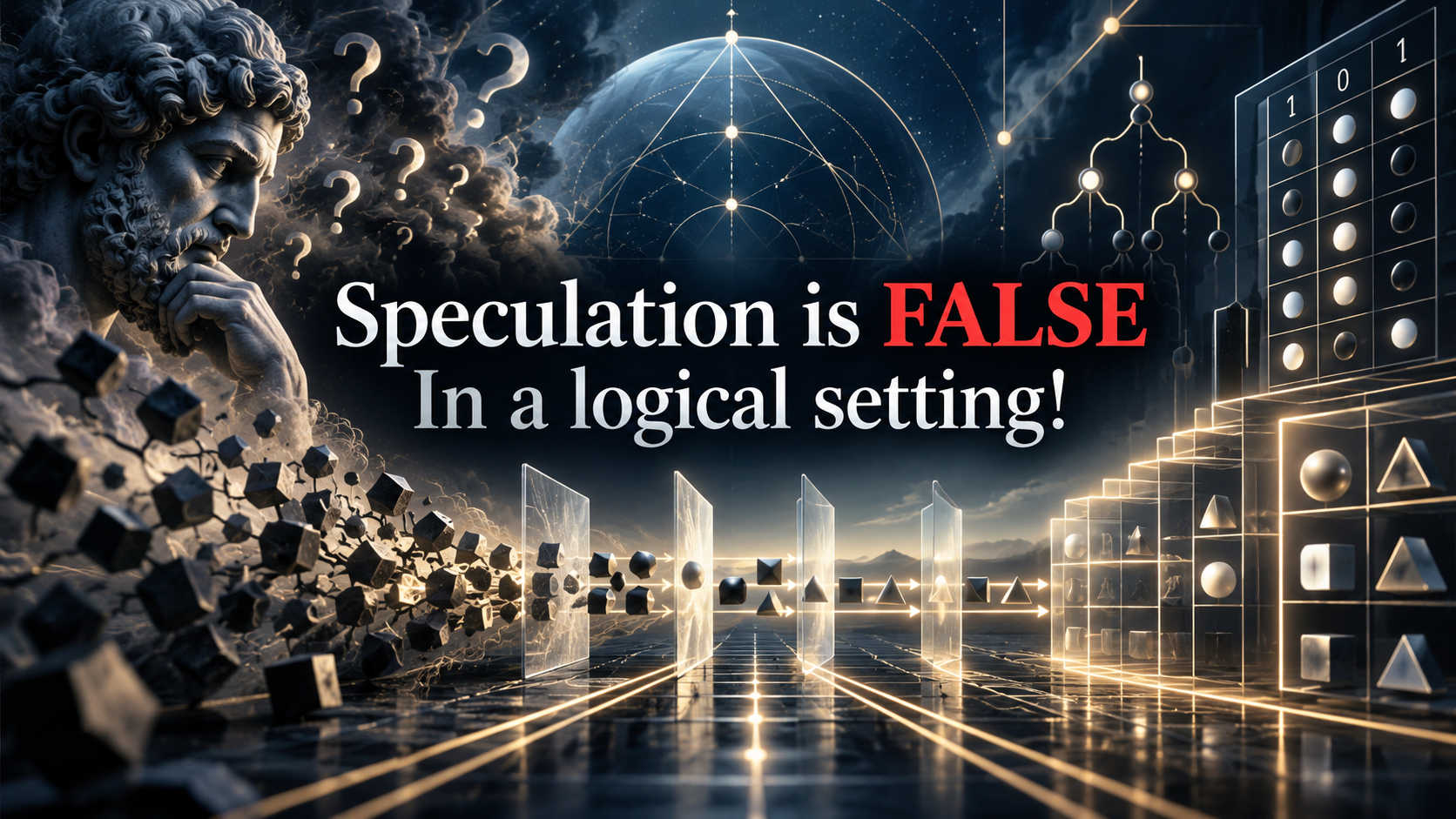
Why is speculation false in a logical setting?

In the Idea of Ideas there are three types of ideas: empirical, rational, and irrational. Empirical ideas describe the material world directly, rational indirectly, and irrational not at all. While truth is alignment with reality, human knowledge is a process. The TST epistemic categories are for evaluating ideas, they’re not categories of reality itself.

Within the irrational category there are two subtypes: disproven and speculative. While disproven ideas should be let go of as personal truth, even if they continue to hold personal “pragmatic” value, speculation is different. Speculation is the wellspring of knowledge. New ideas start out as speculative until they earn a place in knowledge.

Why? It’s a matter of logic. TST adopts classical logic as part of critical-thinking. TST’s three categories are epistemic, not logical truth values. They help us evaluate our ideas while preserving a binary commitment to truth.

So, speculative ideas are only false in a logical setting. Until they are proved or disproved, they remain speculative. They have not yet earned established truth status. Within established knowledge, speculation cannot be accepted as true. And when a binary judgment is required, it is treated as false.

Classical logic is bivalent, meaning truth and falsehood form an exhaustive binary pair: if a proposition is not true, it is false. But bivalence alone does not establish whether a speculative proposition is true or false. These are the reasons why TST’s epistemic categories sit above binary logic. Binary logic is sound, but our understanding of reality requires more than binary judgments. Something philosophers have grappled with since before Aristotle’s time. This idea in TST stems from reality itself; something cannot both be true and false, at the same time, and in the same way.
— map / TST —

TST Tracker
✓ Reading recorded.
Thinking well requires categories. Before deciding what is true, distinguish ideas grounded directly in reality, ideas supported indirectly by reasoning, and ideas that remain speculative or disproven. Speculation deserves exploration, not automatic acceptance. Recognizing these differences keeps our beliefs proportionate to justification while leaving room for tomorrow's discoveries.
Michael Alan Prestwood
Natural Philosopher & Author
Prestwood explores science-first philosophy, with particular attention to the convergence of disciplines. Drawing on his TST Philosophy, his work emphasizes rational inquiry grounded in empirical observation while engaging questions at the edges of established knowledge. With TouchstoneTruth positioned as a living touchstone, this work aims to contribute reliable, evolving analysis in an emerging AI era where the credibility of information is increasingly contested.
The Prestwood Column
Menu
October 2026
Column Research….
1. Timeline Story
The Great Quaker Debates!
2. Linked Quote
“All men are prone to differ. It is no new thing in all former ages, in all parts. Each party is most right in his own eyes.”
3. Science FAQ »
Do facts actually change minds?
4. Philosophy FAQ »
When does persuasion become manipulation?
5. Critical Thinking FAQ »
How can you tell when a debate has stopped being productive?
6. History FAQ!
What is the history of debate?
Bonus Deep-Dive Article
Roger Williams Biography and Dedication to the Freedom of Conscience

Comments

Join the Conversation! Currently logged out.
NEW BOOK! NOW AVAILABLE!!

30 Philosophers: A New Look at Timeless Ideas

by Michael Alan Prestwood
The story of the history of our best ideas!
Scroll to Top