
Phil • Cr. Think • Science • Hist • …
TST PRACTICE

By Philosopher Michael Alan Prestwood

FAQ

Are idea axioms related to Hume’s is–ought problem?

☐ Read
☑ Read
You’ve read this 0 times.
You’ve listened to this 0 times.
Sat 14 Nov 2026
Published 2 minutes ago.
Updated 12 seconds ago.
Related FAQs
Who was William of Ockham, and what principle is named after him?
How do I know what is true and what is just an opinion?
When does consciousness start?
Thinking: How does social media fuel the “grass is always greener” problem?
Was math discovered or invented?
What is the difference between anthropology and paleontology?
Share :
Email
Print

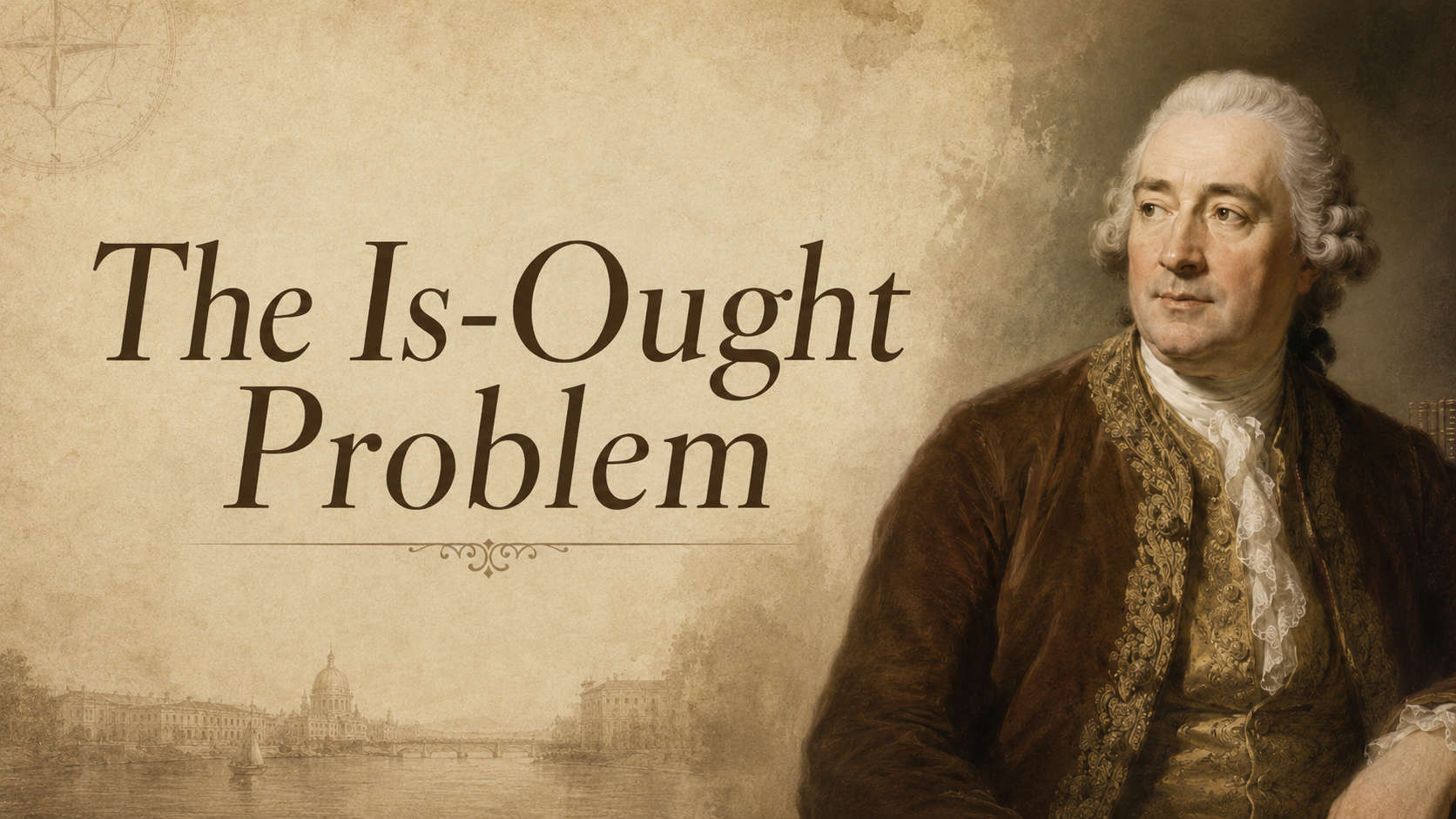
Are idea axioms related to Hume’s is–ought problem?

Yes, idea axioms make Hume’s concern explicit. Let’s explore.

David Hume’s famous is–ought problem points out that we cannot logically derive what ought to be from what is without an additional value judgment. The solution is to make that missing value explicit: is → value → ought. For example, we observe that some people go hungry. That’s the is. We know we should feed them, that’s the ought. But why? That’s all Hume was saying is to fill in the value driving our is-ought principles. We value reducing unnecessary suffering. That’s the value. Therefore, we conclude that we ought to help feed those in need when we can.

Now, consider the close relationship between values, virtues, and principles. A value is something you consider good or important. A virtue is a character trait. A trait you likely wish to cultivate. Perhaps in favor of a value. A principle is a rule that guides your decisions and actions. And that too can be aligned with one of your goods, one of your values in your value system. For example, we value reducing suffering, cultivate compassion as a virtue, and adopt the principle of helping those in need. With this close relationship, you can see that idea axioms are closely related to the is–value–ought structure of normative philosophy.

Idea axioms are a practical thinking tool. Starting with a core idea, we identify a value, a virtue, and a principle that guides us toward action—an ought. They don’t guarantee that the resulting action is right. A questionable value can lead to a questionable conclusion. But they make our reasoning visible, allowing us to examine, challenge, and improve it. Idea axioms are useful across many areas of thought, and Hume’s is–ought problem is one place where they shine.
— map / TST —

TST Tracker
✓ Reading recorded.
Hume’s warning against moving directly from “is” to “ought” has a common informal name: Hume’s guillotine.
Michael Alan Prestwood
Natural Philosopher & Author
Prestwood explores science-first philosophy, with particular attention to the convergence of disciplines. Drawing on his TST Philosophy, his work emphasizes rational inquiry grounded in empirical observation while engaging questions at the edges of established knowledge. With TouchstoneTruth positioned as a living touchstone, this work aims to contribute reliable, evolving analysis in an emerging AI era where the credibility of information is increasingly contested.
The Prestwood Column
Menu
November 2026
Column Research….
1. Timeline Story
Fear-Based Ethics
2. Linked Quote
“A person is a person through other persons; you can’t be human in isolation; you are human only in relationships.”
3. Science FAQ »
Why do complex systems fail when proportionality is removed?
4. Philosophy FAQ »
How does TST Ethics handle the trolley problem?
5. Critical Thinking FAQ »
Why do people confuse rule-following with moral reasoning?
6. History FAQ!
How are original Daoism, Mohism, Confucianism, and Legalism related?
Bonus Deep-Dive Article
TST Moral Calibration: Legal, Moral, and Fair

Comments

Join the Conversation! Currently logged out.
NEW BOOK! NOW AVAILABLE!!

30 Philosophers: A New Look at Timeless Ideas

by Michael Alan Prestwood
The story of the history of our best ideas!
Scroll to Top