

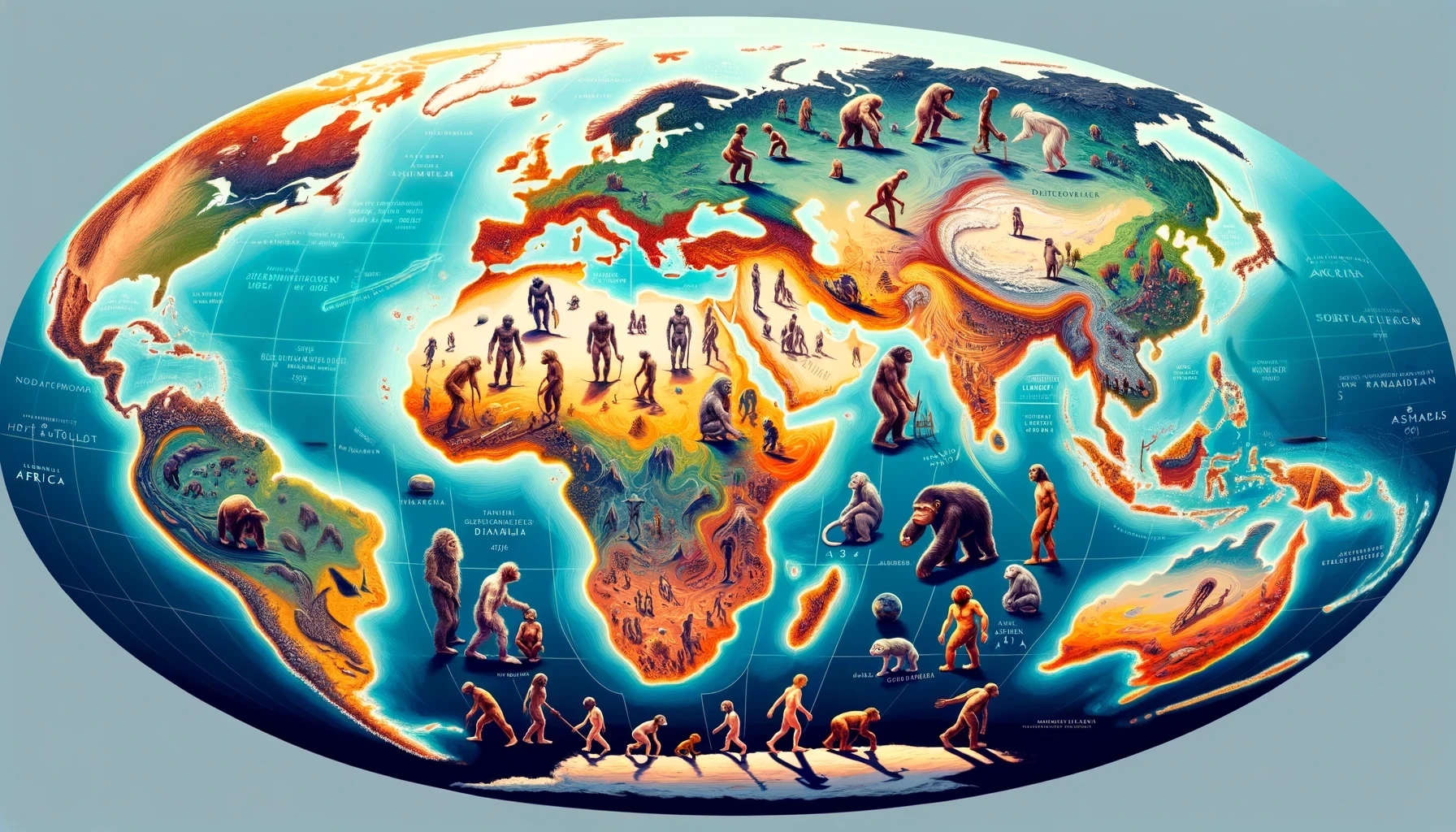
Cognitive Revolution
By 70,000 BCE. Population range: 500,000 to 2.5 million.
Given the uncertainties and lack of direct data, the following are speculative estimates.
- Africa-Middle East: 50-60% or 600,000 to 1 million people
Africa, being the origin of modern humans, likely had the highest population density at this time, particularly in Sub-Saharan regions which were more conducive to human habitation due to their climate and available resources. - Asia: 40% or 200,000 to 400,000 people
- Europe-Mediterranean: 10% or 50,000 to 100,000 people
- The Americas: 0.
- Oceana-Australasia: 1% or 10,000 to 15,000 people
The initial colonization of Australia around 50,000 BCE by modern humans involved small, isolated groups who managed to navigate sea crossings, leading to a very low initial population density. The rest of the remote islands of Oceania were among the last to be reached by humans.
A Shared Earth! Neanderthals-Hobbits-Flourensis
Around this time, Homo sapiens shared the Earth with other hominin species. Neanderthals were still widespread in Europe and parts of western Asia. In Asia, particularly on the islands of Indonesia, Homo floresiensis, often referred to as the “Hobbit” due to their diminutive stature, survived until about 50,000 years ago. Additionally, Denisovans, a less visually documented but genetically distinct group, also roamed Eurasia, leaving behind a genetic legacy that persists in modern humans, particularly among populations in Melanesia.

