
Phil • Cr. Think • Science • Hist •
TST PRACTICE

The Philosophy Website

STORY

Upper Paleolithic Cave Art with Symbols

☐ Read
☑ Read
You’ve read this 0 times.
You’ve listened to this 0 times.

By Michael Alan Prestwood

Fri 19 Apr 2024
Published 2 years ago.
Updated 4 months ago.
Related Stories
Share :

Upper Paleolithic Cave Art with Symbols

circa 40,000 BCE
Spain & France

Earliest known symbol use in the Europe/Mediterranean zone. 

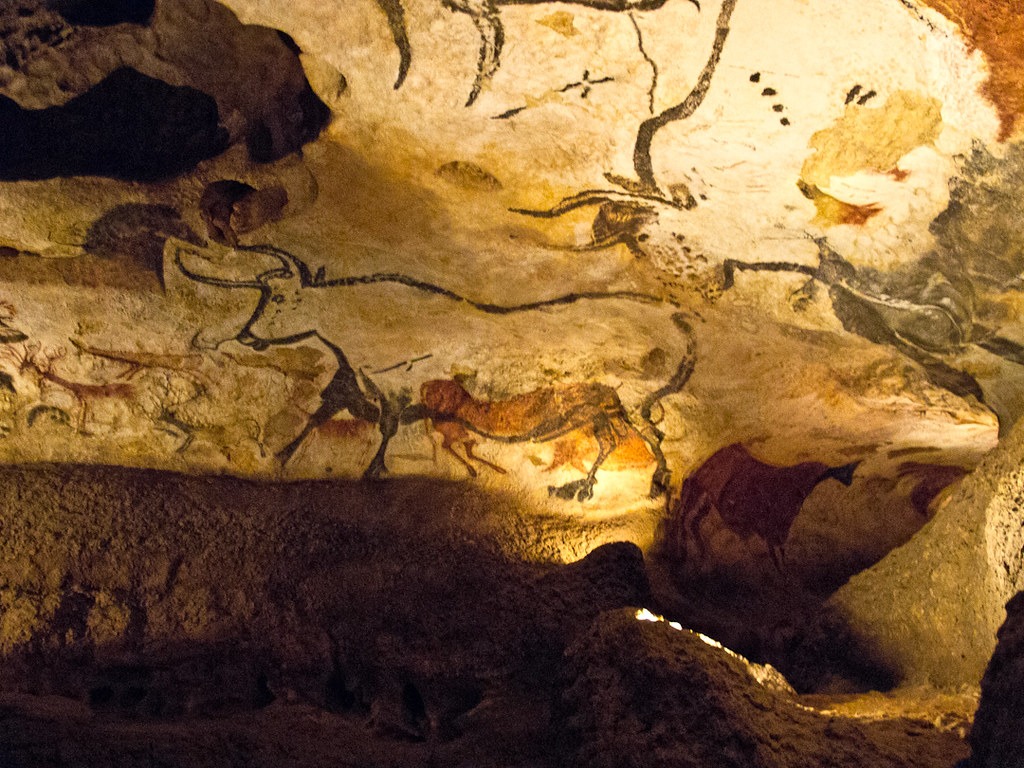
Dating back to around 40,000 BCE, the Upper Paleolithic cave art found across Europe presents a compelling narrative of early human communication and symbolic expression. Sites like Lascaux in France and Altamira in Spain feature elaborate depictions of animals, human figures, and abstract symbols that recur with remarkable consistency across diverse regions. These symbols, including dots, lines, and geometric shapes, suggest a standardized usage that transcends mere artistic decoration. Researchers speculate that these symbols may have served proto-writing functions, possibly representing early attempts to record important information such as seasonal changes, ritual practices, or social codes.

— map / TST —

TST Tracker
✓ Reading recorded.
Michael Alan Prestwood
Author & Natural Philosopher
Prestwood writes on science-first philosophy, with particular attention to the convergence of disciplines. Drawing on his TST Framework, his work emphasizes rational inquiry grounded in empirical observation while engaging questions at the edges of established knowledge. With TouchstoneTruth positioned as a living touchstone, this work aims to contribute reliable, evolving analysis in an emerging AI era where the credibility of information is increasingly contested.
Email
Print
The Prestwood Column
Menu
September 2026
Column Research….
1. Timeline Story
Hume’s Is–Ought Problem
2. Linked Quote
“I meet with no proposition that is not connected with an ought, or an ought not.”
3. Science FAQ »
Can science prove flourishing should be our goal?
4. Philosophy FAQ »
What is the difference between a normative aim and a normative directive?
5. Critical Thinking FAQ »
Is flourishing for all just utilitarianism?
6. History FAQ!
What is the history of the idea of flourishing in philosophy?
Bonus Deep-Dive Article
Flourishing for All: The Normative Aim of TST Philosophy

Comments

Join the Conversation! Currently logged out.

Leave a Reply

NEW BOOK! NOW AVAILABLE!!

30 Philosophers: A New Look at Timeless Ideas

by Michael Alan Prestwood
The story of the history of our best ideas!
Scroll to Top