
Phil • Cr. Think • Science • Hist • …
TST PRACTICE

By Philosopher Michael Alan Prestwood

FAQ

Can anything travel faster than light?

☐ Read
☑ Read
You’ve read this 0 times.
You’ve listened to this 0 times.
Mon 3 Aug 2026
Published 3 months ago.
Updated 2 months ago.
Related FAQs
What’s the minimum change needed to breathe air on Mars?
Does my gravity pull on the Sun?
What is the history behind quantum mechanics?
Does time exist?
Will the night sky have stars nearly forever?
Will the universe end in an ever-expanding cold isolated death?
Share :
Email
Print

Can anything travel faster than light?

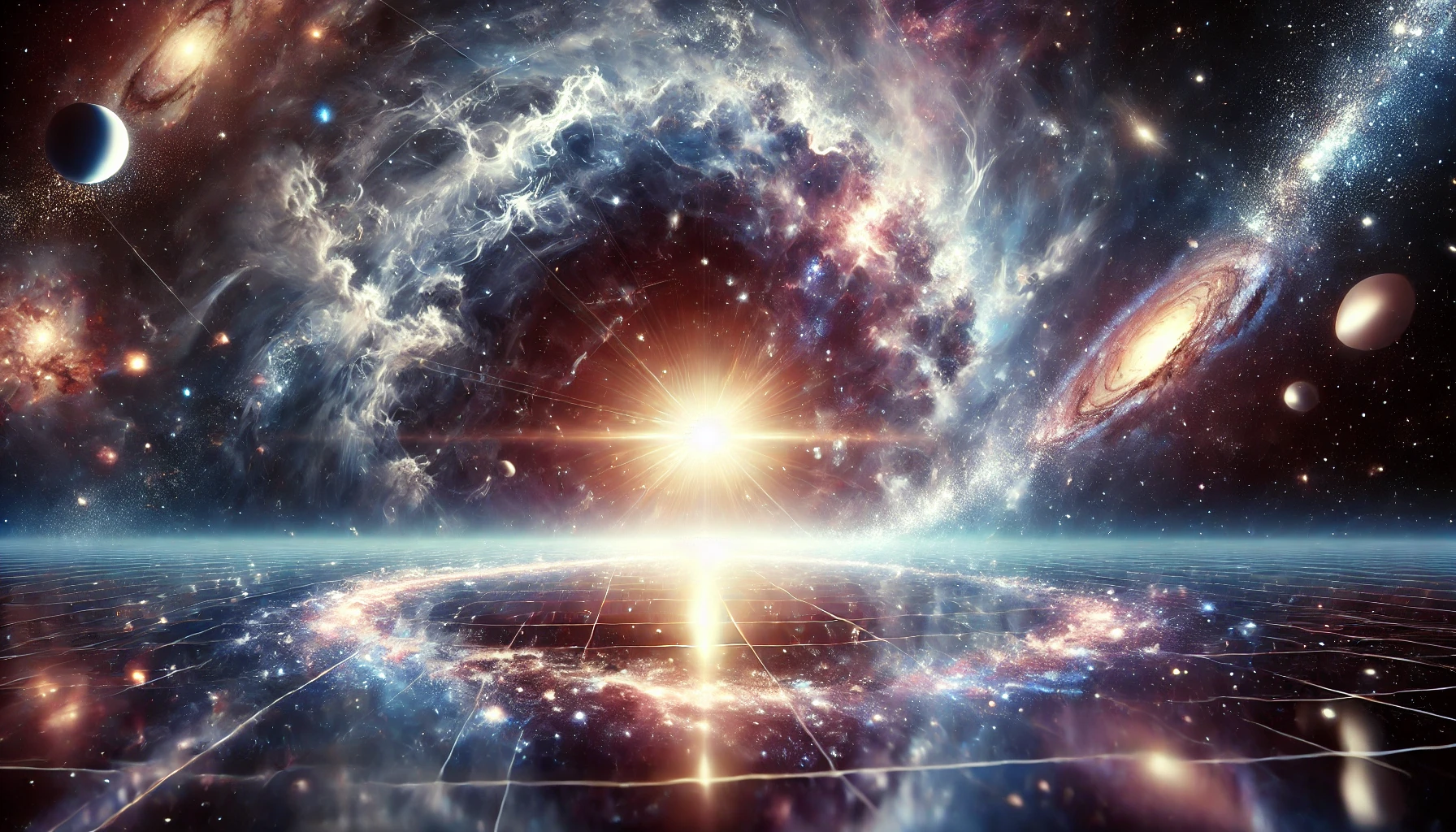
Yes, the universe itself is. And, lots of matter within it is moving away from each other at “speeds” faster than light. However, travelling for us is limited by the universal speed limit. It’s not the speed of light, it’s really about the speed of causation, a fundamental limit built into spacetime. So, any discussion of speed needs to define movement and domain. It’s all relative.

Let’s explore and make sense of this.

Let’s start with our part of the universe. No, I’m not talking about Earth or our solar system. Heck, I’m not even talking about the Milky Way Galaxy. I’m starting with the Local Group. Our gravitationally bound corner of the universe. The material we are travelling with through space, nearly forever. You may have heard of the three great galaxies: Andromeda, Triangulum, and our very own Milky Way. The three much larger galaxies among 100 plus galaxies.

What about the trillions of galaxies? Everything else in the universe is flying away from us at an average middle rate of about 2.5 times faster than the speed of light, faster than causation itself. Billions of years ago, that rate was lower. In billions of years, that rate will be higher. And, there will be a time in the future where intelligent life will claim there are only 100 or so galaxies, and nothing else. From our spacetime point now, we know that’s wrong.

So, within our Local Group, travelling is limited by the universal speed limit. What most people call the speed of light. But the so-called “speed of light” isn’t really about light at all. It’s the speed of causation, a fundamental limit built into spacetime itself as seen “within” our Local Group and throughout the universe.
— map / TST —

TST Tracker
✓ Reading recorded.
The singularity is more philosophical. While the universe's expansion is scientific, the singularity itself remains speculative and unproven.
Michael Alan Prestwood
Natural Philosopher & Author
Prestwood explores science-first philosophy, with particular attention to the convergence of disciplines. Drawing on his TST Philosophy, his work emphasizes rational inquiry grounded in empirical observation while engaging questions at the edges of established knowledge. With TouchstoneTruth positioned as a living touchstone, this work aims to contribute reliable, evolving analysis in an emerging AI era where the credibility of information is increasingly contested.
The Prestwood Column
Menu
November 2026
Column Research….
1. Timeline Story
Fear-Based Ethics
2. Linked Quote
“A person is a person through other persons; you can’t be human in isolation; you are human only in relationships.”
3. Science FAQ »
Why do complex systems fail when proportionality is removed?
4. Philosophy FAQ »
How does TST Ethics handle the trolley problem?
5. Critical Thinking FAQ »
Why do people confuse rule-following with moral reasoning?
6. History FAQ!
How are original Daoism, Mohism, Confucianism, and Legalism related?
Bonus Deep-Dive Article
TST Moral Calibration: Legal, Moral, and Fair

Comments

Join the Conversation! Currently logged out.
NEW BOOK! NOW AVAILABLE!!

30 Philosophers: A New Look at Timeless Ideas

by Michael Alan Prestwood
The story of the history of our best ideas!
Scroll to Top