
Phil • Cr. Think • Science • Hist •
TST PRACTICE

The Philosophy Website

STORY

Hand Axes 1.7 Million Years Ago

☐ Read
☑ Read
You’ve read this 0 times.
You’ve listened to this 0 times.

By Michael Alan Prestwood

Mon 13 May 2024
Published 2 years ago.
Updated 4 months ago.
Related Stories
Share :
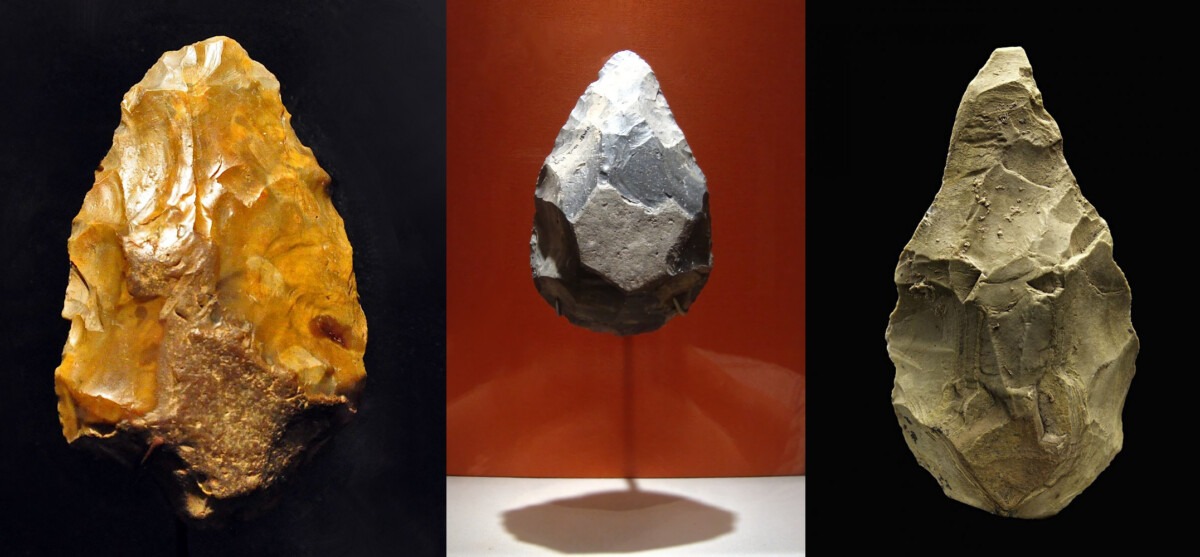
Hand axes: Humans started using them nearly 2 million years ago. These meticulously crafted tools exemplify the advanced technological skills and cognitive capabilities of early humans. Its sophisticated design and precise craftsmanship underscore a deep understanding of material properties and tool use.

Hand Axes 1.7 Million Years Ago

1960

“By 1.76 million years ago, early humans began to create hand axes.”

This seemingly simple statement about hand axes is mind-opening and philosophically significant for a few reasons. It highlights the ingenuity of early humans. Crafting tools from stone requires planning, foresight, and understanding of cause and effect. It also represents a critical leap in technological development. These tools allowed early humans to interact with their environment in entirely new ways, signifying a turning point in their evolution. Finally, it prompts us to consider the vast timeframe involved. Hand axes are a tangible reminder of our distant past and the remarkable cognitive development that laid the groundwork for our current existence.

Analysis: Around 1960, paleoanthropology started uncovering early human cognitive abilities due to Leakeys’ discovery and promotion of Homo habilis. Homo habilis was associated with the Oldowan tools found in Olduvai Gorge, demonstrating early human tool use and cognitive abilities starting around 2.6 million years ago. This discovery was foundational in reshaping our understanding of early human intelligence and technological skill.

— map / TST —

TST Tracker
✓ Reading recorded.
Michael Alan Prestwood
Author & Natural Philosopher
Prestwood writes on science-first philosophy, with particular attention to the convergence of disciplines. Drawing on his TST Framework, his work emphasizes rational inquiry grounded in empirical observation while engaging questions at the edges of established knowledge. With TouchstoneTruth positioned as a living touchstone, this work aims to contribute reliable, evolving analysis in an emerging AI era where the credibility of information is increasingly contested.
Email
Print
The Prestwood Column
Menu
September 2026
Column Research….
1. Timeline Story
Hume’s Is–Ought Problem
2. Linked Quote
“I meet with no proposition that is not connected with an ought, or an ought not.”
3. Science FAQ »
Can science prove flourishing should be our goal?
4. Philosophy FAQ »
What is the difference between a normative aim and a normative directive?
5. Critical Thinking FAQ »
Is flourishing for all just utilitarianism?
6. History FAQ!
What is the history of the idea of flourishing in philosophy?
Bonus Deep-Dive Article
TST Normative Ethics: Flourishing as a Philosophical Goal

Comments

Join the Conversation! Currently logged out.

Leave a Reply

NEW BOOK! NOW AVAILABLE!!

30 Philosophers: A New Look at Timeless Ideas

by Michael Alan Prestwood
The story of the history of our best ideas!
Scroll to Top