
Explore Natural Philosophy

Science • Phil • Cr. Think • Hist •

FAQ

Did Copernicus prove that Earth moves around the Sun?

Wed 21 Jan 2026
Published 5 months ago.
Updated 2 months ago.
Related FAQs
Do empirical ideas require direct observation?
Is “the speed of light” really the best name for the universe’s maximum speed?
What is the preservation bias?
Is secular spirituality supported in history and science?
Is science tainted by bias?
What is the difference between anthropology and paleontology?
Share :
Email
Print

Did Copernicus prove that Earth moves around the Sun?

No, Copernicus did not prove that Earth moves around the Sun in the modern scientific sense. He lacked the instruments to detect stellar parallax or directly measure Earth’s motion. What he offered instead was a mathematical model that reorganized the solar system in a way that made planetary motion simpler, more consistent, and more predictable.

Under the geocentric system, astronomers were forced to pile epicycles upon epicycles to explain what they observed—especially retrograde motion. Copernicus’s heliocentric model didn’t immediately improve observational accuracy, but it dramatically improved coherence. The strange motions of the planets became natural consequences of Earth itself being in motion.

This distinction matters. Science does not always begin with proof; it often begins with better explanations. Copernicus showed that a model could be superior even before it was empirically confirmed. Later observations—by Galileo, Kepler, and eventually Newton—would supply the proof Copernicus lacked. But without his model, those confirmations might never have been recognized for what they were.
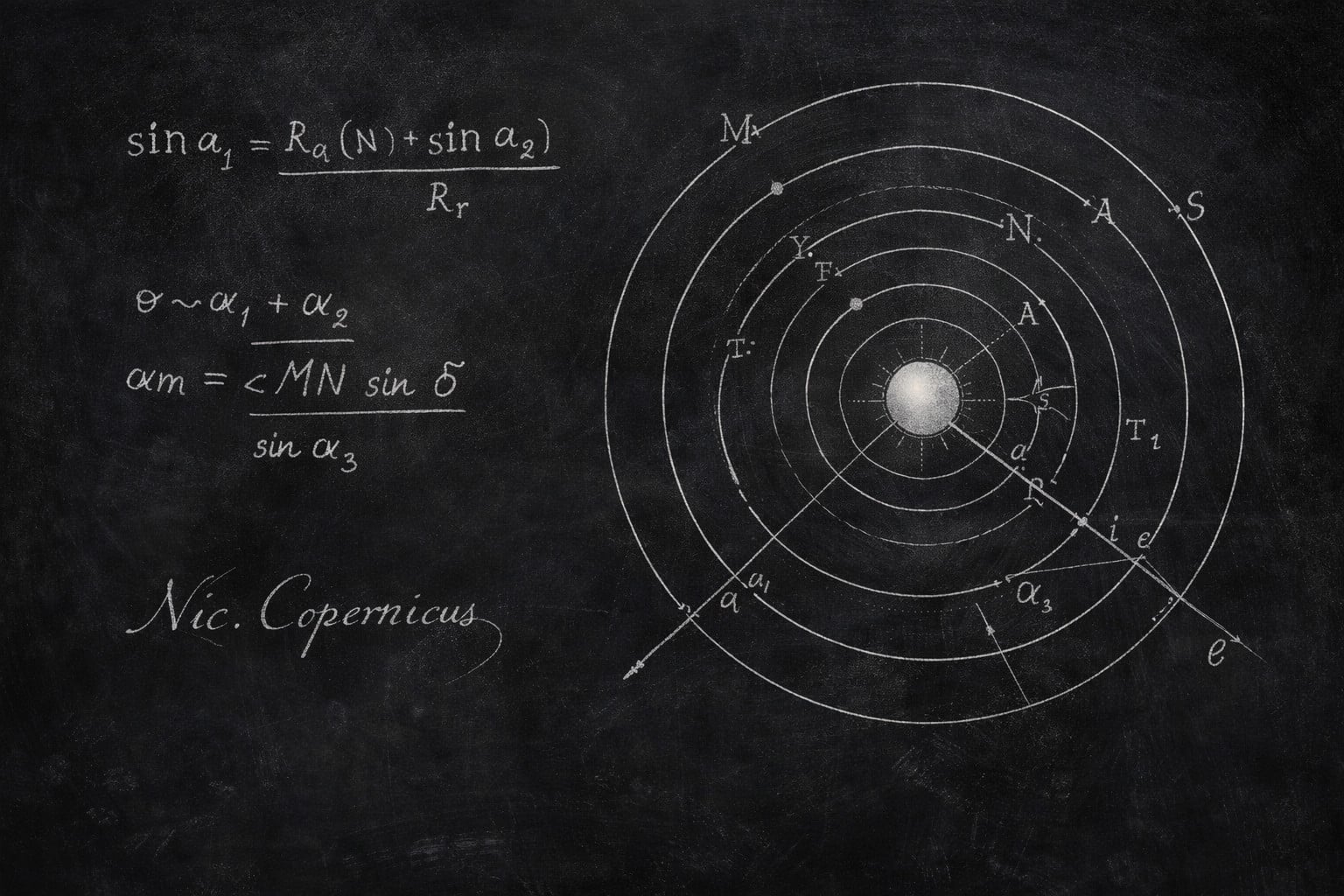
— map / TST —

Modern illustration inspired by Copernicus’s mathematical approach. While he didn’t use modern equations or symbols, his work relied on geometry and numerical comparison.
Michael Alan Prestwood
Author & Natural Philosopher
Prestwood writes on science-first philosophy, with particular attention to the convergence of disciplines. Drawing on his TST Framework, his work emphasizes rational inquiry grounded in empirical observation while engaging questions at the edges of established knowledge. With TouchstoneTruth positioned as a living touchstone, this work aims to contribute reliable, evolving analysis in an emerging AI era where the credibility of information is increasingly contested.
This month @ TST
Column Menu
June 2026
»COLUMN ARCHIVE
Column Research….
1. Timeline Story
Secular Spirituality Settles
2. Linked Quote
“Extraordinary claims require extraordinary evidence.”
3. Science FAQ »
What is the difference between a spiritual and empirical belief?
4. Philosophy FAQ »
What is secular spirituality?
5. Critical Thinking FAQ »
How does spirituality relate to public belief?
6. History FAQ!
Is secular spirituality supported in history and science?
Bonus Deep-Dive Article
The Material-Spiritual Framework: A Philosophy of Spirituality

Comments

Join the Conversation! Currently logged out.
NEW BOOK! NOW AVAILABLE!!

30 Philosophers: A New Look at Timeless Ideas

by Michael Alan Prestwood
The story of the history of our best ideas!
Scroll to Top