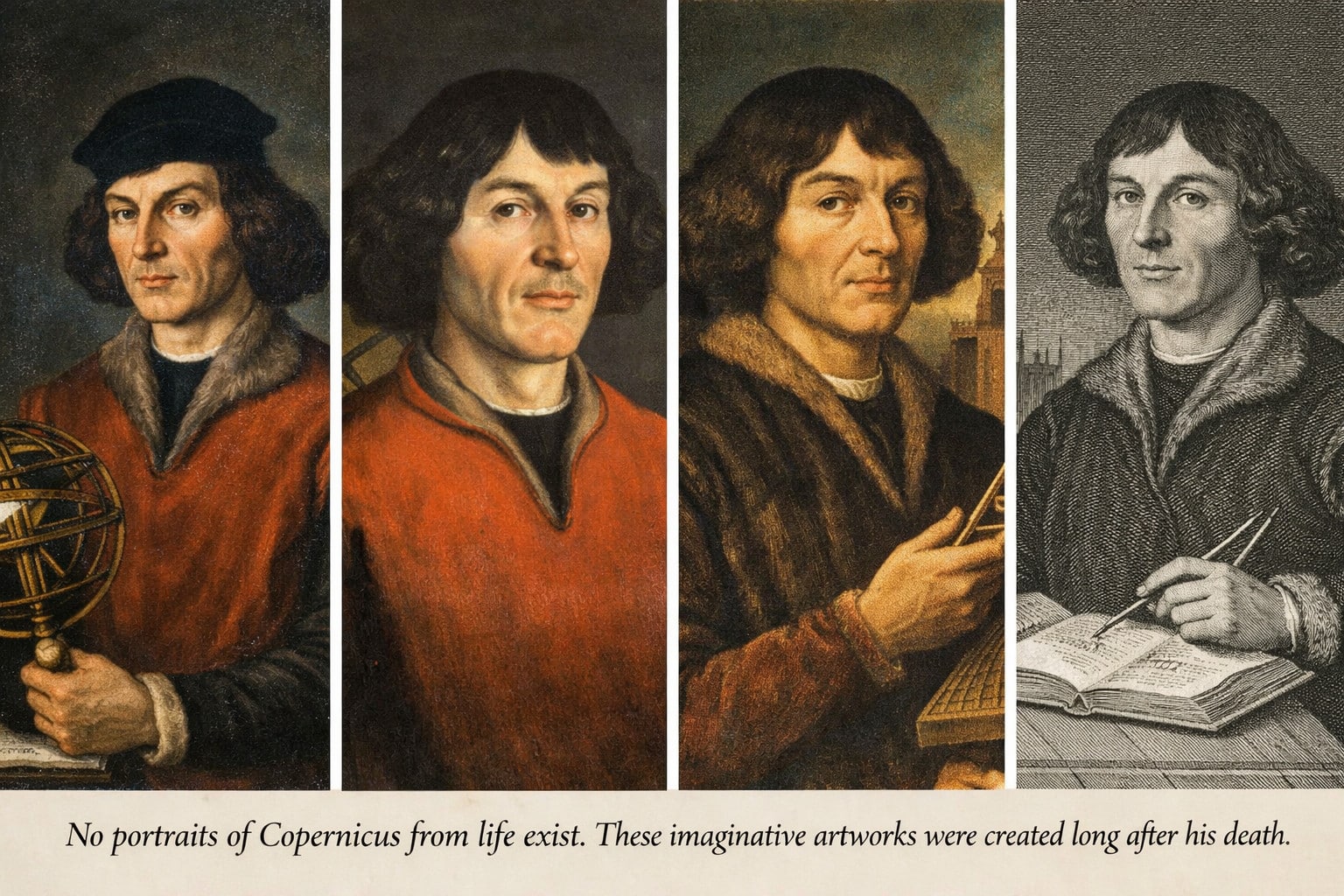
Nicolas Copernicus
Nicolaus Copernicus lived quietly, worked carefully, and changed the universe without ever seeing the revolution he began.
Nicolas Copernicus Read More »


The Book Timeline: 30 Philosophers
Nicolaus Copernicus lived quietly, worked carefully, and changed the universe without ever seeing the revolution he began.
Nicolas Copernicus Read More »

Schopenhauer, deeply influenced by Kant’s work, extended the distinction between Phenomena and Noumena by introducing his concept of the will. While Kant viewed the noumenal world as unknowable, Schopenhauer identified it as a blind will that drives all living beings. This will, much like Aristotle’s life force (entelechy), propels existence. The key difference in Schopenhauer’s
Arthur Schopenhauer Read More »

Kierkegaard explored themes of anxiety, freedom, and the burden of choice. Living before psychology was a formal discipline, he wrote about angst, an existential anxiety arising from human freedom. His concept of the leap of faith emphasized making decisions authentically, even when faced with uncertainty. For Kierkegaard, anxiety wasn’t to be feared but embraced, as
Søren Aabye Kierkegaard Read More »

Even vivid personal details can anchor historical narratives that exceed the available evidence.
Nietzsche Mustache Read More »

The story of the printing press is the story of cultural transmission. Invented in 1440 in Germany by Johannes Gutenberg, it revolutionized book production by introducing movable type. It replaced hand-copying, prone to errors, with movable metal type, allowing mass production of books for the first time in human history. Over the next few centuries,
Printing Press Invented Read More »

What we now call holism was once expressed as Logos in the West and the Dao in the East.
Chapter 1 Quote Attribution Clarification Read More »

The Library of Ashurbanipal, established during the reign of Ashurbanipal (668–627 BCE), the last great king of the Neo-Assyrian Empire, is one of the most significant collections of ancient texts. Located in Nineveh, the capital of Assyria, this library housed thousands of clay tablets inscribed with cuneiform script, covering a wide range of subjects including
Library of Ashurbanipal Read More »

Gilgamesh is the legendary figure whose exploits are immortalized in the “Epic of Gilgamesh.” Gilgamesh’s reign as king is shrouded in myth and history. The epic describes his journey from a tyrannical ruler to a wise and beloved king, highlighting his quest for immortality and the profound friendship with Enkidu, a wild man created by
Gilgamesh, circa 2700 BCE Read More »

Bernard of Chartres, a prominent 12th-century French philosopher, lived around 1070 to 1130. He is best known for his influential teaching that emphasized the continuity of knowledge through the ages. Bernard is famously credited with the phrase, “We are like dwarfs on the shoulders of giants,” highlighting the idea that contemporary scholars build upon the
Bernard of Chartres (circa 1070 – 1130) Read More »

Alfred Russel Wallace lived from January 8, 1823, to November 7, 1913. He is best known for independently proposing the theory of evolution by natural selection, prompting Charles Darwin to publish his own findings. Wallace’s work as a biologist, anthropologist, and geographer took him to the Amazon and the Malay Archipelago, where he identified the
Alfred Russel Wallace (1823-1913) Read More »
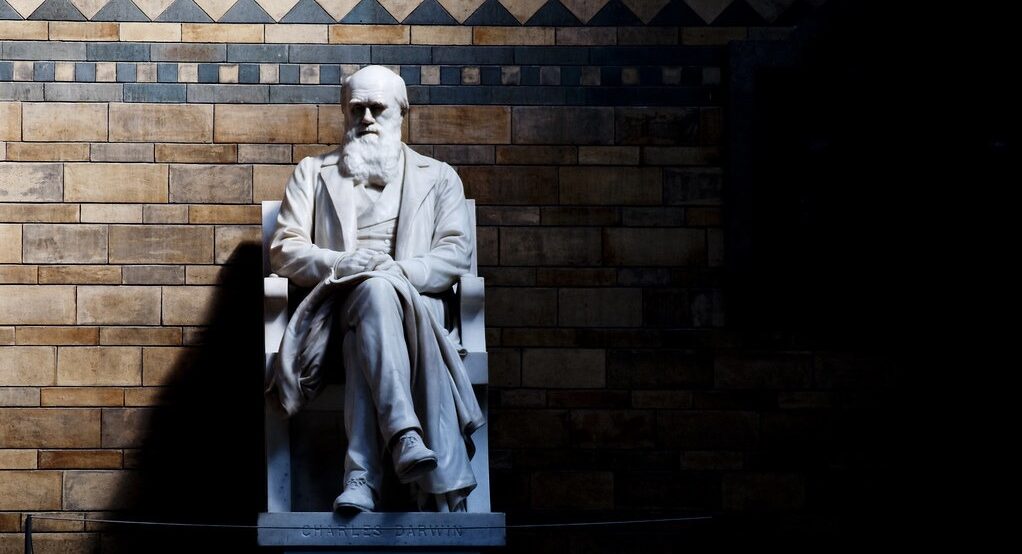
Charles Darwin, born on February 12, 1809, and passing on April 19, 1882, was an English naturalist whose groundbreaking work laid the foundation for the theory of evolution. His voyage on the HMS Beagle and the subsequent observations he made led him to formulate his theory of natural selection, published in his seminal work “On
Charles Darwin (1809-1882) Read More »

Democritus introduced a radical idea: reality is composed of invisible atoms moving through empty space.
Democritus (460 BCE – circa 370 BCE) Read More »

A Final Word This book is a wild ride through humanity, spotlighting fourscore of touchstone ideas. A worthy “similar” book to my original intent a quarter century ago and a worthy dedication to my dad. There are many paths one can take through the minds of our great thinkers; I hope you will enjoy the

30 Phil, Chapter 31: In this new look at Kierkegaard’s notion of the “leap of faith” I transform it from a religious leap to a secular leap. While his leap is about belief in God, and more broadly a commitment to a set of values, with an OVM new look, I define a generic “leap

30 Phil, Chapter 30: In this telling of Nietzsche ideas, we take a new look at it and forge it into a five-step authentic recipe. Step one is the Übermensch. It is often translated as the “Overman” or “Superman.” It is a call to individual empowerment and liberation from societal norms and traditional values. Step two
Authentic Recipe: Nietzsche’s Five-step Approach Read More »

30 Phil, Chapter 27: From Aristotle’s virtue to Mill’s greatest happiness, ethical systems have explored both sides of the “good intent-good results” approach to morality. In modern philosophy, most have decided there is no single rule to ethics. For many, a holistic approach is the key. The basic idea is to understand and avoid fear-based ethical

30 Phil, Chapter 27: Categorized within Consequentialism, fear-based ethics focuses on “good results” and are measured with a big stick–acts are not primarily measured by merit. Karma and Divine Command Theory are two examples of this faulty ethical system. With Karma, you fear a negative rebirth, and with Divine Command Theory, you fear God’s wrath.

30 Phil, Chapter 27: In this new look at Hume’s idea of impressions and its relation to innate knowledge, I position instincts as innate knowledge with three types: basic, developmental, and situational.
Modern Innate Knowledge Read More »

OVM structures disagreement so that clarity replaces tribalism and calibrated dialogue replaces dogmatic assertion.
Open Viewpoint Method (OVM) Read More »

The Grand Rational Framework is the evolving body of knowledge anchored to the material world, where only evidence-grounded reasoning reshapes what we collectively treat as true.
Grand Rational Framework Read More »