
Phil • Cr. Think • Science • Hist •
TST PRACTICE

The Philosophy Website

STORY

Nicolas Copernicus

☐ Read
☑ Read
You’ve read this 0 times.
You’ve listened to this 0 times.

By Michael Alan Prestwood

Wed 21 Jan 2026
Published 8 months ago.
Updated 4 months ago.
Related Stories
Share :
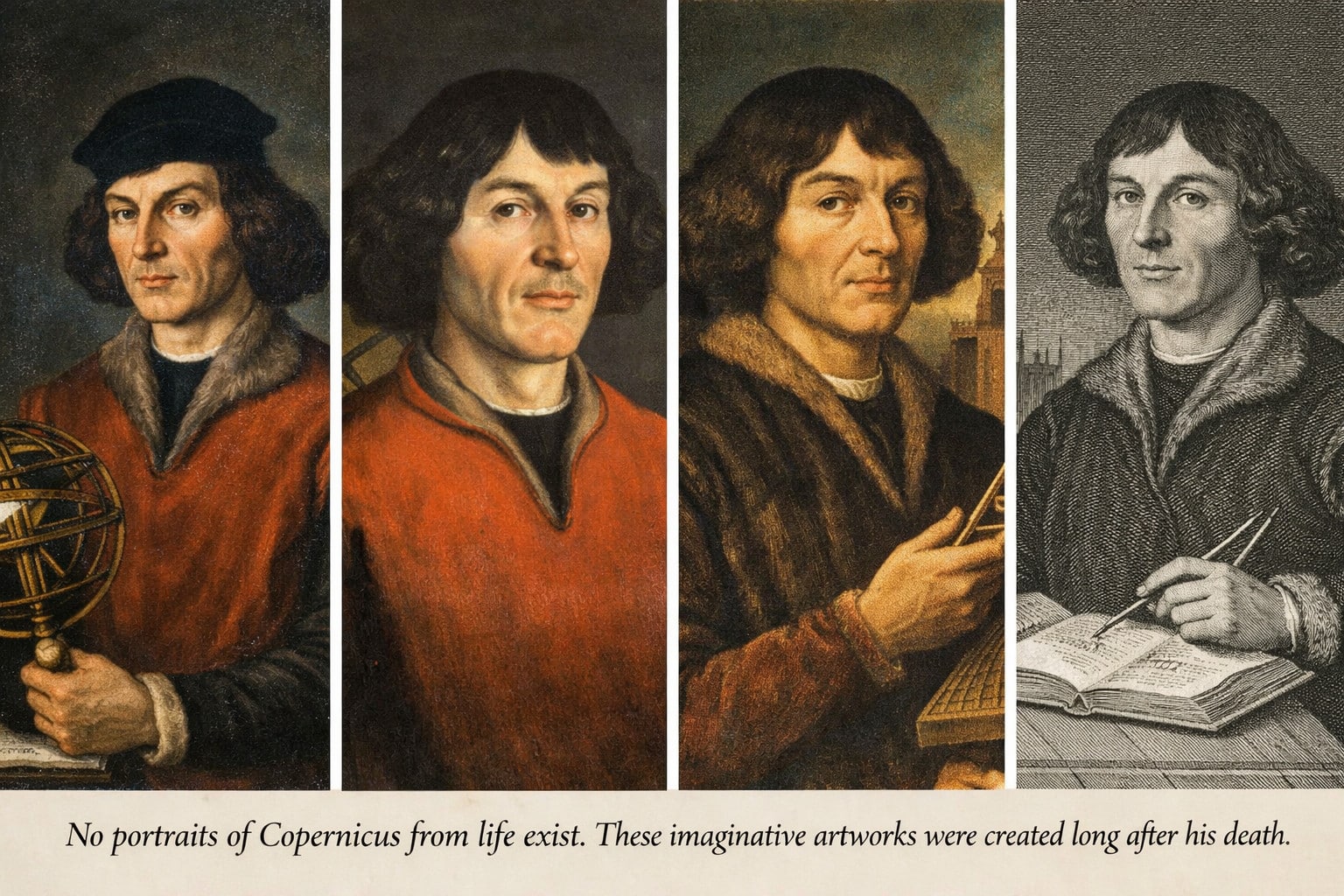
No confirmed likeness survives. These portraits are later artistic interpretations.

Nicolas Copernicus

born 1473
Lived 1473 to 1543, aged 70.

Nicolaus Copernicus was born in 1473 in Toruń, in what is now Poland. He was born on Wednesday, February 19, 1473. Trained in law, medicine, mathematics, and astronomy, he spent most of his life working as a church canon—an administrator, not a professional scientist. Astronomy was his private passion, pursued quietly alongside his official duties.

Over decades, Copernicus wrestled with a problem inherited from antiquity: the messy complexity of planetary motion in the Earth-centered universe. The more he worked, the clearer it became that placing the Sun at the center simplified everything. Yet he hesitated. Publishing such an idea challenged centuries of accepted thought, and Copernicus was cautious by nature.

Near the end of his life, encouraged by younger scholars, he finally allowed his work to be published. De revolutionibus orbium coelestium appeared in 1543—the year of his death. He died on Monday, May 24, 1543 in Frombork, a cathedral town in Warmia, Poland, where he had lived and worked for many years as a church canon. Copernicus never witnessed the storm his idea would unleash, but his quiet insistence on mathematical coherence reshaped how humanity understands its place in the cosmos.

— map / TST —

TST Tracker
✓ Reading recorded.
Michael Alan Prestwood
Author & Natural Philosopher
Prestwood writes on science-first philosophy, with particular attention to the convergence of disciplines. Drawing on his TST Framework, his work emphasizes rational inquiry grounded in empirical observation while engaging questions at the edges of established knowledge. With TouchstoneTruth positioned as a living touchstone, this work aims to contribute reliable, evolving analysis in an emerging AI era where the credibility of information is increasingly contested.
Email
Print
The Prestwood Column
Menu
September 2026
Column Research….
1. Timeline Story
Hume’s Is–Ought Problem
2. Linked Quote
“I meet with no proposition that is not connected with an ought, or an ought not.”
3. Science FAQ »
Can science prove flourishing should be our goal?
4. Philosophy FAQ »
What is the difference between a normative aim and a normative directive?
5. Critical Thinking FAQ »
Is flourishing for all just utilitarianism?
6. History FAQ!
What is the history of the idea of flourishing in philosophy?
Bonus Deep-Dive Article
TST Normative Ethics: Flourishing as a Philosophical Goal

Comments

Join the Conversation! Currently logged out.

Leave a Reply

NEW BOOK! NOW AVAILABLE!!

30 Philosophers: A New Look at Timeless Ideas

by Michael Alan Prestwood
The story of the history of our best ideas!
Scroll to Top