

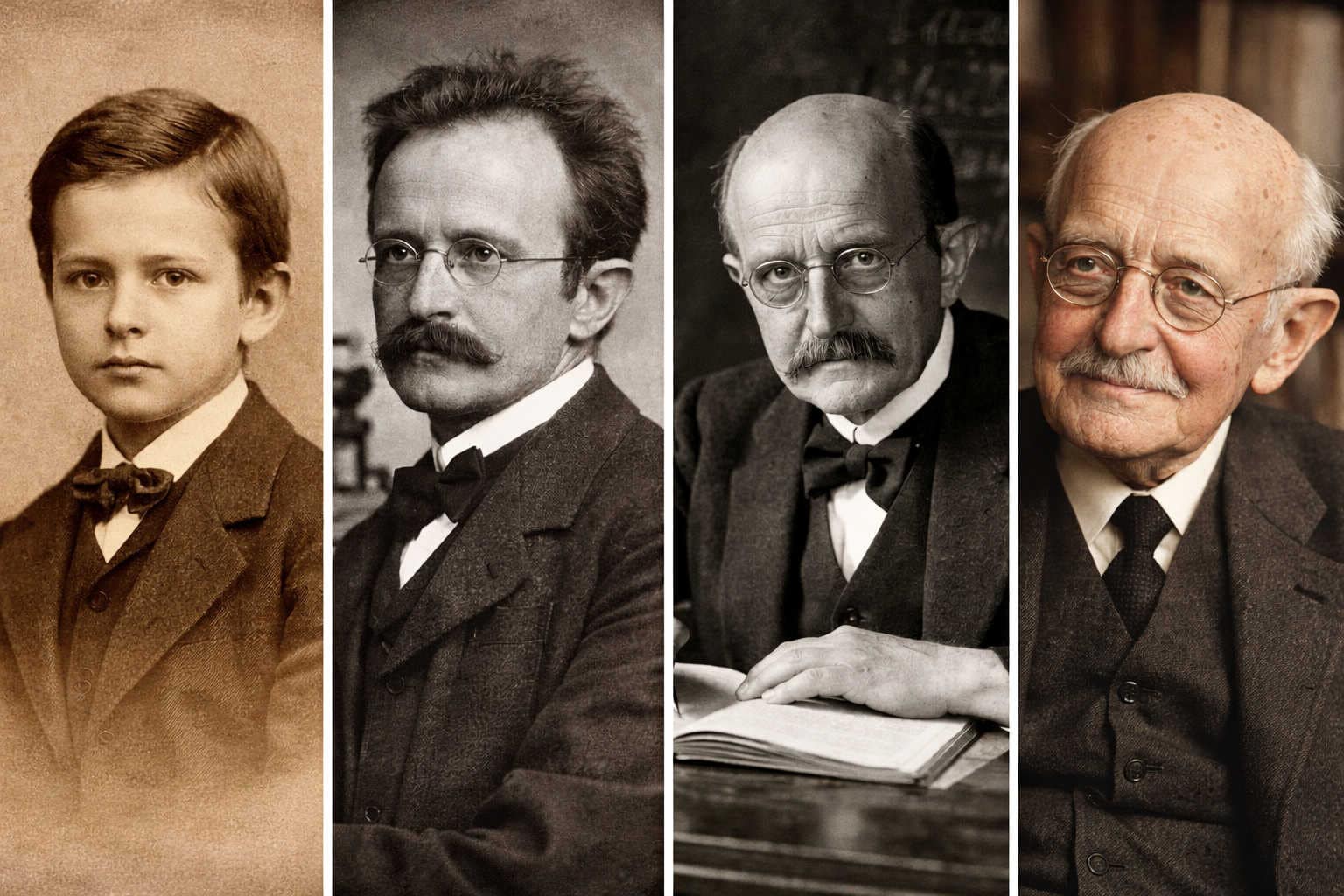
Max Planck was born in 1858, the year before Charles Darwin published On the Origin of Species. His journey from a traditional, classically trained physicist to the “reluctant revolutionary” of quantum mechanics is one of the most important pivots in the history of science. He didn’t set out to break physics; he simply wanted to fix a stubborn mathematical problem.
Up to Planck, physics treated energy as continuous: a smooth stream, like a firehose. After Planck, energy came in packets—quanta. He was a professor at the University of Berlin, and his specific “Eureka” moment occurred at home on October 7, 1900, after a visit from fellow physicist Heinrich Rubens, whose experimental results refused to fit classical expectations.
Ironically, Planck disliked his own discovery for years. He was a classical physicist at heart and hoped that these “quanta” were merely a mathematical trick or a property of atoms, not a fundamental feature of light itself. It wasn’t until Albert Einstein used Planck’s idea in 1905 to explain the photoelectric effect that the scientific world realized Planck had uncovered something profound: the grainy nature of reality.
Planck did something quietly radical. He accepted what the math demanded. More than any single discovery, this is the lesson we can still learn from his legacy.
Planck understood this tension too. Later in life, he reflected that scientific advances often proceed “one funeral at a time.”
Planck lived through two world wars in the heart of Germany. His eldest son was killed in World War I, and his only other son was executed by the Nazi regime for his role in attempting to assassinate Adolf Hitler. Though marked by immense personal loss, Planck’s family line did not end with him. His descendants live on today.

