

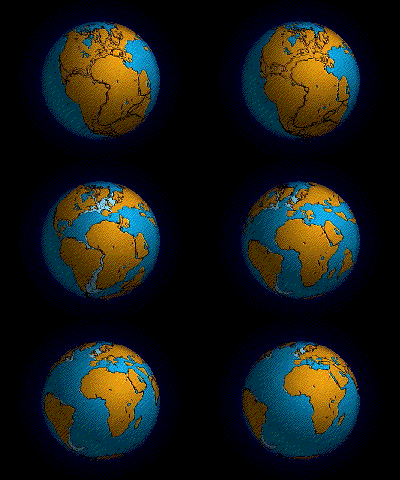
Animation of the break-up of the supercontinent Pangaea and the subsequent drift of its constituents, from the Early Triassic to recent (250 Million BCE to 1 CE). The super continent Pangaea existed from about 335 to 175 Million BCE.
Pangaea was one vast evolutionary experiment. For a time, much of Earth’s land was stitched into a single supercontinent, allowing plants and animals to spread across enormous connected landscapes. Deserts stretched through the interior, river systems crossed huge distances, and coastlines wrapped around one giant landmass. In a world like that, barriers were fewer, movement was easier, and evolution often played out on a broad, shared stage. It was not one uniform ecosystem, of course, but it was one connected world in a way the later Earth would not be. Pangaea began to break apart roughly 225 to 200 million years ago, and that slow tearing changed the rules of evolution.
The first great split was the north-south division between Laurasia in the north and Gondwana in the south, beginning in the Late Triassic and becoming more established in the Early Jurassic, around 200 to 180 million years ago. As rifting and seaways developed, populations that had once shared one continental stage were increasingly cut off from one another. This did not instantly create brand-new animals overnight, but it began locking lineages into separate evolutionary arenas. Northern and southern branches of reptiles, plants, and other terrestrial groups now faced different climates, different routes of movement, and different competitors. The world had begun to provincialize.
The next major split came within Gondwana itself. By about 180 million years ago, the western half—mainly Africa and South America—began separating from the eastern half—Antarctica, Australia, Madagascar, and India. This mattered because Gondwana had preserved many old southern lineages, including the famous Glossopteris flora in earlier times, and its breakup turned one broad southern biota into increasingly isolated evolutionary experiments. From here on, southern life was no longer merely “Gondwanan” in one shared sense. It began dividing into African, South American, Indo-Madagascan, and Australo-Antarctic stories.
Then came the opening of the South Atlantic, around 140 million years ago, as Africa and South America finally pulled apart more decisively. That widening ocean became one of the clearest evolutionary boundaries on Earth. Once-separated populations could no longer mix freely, and over time the two continents developed increasingly distinct faunas and floras. This is one reason later South America could become such a peculiar evolutionary world, eventually famous for its own mammals, birds, and predators, while Africa followed a different path. What began as one southern landmass was becoming a set of biological worlds with different futures.
At about the same time, India and Madagascar began separating from Antarctica and Australia, opening the central Indian Ocean. That split would have enormous consequences. India became a drifting biological raft for tens of millions of years before colliding with Asia, while Australia remained tied to Antarctica much longer and then, after its own separation, became one of the most isolated continents on Earth. That long isolation helped preserve and amplify unusual lineages, especially marsupials and monotremes in Australia. Antarctica too changed dramatically, from a once-greener southern land to an isolated polar continent.
So the breakup of Pangaea did not just redraw the map. It broke one giant evolutionary laboratory into many. First came the Laurasia-Gondwana divide, then the splitting of Gondwana, then the widening of oceans that turned separation into destiny. Once barriers rose, evolution no longer worked on one shared stage, but on many smaller ones. Over deep time, those separations helped produce the regional worlds we know later in the fossil record: distinct northern and southern lineages, drifting continental experiments like India, and isolated evolutionary theaters like Australia and South America. The map changed, and life changed with it.
