Human presence on Mars will transition from science fiction to reality with the successful establishment of the first permanent Martian colony.
Analysis: While initial crewed missions to Mars could potentially occur by 2029 or early 2030s, achieving a fully self-sustaining, permanent colony will take a bit longer. While 2033 is a bit overly ambitious, it is possible. A more realistic timeline for a sustainable colony is by 2039, but very likely by 2045. And, the first long-term human presence on Mars will likely be in subsurface habitats carved into lava tubes, not domes.
Companies like SpaceX are already targeting an early timeframe. Even the United Arab Emirates’ plan to establish a settlement on Mars, well, by 2117, but that goal brings a certain reality to the project. NASA’s current plans to return astronauts to the lunar surface in 2024 and establish a sustainable presence on the lunar surface by 2028 also bring this project to the forefront. NASA’s goal it to send humans to Mars in the 2030s supporting the prediction of self-sustaining space exploration station by 2039.
Living Underground
Subsurface habitats offer a decisive advantage on Mars: natural radiation protection. Unlike Earth, Mars lacks a strong magnetic field and thick atmosphere, leaving the surface constantly exposed to cosmic rays and solar radiation. Domes, no matter how advanced, would require massive shielding—thick walls, heavy regolith coverage, or active magnetic systems—to mitigate this long-term health risk. Living underground solves this problem elegantly. Just a few meters of Martian rock dramatically reduce radiation exposure, bringing levels closer to what humans experience on Earth. Over decades or centuries, this isn’t a minor benefit; it’s the difference between a sustainable civilization and a slow biological toll that no amount of optimism can ignore.
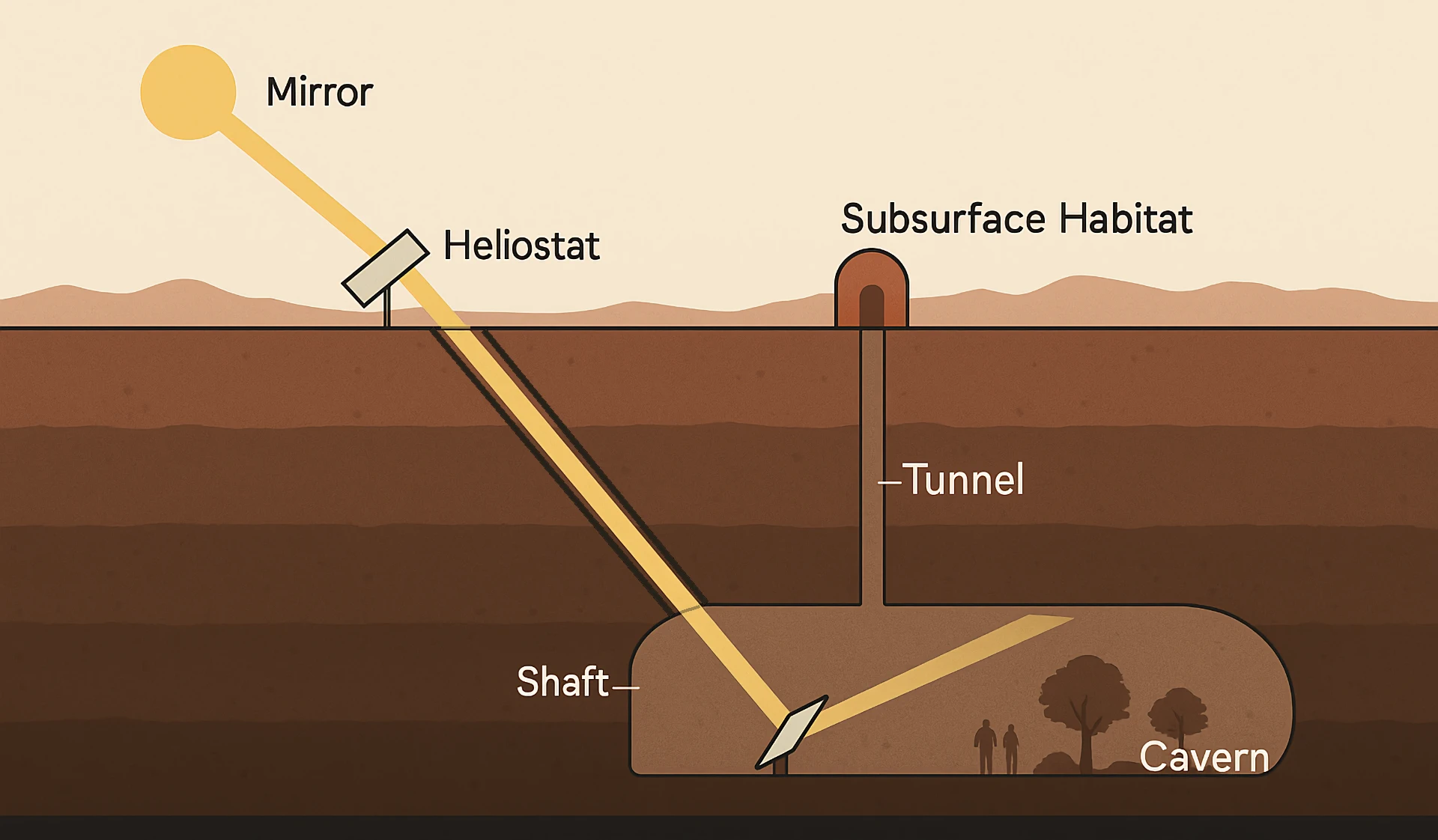
Surface mirrors redirect natural sunlight underground for living spaces, while nearby systems collect solar energy for power.
Critics often imagine underground living as dark or claustrophobic, but modern technology flips that assumption on its head. Sunlight can be captured at the surface and redirected deep underground using systems already in use today, such as heliostats (sun-tracking mirrors), light pipes, and fiber-optic daylighting. These technologies are currently used in mines, large buildings, and underground facilities on Earth to deliver full-spectrum natural light far from the surface. On Mars, arrays of mirrors could funnel sunlight through shafts into vast lava-tube caverns, illuminating living spaces, supporting agriculture, and maintaining natural circadian rhythms. In this sense, subsurface habitats aren’t a retreat from the environment—they’re a smarter adaptation to it, combining ancient shelter with cutting-edge engineering to make long-term life on Mars not just possible, but humane.
Beyond biology, there’s also a psychological comfort in seeing real sunlight rather than relying entirely on generated light. Artificial systems, no matter how reliable, subtly remind us that everything depends on uninterrupted power and perfect machinery. Redirected sunlight provides a quieter reassurance: the Sun is still there, still rising and setting over Mars. In a hostile environment where survival depends on technology, that visible continuity matters. It reduces anxiety, anchors a sense of normalcy, and reminds settlers that not everything keeping them alive is artificial or fragile. Even on another planet, the simple rhythm of daylight can help a buried world feel stable, predictable, and human.
Suface & Subsurface
Living underground provides radiation protection.
— map / TST —
Michael Alan Prestwood Author & Natural Philosopher
Prestwood writes on science-first philosophy, with particular attention to the convergence of disciplines. Drawing on his TST Framework, his work emphasizes rational inquiry grounded in empirical observation while engaging questions at the edges of established knowledge. With TouchstoneTruth positioned as a living touchstone, this work aims to contribute reliable, evolving analysis in an emerging AI era where the credibility of information is increasingly contested.