
Phil • Cr. Think • Science • Hist • …
TST PRACTICE

By Philosopher Michael Alan Prestwood

FAQ

What is an Epicurean Stoic?

☐ Read
☑ Read
You’ve read this 0 times.
You’ve listened to this 0 times.
Wed 14 Oct 2026
Published 4 weeks ago.
Updated 4 weeks ago.
Related FAQs
What is consciousness?
In TST, what is an idea axiom?
Why do we struggle to recognize the limits of our own thinking?
What is the difference between a spiritual and empirical belief?
What did the Nuremberg Trials clarify about moral agents?
How does spirituality relate to public belief?
Share :
Email
Print

What is an Epicurean Stoic?

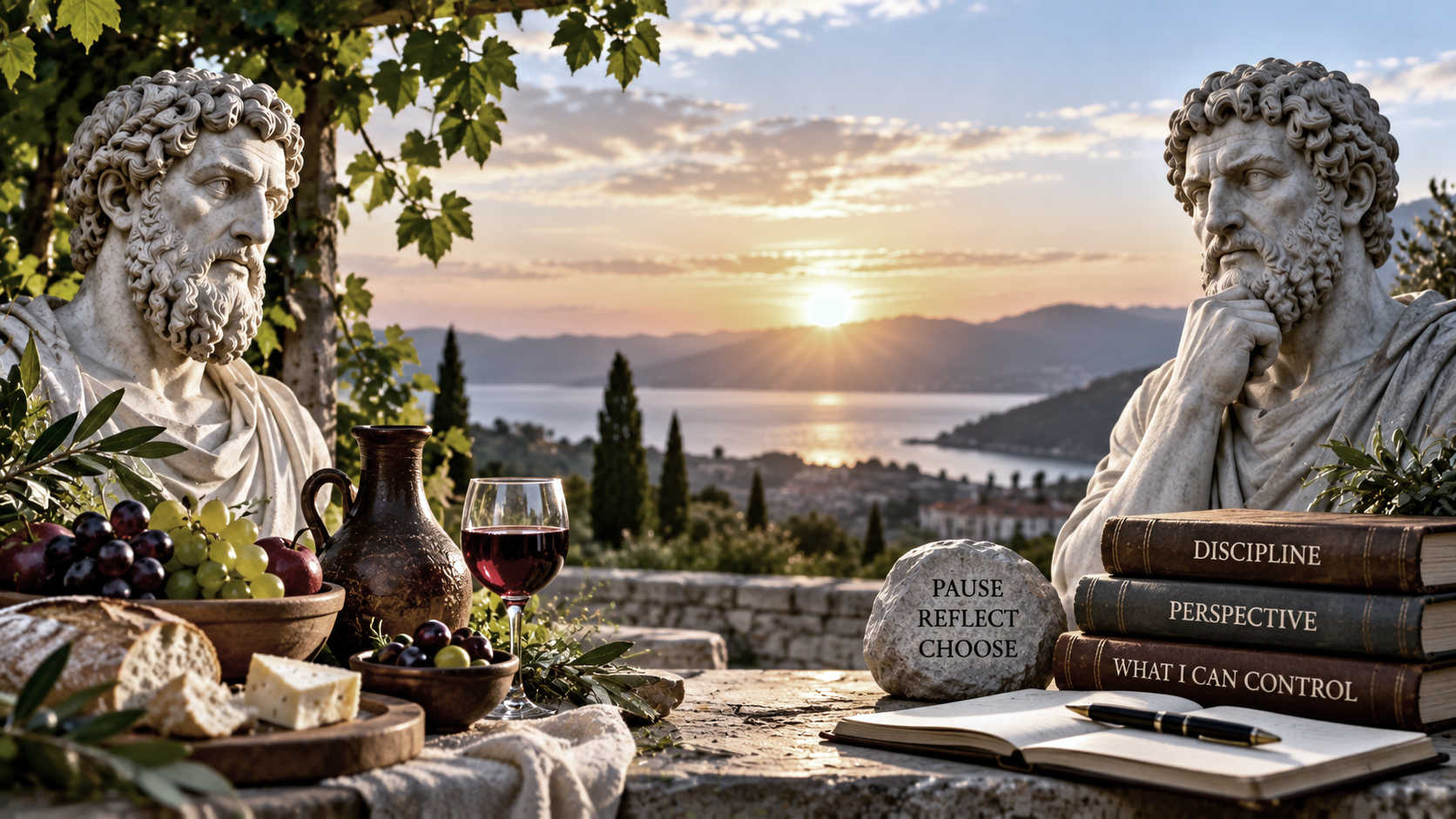
An Epicurean Stoic is a Stoic that borrows from Epicureanism.

In my book 30 Philosophers, I wrote that I sometimes identify as an “Epicurean Stoic.” Let’s start with Epicureanism. It puts pleasure at the center of a good life. But not pleasure in the sense of indulging every desire. Quite the opposite. Epicurus recognized that some pleasures cause harm and others contribute to a lifetime of happiness. The trick is learning the difference. Epicureanism has its dichotomy of pleasure where you learn to prefer long term pleasures over short term ones. Pleasures like being healthy over eating lots of Donuts. 

What I love about Stoicism is its emphasis on self-discipline. Stoicism has its dichotomy of control where you learn to focus on what you can control. We can’t control the world around us, and we can’t always control the thoughts that pop into our heads. But we can learn to manage our responses. Take emotional spiraling. We all spiral sometimes. Something goes wrong, we get frustrated, and one negative thought leads to another. Before long, we’re feeling worse and worse, sometimes over something relatively minor. Stoicism offers tools to recognize that downward spiral, catch ourselves, and work our way back up.

Epicureanism reminds me to enjoy life, especially the simple pleasures that contribute to lasting happiness. Stoicism reminds me to develop the discipline and emotional resilience to navigate life’s inevitable difficulties. Perhaps what I appreciate most is that both are applied philosophies. They’re not just abstract discussions about existence, reality, and truth. They offer practical advice about how to live.

Enjoy the pleasures of life, but think about tomorrow. Practice discipline, but don’t forget to enjoy today.

That’s what being an Epicurean Stoic means to me.
— map / TST —

TST Tracker
✓ Reading recorded.
You can learn something from every tradition, but these two I use in daily life. Epicureanism has its dichotomy of pleasure where you learn to prefer long term pleasures over short term ones. Pleasures like being healthy over eating lots of Donuts. Stoicism has its dichotomy of control where you learn to focus on what you can control. I particularly like how Stoicism focuses on the idea that you have control over your own thoughts. Both help me every day. Both are much deeper too. You can spend a lifetime exploring either. Sometimes taking control of your own life means deciding what good tools to borrow and forging good habits.
Michael Alan Prestwood
Natural Philosopher & Author
Prestwood explores science-first philosophy, with particular attention to the convergence of disciplines. Drawing on his TST Philosophy, his work emphasizes rational inquiry grounded in empirical observation while engaging questions at the edges of established knowledge. With TouchstoneTruth positioned as a living touchstone, this work aims to contribute reliable, evolving analysis in an emerging AI era where the credibility of information is increasingly contested.
The Prestwood Column
Menu
November 2026
Column Research….
1. Timeline Story
Fear-Based Ethics
2. Linked Quote
“A person is a person through other persons; you can’t be human in isolation; you are human only in relationships.”
3. Science FAQ »
Why do complex systems fail when proportionality is removed?
4. Philosophy FAQ »
How does TST Ethics handle the trolley problem?
5. Critical Thinking FAQ »
Why do people confuse rule-following with moral reasoning?
6. History FAQ!
How are original Daoism, Mohism, Confucianism, and Legalism related?
Bonus Deep-Dive Article
TST Moral Calibration: Legal, Moral, and Fair

Comments

Join the Conversation! Currently logged out.
NEW BOOK! NOW AVAILABLE!!

30 Philosophers: A New Look at Timeless Ideas

by Michael Alan Prestwood
The story of the history of our best ideas!
Scroll to Top