
Explore Natural Philosophy

Science • Phil • Cr. Think • Hist •

FAQ

Why do we struggle to recognize the limits of our own thinking?

Wed 4 Feb 2026
Published 5 months ago.
Updated 4 weeks ago.
Related FAQs
What is the difference between anthropology and paleontology?
Is Occam’s Razor always right?
How does spirituality relate to public belief?
Does TST Philosophy use existential givens?
Is there evidence for other dimensions?
Why do people confuse rule-following with moral reasoning?
Share :
Email
Print

Why do we struggle to recognize the limits of our own thinking?

We struggle because confidence feels like control. Once an idea helps us make sense of the world, we naturally want to defend it. But real self-command requires knowing where our thinking ends and uncertainty begins.

In TST, awareness of conceptual boundaries is a core part of viewpoint prevention, an idea central to the Open Viewpoint Method (OVM). Boundaries mark the point where our best models stop making reliable claims and humility becomes mandatory. Recognizing that line is not weakness. It is one way we take control of our thinking.

Science does this well. When explanations fail, such as at the Planck scale, limits are acknowledged. Physicists do not force certainty where their tools stop working. They mark the boundary and proceed carefully.

In political, social, and personal thinking, we often do the opposite. We push certainty past what evidence can support, treating belief as explanation and confidence as proof. Once that happens, disagreement hardens, identities form around models, and communication breaks down.

Recognizing boundaries does not weaken truth. It protects it. And on a personal level, it rebuilds agency. The moment you can say, “I do not know enough yet,” you are no longer trapped by the need to be right. You are free to think better, choose better, and take control of your next response.
— map / TST —

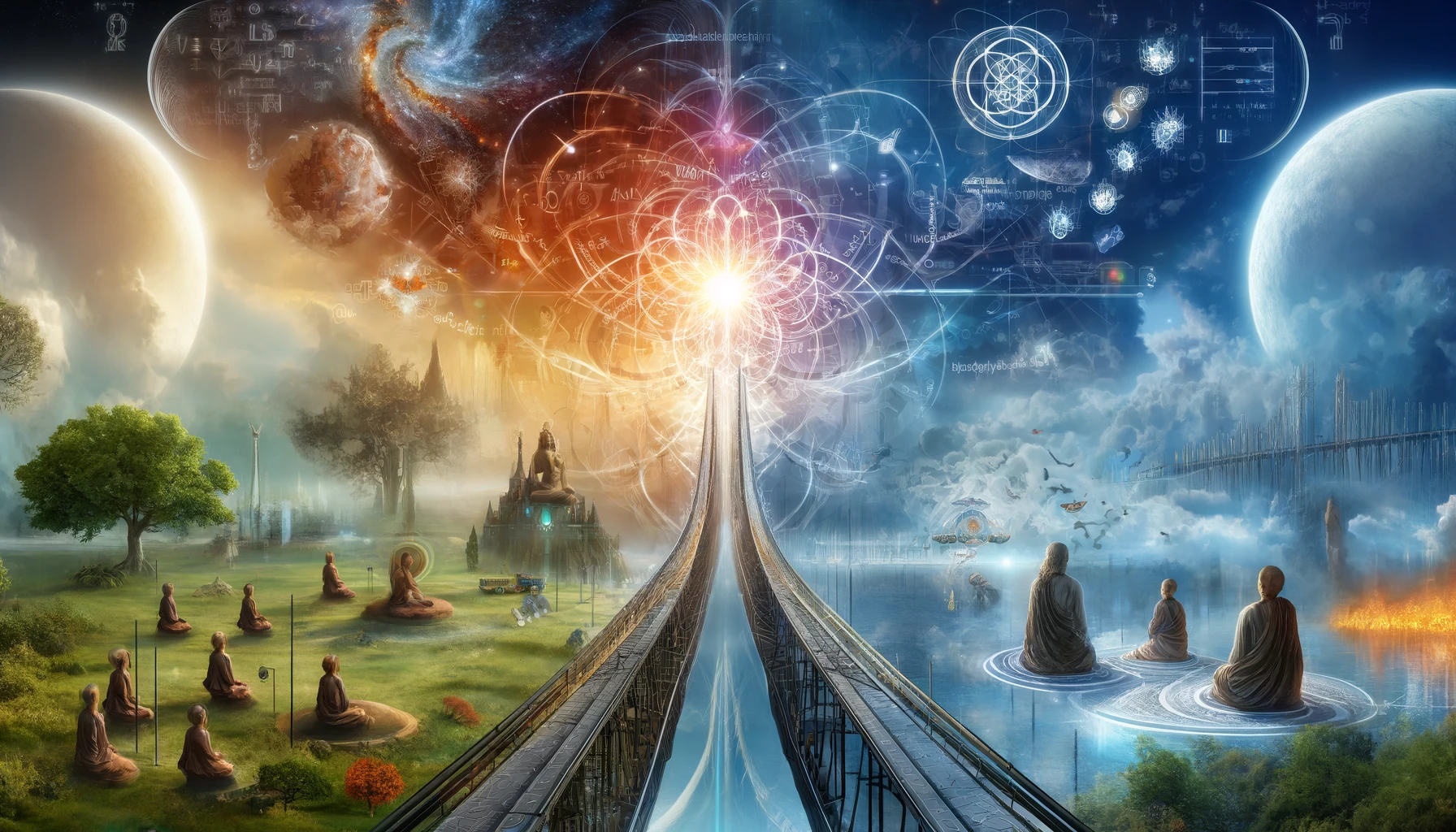
OVM is a linguistic bridge that uses intertwined words and symbols to connect people in serene and sometimes spiritual dialog. On one side is the rational and scientific, across a bridge of respect is the spiritual, unknown, and unknowable.
Michael Alan Prestwood
Author & Natural Philosopher
Prestwood writes on science-first philosophy, with particular attention to the convergence of disciplines. Drawing on his TST Framework, his work emphasizes rational inquiry grounded in empirical observation while engaging questions at the edges of established knowledge. With TouchstoneTruth positioned as a living touchstone, this work aims to contribute reliable, evolving analysis in an emerging AI era where the credibility of information is increasingly contested.
This month @ TST
Column Menu
June 2026
»COLUMN ARCHIVE
Column Research….
1. Timeline Story
Secular Spirituality Settles
2. Linked Quote
“Extraordinary claims require extraordinary evidence.”
3. Science FAQ »
What is the difference between a spiritual and empirical belief?
4. Philosophy FAQ »
What is secular spirituality?
5. Critical Thinking FAQ »
How does spirituality relate to public belief?
6. History FAQ!
Is secular spirituality supported in history and science?
Bonus Deep-Dive Article
The Material-Spiritual Framework: A Philosophy of Spirituality

Comments

Join the Conversation! Currently logged out.
NEW BOOK! NOW AVAILABLE!!

30 Philosophers: A New Look at Timeless Ideas

by Michael Alan Prestwood
The story of the history of our best ideas!
Scroll to Top