
Phil • Cr. Think • Science • Hist •

Explore Natural Philosophy

STORY

Mesozoic Era: Age of Dinosaurs

By Michael Alan Prestwood

Sun 22 Mar 2026
Published 5 months ago.
Updated 3 months ago.
Related Stories
Orangutans Branch Off: Genus Sivapithecus
Great Oxidation Event: Third Atmosphere
Chimpanzee-Bonobo Split
Modern Trees: Modern Leaves
Dinosauria Emerge: True Dinosaurs!
Ornithischians Diverge Within Dinosauria “Bird Hipped”
Share :
The Mesozoic era starts with the end-Permian mass extinction 252 million years ago. It ends the reign of dinosaurs with the K–Pg extinction 66 million years ago.

Mesozoic Era: Age of Dinosaurs

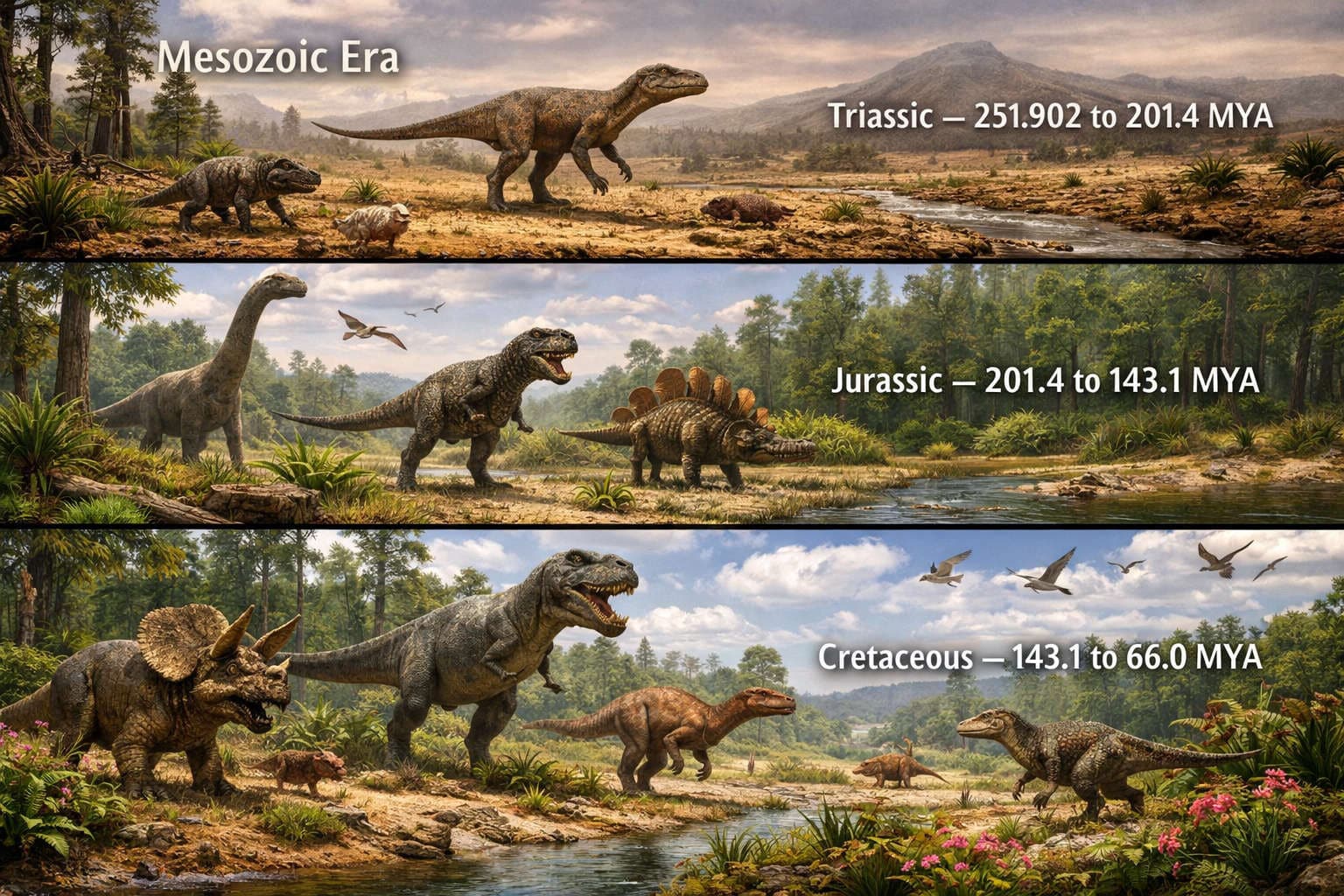
From 251.902 to 66.0 million years ago.
186 Million years: Dinosauria reigned from extinction to extinction.

The Mesozoic Era begins 251.9 million years ago, at the start of the Triassic Period, right after the catastrophic end-Permian extinction that closed the Paleozoic. The largest mass extinction in Earth history, it wiped out roughly 90 percent of marine species and devastated life on land. The boundary matters because it marks not just a change in rock layers, but a biological reset of the planet after extraordinary volcanic upheaval, greenhouse warming, and environmental collapse. So when we speak of the start of the Mesozoic, we are looking at a world recovering from devastation, with the first chapter of the era defined by survival, rebuilding, and the opening of ecological space that new lineages would eventually fill.

Life during the Mesozoic is why people call it the Age of Dinosaurs, but the era was broader than dinosaurs alone. Dinosaurs rose to dominance on land, while marine reptiles ruled many seas and flying reptiles took to the skies. This was also the era when the first true mammals appeared, birds emerged from theropod dinosaur ancestry, and major plant communities changed over time, with conifers and cycads common early on and flowering plants spreading especially late in the era. In other words, the Mesozoic was not just the age of giant reptiles. It was one of Earth’s great ages of biological innovation.

To frame its roughly 186 million years, it helps to think of the Mesozoic in three grand acts. First comes the Triassic, a recovery world in which ecosystems were still rebuilding and the earliest dinosaurs appeared. Then comes the Jurassic, when dinosaurs expanded into many of their most famous forms and Pangaea began to break apart more clearly. Finally comes the Cretaceous, when dinosaurs remained dominant, birds and mammals continued developing, and flowering plants spread across much of the planet. These three periods—Triassic, Jurassic, and Cretaceous—give the Mesozoic its basic rhythm: rise, expansion, and final flourishing.

— map / TST —

Michael Alan Prestwood
Author & Natural Philosopher
Prestwood writes on science-first philosophy, with particular attention to the convergence of disciplines. Drawing on his TST Framework, his work emphasizes rational inquiry grounded in empirical observation while engaging questions at the edges of established knowledge. With TouchstoneTruth positioned as a living touchstone, this work aims to contribute reliable, evolving analysis in an emerging AI era where the credibility of information is increasingly contested.
Email
Print
The Prestwood Column
Menu
August 2026
»COLUMN ARCHIVE
--COLUMN--
Column Research….
1. Timeline Story
Ethical Roadmap
2. Linked Quote
“The greatest weapon against stress is our ability to choose one thought over another.”
3. Science FAQ »
Did morality evolve?
4. Philosophy FAQ »
Is the Me Too movement consistent with TST Ethics?
5. Critical Thinking FAQ »
When should you stop following the crowd?
6. History FAQ!
What did the Nuremberg Trials clarify about moral agents?
Bonus Deep-Dive Article
TST Ethical Roadmap: A Process Model for Ethical Guidance and Moral Choice

Comments

Join the Conversation! Currently logged out.

Leave a Reply

NEW BOOK! NOW AVAILABLE!!

30 Philosophers: A New Look at Timeless Ideas

by Michael Alan Prestwood
The story of the history of our best ideas!
Scroll to Top