
Explore Science-first Philosophy

STORY

The Idea of History

By Michael Alan Prestwood

Sun 3 May 2026
Published 6 minutes ago.
Updated 1 hour ago.
Related Stories
Share :
Collingwood married Ethel Winifred Graham in 1918, and they had a son and a daughter. Late in life, after years of declining health, he married Kathleen Frances Edwardes in 1942, with whom he had another daughter.

The Idea of History

1946
Published posthumously.

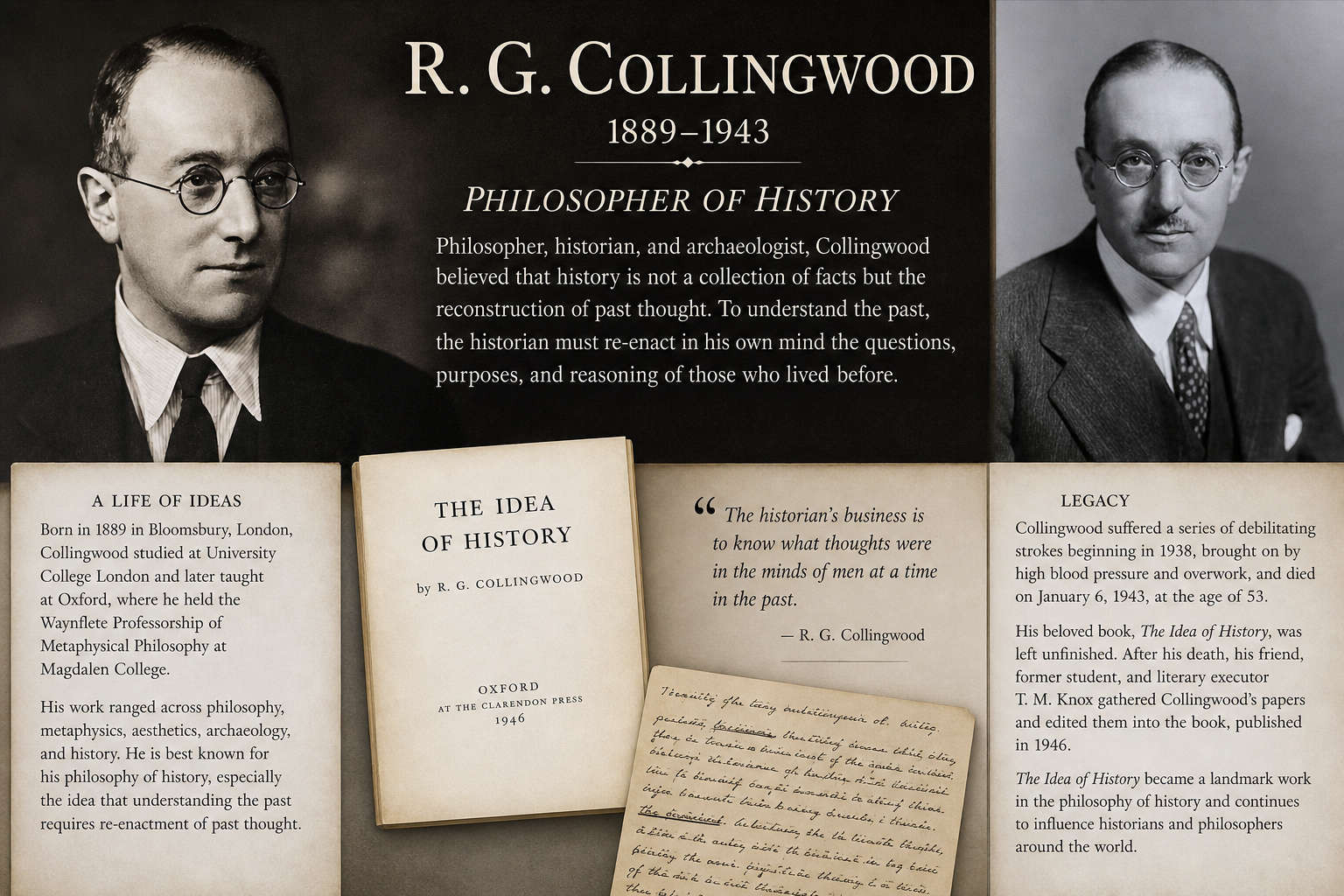
Robin George Collingwood was born in England in 1889 and became a philosopher, historian, and practicing archaeologist. He taught at Oxford and eventually became Waynflete Professor of Metaphysical Philosophy at Magdalen College. His work ranged across aesthetics, metaphysics, archaeology, and history, but he is best remembered for his philosophy of history. Collingwood mattered because he treated history not as a dead pile of facts, but as an active discipline of reconstruction. To understand the past, the historian must do more than collect evidence; the historian must think through the actions, purposes, and questions of those who lived before.

Collingwood’s ideas align strongly with TST’s empirical narrative realism because he understood history as an act of interpretation grounded in evidence. His famous idea of historical “re-enactment” means that historians try to reconstruct the thought behind past human actions. That supports the view that history is not the past itself. It is a rational retelling of the past. The event happened in the material world, but the historical account requires the mind to organize traces, infer motives, connect causes, and reconstruct meaning. In that sense, Collingwood helps support the TST claim that history is rational reconstruction, not direct empirical observation.

TST extends Collingwood by placing his insight inside a broader framework of empirical, rational, and irrational ideas. Collingwood focused especially on reconstructing human thought and intent. TST widens the lens: the past was empirical, the surviving traces are empirical, but the historical story is rational and measured against empirical traces. A diary, fossil, photograph, ruin, recording, or memory gives history an empirical anchor. The narrative built from those anchors is rational because it arranges evidence into sequence, cause, context, and meaning. TST also adds the language of confidence: some historical stories are strongly supported, some are weak, and some collapse when reality pushes back.

Collingwood’s final years were difficult, as he felt death coming early for him, and pushed himself, hard. Too hard. He desparately wanted to finish his life’s work and send it into the future. After suffering from high blood pressure, and a series of debilitating strokes, he died in 1943 at Coniston in Lancashire. Nearing age 54, Collingwood was not quite done with his life’s work. 

Collingwood’s holistic eudaimonia was completed after his death by T. M. Knox, his friend, former student, and literary executor. Knox gathered the unfinished materials and edited them into The Idea of History, published in 1946. 

The book became one of the major English-language works in the philosophy of history and helped shape later debates over historical explanation, especially during the 1950s and 1960s. In a fitting twist, Collingwood himself became part of the kind of story he studied: a thinker whose unfinished work was gathered from traces, reconstructed by others, and carried forward into history.

— map / TST —

Michael Alan Prestwood
Author & Natural Philosopher
Prestwood writes on science-first philosophy, with particular attention to the convergence of disciplines. Drawing on his TST Framework, his work emphasizes rational inquiry grounded in empirical observation while engaging questions at the edges of established knowledge. With TouchstoneTruth positioned as a living touchstone, this work aims to contribute reliable, evolving analysis in an emerging AI era where the credibility of information is increasingly contested.
Email
Print
TST Column
May 3, 2026
Column Research….
1. Timeline Story
The Idea of History
2. Linked Quote
“The historian without his facts is rootless and futile; the facts without their historian are dead and meaningless.”
3. Science FAQ »
Is science tainted by bias?
4. Philosophy FAQ »
Debating History: Should We Say “Dark Ages” or “Middle Ages?”
5. Critical Thinking FAQ »
What is the preservation bias?
6. History FAQ!
Did Einstein’s driver really give one of his early talks?
Bonus Deep-Dive Article
TST Philosophy of History: Empirical Narrative Realism

Comments

Join the Conversation! Currently logged out.

Leave a Reply

NEW BOOK! NOW AVAILABLE!!

30 Philosophers: A New Look at Timeless Ideas

by Michael Alan Prestwood
The story of the history of our best ideas!
Scroll to Top