
Phil • Cr. Think • Science • Hist • …
TST PRACTICE

The Philosophy Website

STORY

First Animal Teeth

☐ Read
☑ Read
You’ve read this 0 times.
You’ve listened to this 0 times.

By Michael Alan Prestwood

Thu 1 Oct 2026
Published 5 hours ago.
Updated 4 hours ago.
Related Stories
Pterosaurs Diverge From Dinosaur Ancestors (within Ornithodira)
Diplodocus
The Last Pterosaurs
Ordovician–Silurian Extinction: Ice Strikes the Seas
Intracellular Flow and Nutrient Exchange
Last Non-Therapsid Synapsids
Share :
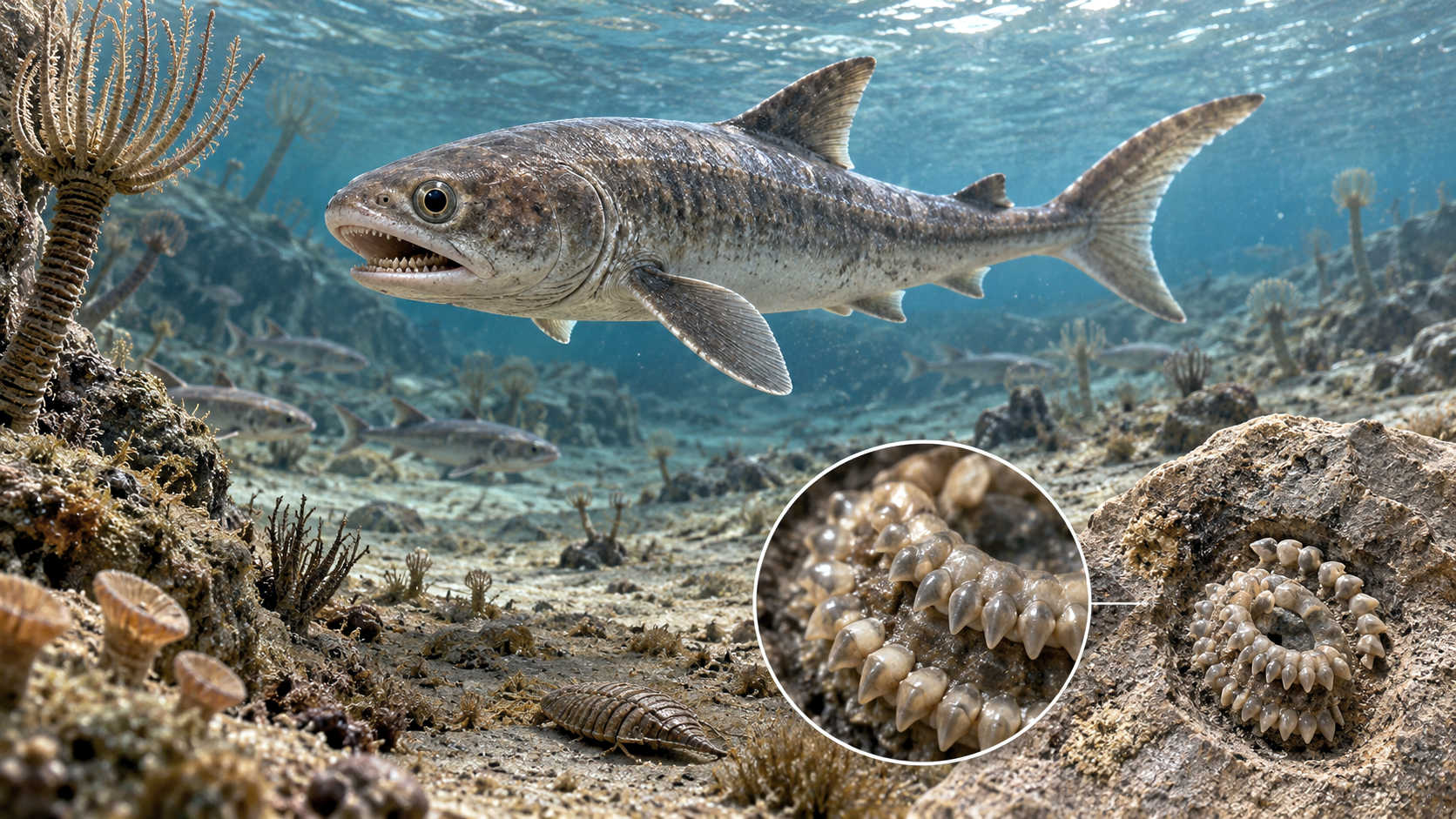
Teeth first evolved in a common fish ancestor to reptiles, dinosaurs, and mammals. The earliest direct evidence we currently have for true teeth comes from a tiny jawed fish called Qianodus duplicis, which lived about 439 million years ago during the Silurian Period. We don’t have a nice complete fish fossil smiling back at us. What we have are tiny fossilized tooth whorls from China, with rows of teeth added as the animal grew. These structures show features recognizable in later jawed vertebrates, making Qianodus our current oldest solid evidence for a toothed animal.

First Animal Teeth

439 Million years ago (+/- 1 million)

Teeth first evolved in a common fish ancestor of reptiles, dinosaurs, and mammals.

The earliest direct evidence we currently have for true teeth comes from a tiny jawed fish called Qianodus duplicis, which lived about 439 million years ago during the Silurian Period. This tiny fossilized tooth whorls from China, how rows of teeth added as the animal grew.

But teeth almost certainly have an older backstory going back another 20 million years, in jawless vertebrates such as Eriptychius. These animals had dentine-bearing structures called odontodes on the outside of their bodies. Remarkably, modern sharks, rays, and skates still carry thousands of these tooth-like dermal denticles across their skin. Current evidence suggests that teeth evolved when this ancient developmental machinery was recruited into the mouth.

From there, teeth exploded into variety. Fish evolved rows, whorls, crushing plates, needles, and replaceable teeth. As vertebrates moved onto land, reptiles and the synapsid line leading to mammals kept modifying them. Dinosaurs took teeth in their own spectacular directions. Meat-eating theropods generally evolved sharp, recurved, serrated teeth for gripping and slicing flesh, while plant-eating dinosaurs evolved a much wider variety capable of grinding tough vegetation. Some dinosaurs even evolved distinctly different kinds of teeth in the same mouth.

In our own lineage, therapsids differentiated them into incisors, canines, and grinding cheek teeth. And evolution sometimes went the other direction. Modern birds descended from toothed dinosaurs but lost their teeth. Adult platypuses lost theirs too. Some fish even lose oral teeth while keeping teeth deeper in the throat. Once evolution had successful teeth, it was perfectly willing to reshape them, move them, or throw them away.

— map / TST —

TST Tracker
✓ Reading recorded.
Michael Alan Prestwood
Author & Natural Philosopher
Prestwood writes on science-first philosophy, with particular attention to the convergence of disciplines. Drawing on his TST Framework, his work emphasizes rational inquiry grounded in empirical observation while engaging questions at the edges of established knowledge. With TouchstoneTruth positioned as a living touchstone, this work aims to contribute reliable, evolving analysis in an emerging AI era where the credibility of information is increasingly contested.
Email
Print
The Prestwood Column
Menu
October 2026
Column Research….
1. Timeline Story
The Great Quaker Debates!
2. Linked Quote
“All men are prone to differ. It is no new thing in all former ages, in all parts. Each party is most right in his own eyes.”
3. Science FAQ »
Do facts actually change minds?
4. Philosophy FAQ »
When does persuasion become manipulation?
5. Critical Thinking FAQ »
How can you tell when a debate has stopped being productive?
6. History FAQ!
What is the history of debate?
Bonus Deep-Dive Article
Roger Williams Biography and Dedication to the Freedom of Conscience

Comments

Join the Conversation! Currently logged out.

Leave a Reply

NEW BOOK! NOW AVAILABLE!!

30 Philosophers: A New Look at Timeless Ideas

by Michael Alan Prestwood
The story of the history of our best ideas!
Scroll to Top