
Phil • Cr. Think • Science • Hist • …
TST PRACTICE

By Philosopher Michael Alan Prestwood

STORY

Salamander Line Splits Off

☐ Read
☑ Read
You’ve read this 0 times.
You’ve listened to this 0 times.

By Michael Alan Prestwood

Sun 15 Nov 2026
Published 8 hours ago.
Updated 8 hours ago.
Related Stories
Neoaves Birds Emerge (from Neognathae)
Gorillas Branch Off: Genus Nakalipithecus
Last Non-Therapsid Synapsids
The Last Stegosaurus: Wuerhosaurus
Confuciusornithiformes Birds Emerge (Now Extinct)
Bird-line Archosaur: Nyasasaurus parringtoni
Share :
Modern salamanders aren’t our ancestors, but their eardrum-free hearing offers clues to how early tetrapods sensed sound. By studying their ears alongside fossils and other living animals, we can trace how evolution took that shared starting point down different paths, eventually producing the specialized hearing of birds and mammals today.

Salamander Line Splits Off

350 Million years ago (+/- 5 million)

350 million years ago | Early Carboniferous

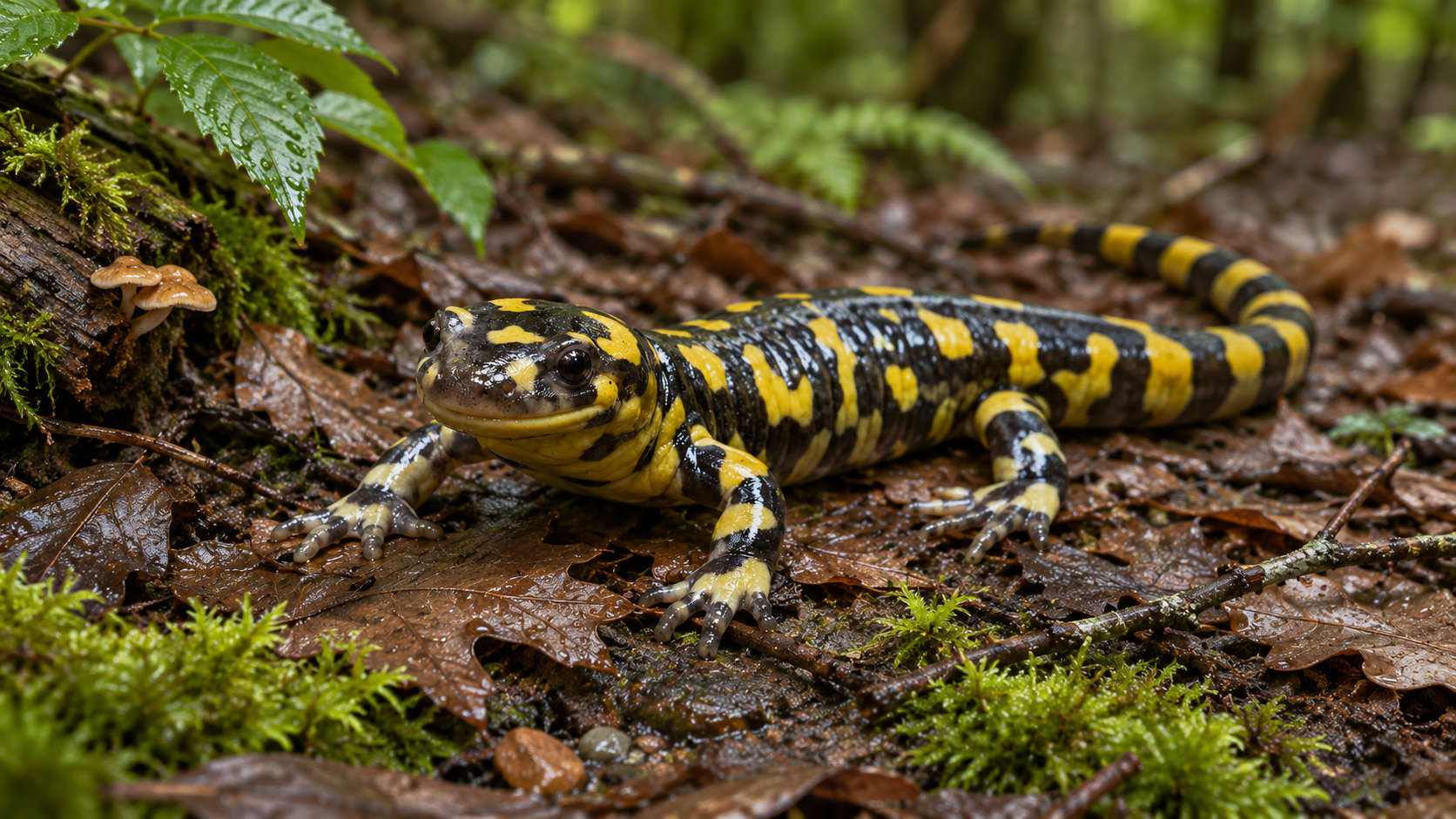
Around 350 million years ago, our ancient tetrapod ancestors split into two great evolutionary lineages. One led to today’s amphibians, including salamanders and frogs. The other eventually led to reptiles, dinosaurs, birds, and mammals. Salamanders themselves evolved later, but their ears still retain important features of early tetrapod hearing. They lack eardrums and rely on other structures to detect sound and vibrations. Although not our ancestors, modern salamanders give us a living model for studying features of our distant common ancestors, including hearing.

The story of hearing began much earlier, in water. Ancient fish detected underwater vibrations through their inner ears. As vertebrates moved onto land, evolution faced a new challenge: hearing sound traveling through air. Over millions of years, different branches developed their own solutions. Dinosaurs and their bird descendants evolved ears with a single middle-ear bone, while mammals independently developed a system with three. Two of the mammalian hearing bones even evolved from ancestral jaw bones.

Today, those evolutionary paths are still visible. Salamanders hear low-frequency sounds without eardrums. Frogs developed eardrums that help them hear one another’s calls. Birds evolved remarkable hearing abilities, with owls able to locate prey by sound alone. Mammals generally hear a wider range of frequencies, with bats detecting ultrasonic echoes far beyond the hearing of birds. No single ear is best at everything. Evolution produced different solutions to the same problem: making sense of a world filled with sound.

— map / TST —

TST Tracker
✓ Reading recorded.
Michael Alan Prestwood
Natural Philosopher & Author
Prestwood explores science-first philosophy, with particular attention to the convergence of disciplines. Drawing on his TST Philosophy, his work emphasizes rational inquiry grounded in empirical observation while engaging questions at the edges of established knowledge. With TouchstoneTruth positioned as a living touchstone, this work aims to contribute reliable, evolving analysis in an emerging AI era where the credibility of information is increasingly contested.
Email
Print
The Prestwood Column
Menu
November 2026
Column Research….
1. Timeline Story
Fear-Based Ethics
2. Linked Quote
“A person is a person through other persons; you can’t be human in isolation; you are human only in relationships.”
3. Science FAQ »
Why do complex systems fail when proportionality is removed?
4. Philosophy FAQ »
How does TST Ethics handle the trolley problem?
5. Critical Thinking FAQ »
Why do people confuse rule-following with moral reasoning?
6. History FAQ!
How are original Daoism, Mohism, Confucianism, and Legalism related?
Bonus Deep-Dive Article
TST Moral Calibration: Legal, Moral, and Fair

Comments

Join the Conversation! Currently logged out.

Leave a Reply

NEW BOOK! NOW AVAILABLE!!

30 Philosophers: A New Look at Timeless Ideas

by Michael Alan Prestwood
The story of the history of our best ideas!
Scroll to Top