
Phil • Cr. Think • Science • Hist • …
TST PRACTICE

By Philosopher Michael Alan Prestwood

STORY

Sweetness Gene Evolves

☐ Read
☑ Read
You’ve read this 0 times.
You’ve listened to this 0 times.

By Michael Alan Prestwood

Wed 4 Nov 2026
Published 14 minutes ago.
Updated 19 seconds ago.
Related Stories
Last Non-Mammaliaform Cynodonts
Bird-line Archosaurs: Asilisaurus kongwe (within Ornithodira)
The Last Stegosaurus: Wuerhosaurus
Platypus–Ape Common Ancestor
The Last Ornithischians
Zuniceratops
Share :
Thinking well about evolution means following the evidence, not just accepting the explanation. By comparing genes across species, identifying shared mutations, and testing ancient receptors, scientists can reconstruct how traits evolved hundreds of millions of years ago. Evolution is not merely a story about the past. It is a scientific explanation supported by evidence we can examine and test today.

Sweetness Gene Evolves

450 Million years ago (+/- 20 million)
The evolution of sweetness: A gene's remarkable journey.

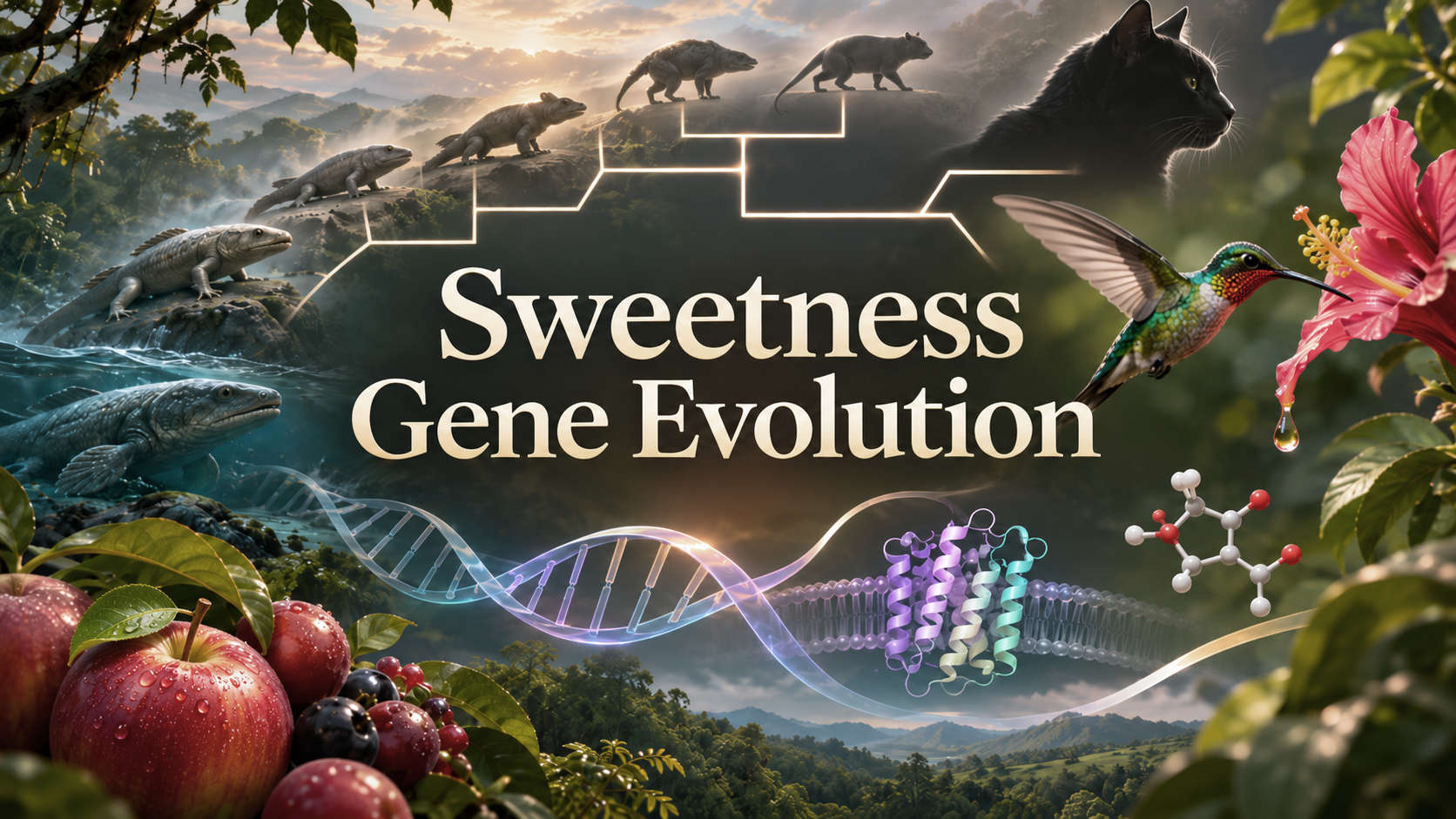
The evolution of sweetness is a fascinating example of evolution. The modern sweet flavor we enjoy depends on the Tas1r2 gene, which first evolved about 450 million years ago: from the ancient Tas1r gene family. From there, evolution did its thing.

Take cats and dogs. Put candy in front of a cat, no thanks says the cat. A dog? Yes please. Slurp. Cats, dogs, and other mammalian predators descended from ancestors with a functional Tas1r2 gene. But several meat-eating lineages independently lost their ability to detect sweetness. Think about it: if your descendants eat animals, a taste for sweetness has little advantage. Picture a complex combination of scent and taste receptors, genes, and other evolutionary tweaks. Traits taking shape multiple times over many generations. And that makes sense.

Now, take birds. Birds descend from the T. rex theropod line of dinosaurs. Somewhere along that lineage, the Tas1r2 gene was lost.

Here’s where the story gets good.

Take hummingbirds. These dinosaurs love sugar. So, did they “fix” their Tas1r2 gene? No! While it’s possible to regain lost capabilities, evolution can find other paths. Life finds its way.

Hummingbirds rediscovered sweetness and opened up a new ecological opportunity: feeding on energy-rich flower nectar. By about 22 million years ago, the ancestorial hummingbird line changed how their savory taste receptors worked, specifically the proteins produced by their Tas1r1 and Tas1r3 genes. That’s a clean example of convergent evolution. Scientists have even reconstructed that receptor, and it responds to sugar! And, the reconstructed one from a 42 million year ago ancestor with swifts, does not respond to sugar! Now that’s evidence.

Think about it. An ancient gene. Several evolutionary branches lost or tweaked sweetness. One branch even found another path to enjoying sweetness. So many ways to cross check the details of evolution.

— map / TST —

TST Tracker
✓ Reading recorded.
Michael Alan Prestwood
Natural Philosopher & Author
Prestwood explores science-first philosophy, with particular attention to the convergence of disciplines. Drawing on his TST Philosophy, his work emphasizes rational inquiry grounded in empirical observation while engaging questions at the edges of established knowledge. With TouchstoneTruth positioned as a living touchstone, this work aims to contribute reliable, evolving analysis in an emerging AI era where the credibility of information is increasingly contested.
Email
Print
The Prestwood Column
Menu
November 2026
Column Research….
1. Timeline Story
Fear-Based Ethics
2. Linked Quote
“A person is a person through other persons; you can’t be human in isolation; you are human only in relationships.”
3. Science FAQ »
Why do complex systems fail when proportionality is removed?
4. Philosophy FAQ »
How does TST Ethics handle the trolley problem?
5. Critical Thinking FAQ »
Why do people confuse rule-following with moral reasoning?
6. History FAQ!
How are original Daoism, Mohism, Confucianism, and Legalism related?
Bonus Deep-Dive Article
TST Moral Calibration: Legal, Moral, and Fair

Comments

Join the Conversation! Currently logged out.

Leave a Reply

NEW BOOK! NOW AVAILABLE!!

30 Philosophers: A New Look at Timeless Ideas

by Michael Alan Prestwood
The story of the history of our best ideas!
Scroll to Top