
Phil • Cr. Think • Science • Hist •
TST PRACTICE

The Philosophy Website

STORY

Platypus–Ape Common Ancestor

☐ Read
☑ Read
You’ve read this 0 times.
You’ve listened to this 0 times.

By Michael Alan Prestwood

Wed 29 Oct 2025
Published 11 months ago.
Updated 4 months ago.
Related Stories
Plesiadapis: First fruit-insect eaters.
Complex Sentience Settles: Eomaia scansoria
Amniotes Emerge: Amniotic Eggs
First Mammaliaforms: Morganucodon
Genus Orangutans
First Synapsids
Share :
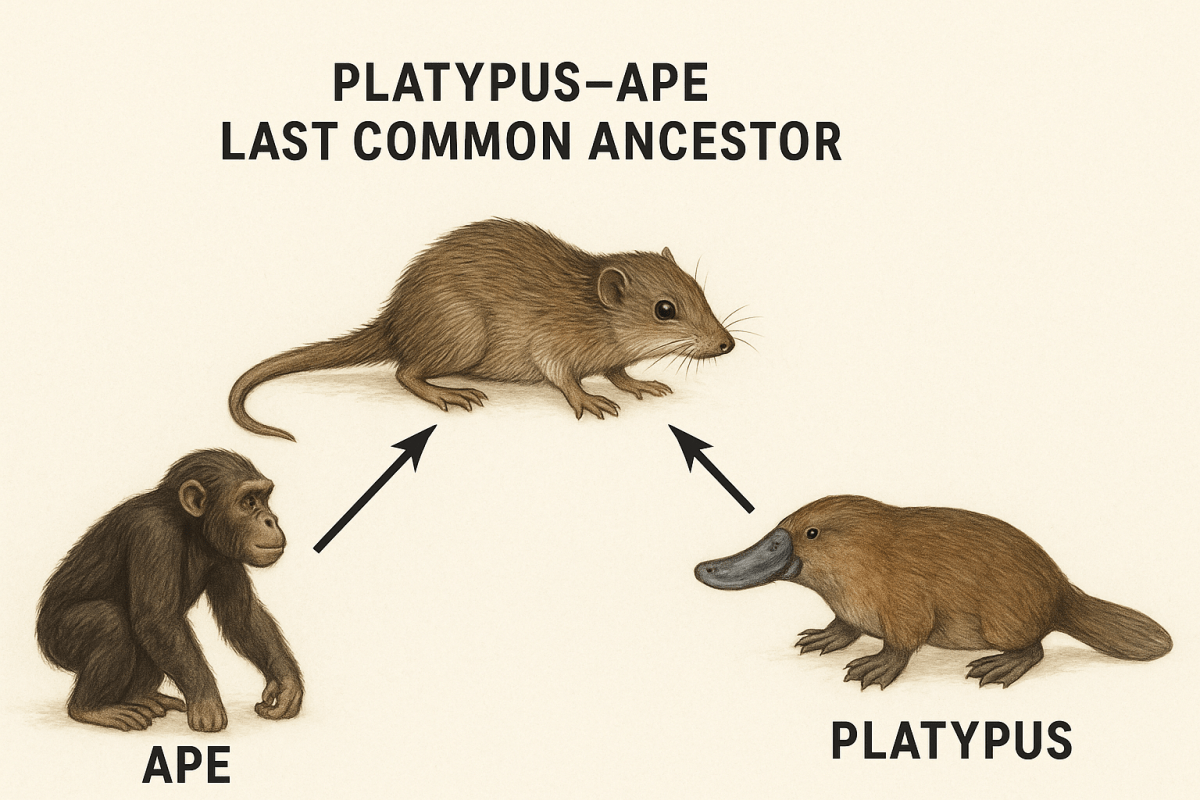
The last common ancestor of platypus and ape lived around 225 million years ago, during the Late Triassic. It wasn’t a modern mammal yet, but a very late synapsid—or early mammaliaform—already carrying the essentials: fur for insulation, a warm-blooded metabolism, and mammal-style teeth. From this small, generalized creature, every living mammal would diverge—both the strange egg-laying platypus and the most self-aware ape.

Platypus–Ape Common Ancestor

225 million years ago (±5 million years)
When dinosaurs rose, our line quietly began.

In the dense, humid forests of the Late Triassic, long before mammals ruled the night, a small, shrew-like creature scurried beneath the ferns. This ancestor—our shared forebear with the platypus—was warm-blooded, fur-covered, and likely laid soft-shelled eggs. It represents the last hazy moment before the mammalian lineage fully diverged: one path leading to the egg-laying monotremes, the other eventually giving rise to marsupials and placental mammals, and much later, apes and humans.

The platypus feels odd to us: a duck-like bill, fur, warm blood, and egg-laying all wrapped into one animal. It doesn’t feel like a mammal, yet it undeniably is one. The truth is, evolution didn’t jump cleanly from synapsids to modern mammals. It moved slowly, branching, overlapping, and entangling traits along the way.

The last common ancestor of platypus and ape lived around 225 million years ago, during the Late Triassic. It wasn’t a modern mammal yet, but a very late synapsid—or early mammaliaform—already carrying the essentials: fur for insulation, a warm-blooded metabolism, and mammal-style teeth. From this small, generalized creature, every living mammal would diverge—both the strange egg-laying platypus and the most self-aware ape.

While dinosaurs were just beginning their ascent toward dominance, this humble animal carried the spark of something different: not just fur, but milk; not just survival, but endurance through deep time. Its descendants would adapt, shrink, and diversify through extinction after extinction, quietly refining the traits that define mammals today.

Only one branch of egg-laying mammals survives now: the Australasian monotremes—the platypus and four species of echidna. Much later, around 185 million years ago, mammals with live birth appeared, marking another major evolutionary turn. But the older story still lives on, quietly, in rivers and forests half a world away.

— map / TST —

TST Tracker
✓ Reading recorded.
Michael Alan Prestwood
Author & Natural Philosopher
Prestwood writes on science-first philosophy, with particular attention to the convergence of disciplines. Drawing on his TST Framework, his work emphasizes rational inquiry grounded in empirical observation while engaging questions at the edges of established knowledge. With TouchstoneTruth positioned as a living touchstone, this work aims to contribute reliable, evolving analysis in an emerging AI era where the credibility of information is increasingly contested.
Email
Print
The Prestwood Column
Menu
September 2026
Column Research….
1. Timeline Story
Hume’s Is–Ought Problem
2. Linked Quote
“I meet with no proposition that is not connected with an ought, or an ought not.”
3. Science FAQ »
Can science prove flourishing should be our goal?
4. Philosophy FAQ »
What is the difference between a normative aim and a normative directive?
5. Critical Thinking FAQ »
Is flourishing for all just utilitarianism?
6. History FAQ!
What is the history of the idea of flourishing in philosophy?
Bonus Deep-Dive Article
TST Normative Ethics: Flourishing as a Philosophical Goal

Comments

Join the Conversation! Currently logged out.

Leave a Reply

NEW BOOK! NOW AVAILABLE!!

30 Philosophers: A New Look at Timeless Ideas

by Michael Alan Prestwood
The story of the history of our best ideas!
Scroll to Top