
Phil • Cr. Think • Science • Hist • …
TST PRACTICE

By Philosopher Michael Alan Prestwood

TST-SPECIFIC TERM

Consciousness

☐ Read
☑ Read
You’ve read this 0 times.
You’ve listened to this 0 times.
Sun 18 Oct 2026
Published 19 hours ago.
Updated 19 hours ago.
Related Terms
Eternal Recurrence
Illusion
Memory
Prelinguistic Thought
Eudaimonia
Apathetic Agnostic
Share :
Email
Print

Consciousness

Experiencing reality using senses and cognitive abilities.

TST embraces an experience-centered understanding of consciousness found in traditional philosophy. It can even be shortened to experiencing reality. In this usage, experiencing involves sensory information, perception, memory, and cognitive abilities as a mind interacts with the material world. It does not require language or humanlike self-awareness and includes alien, artificial, and supernatural consciousness.

To better understand consciousness, here’s another word painting. In everyday life, consciousness can mean being awake, aware of your surroundings, or aware of yourself. In philosophy and science, the definitions get more interesting. Sentience concerns the capacity to feel, self-awareness involves recognizing oneself, and cognition includes abilities like learning, remembering, and reasoning. Phenomenal consciousness explores what an experience feels like.

One famous question, the hard problem of consciousness, asks why physical processes give rise to subjective experience. TST does not attempt to settle every aspect of that debate.

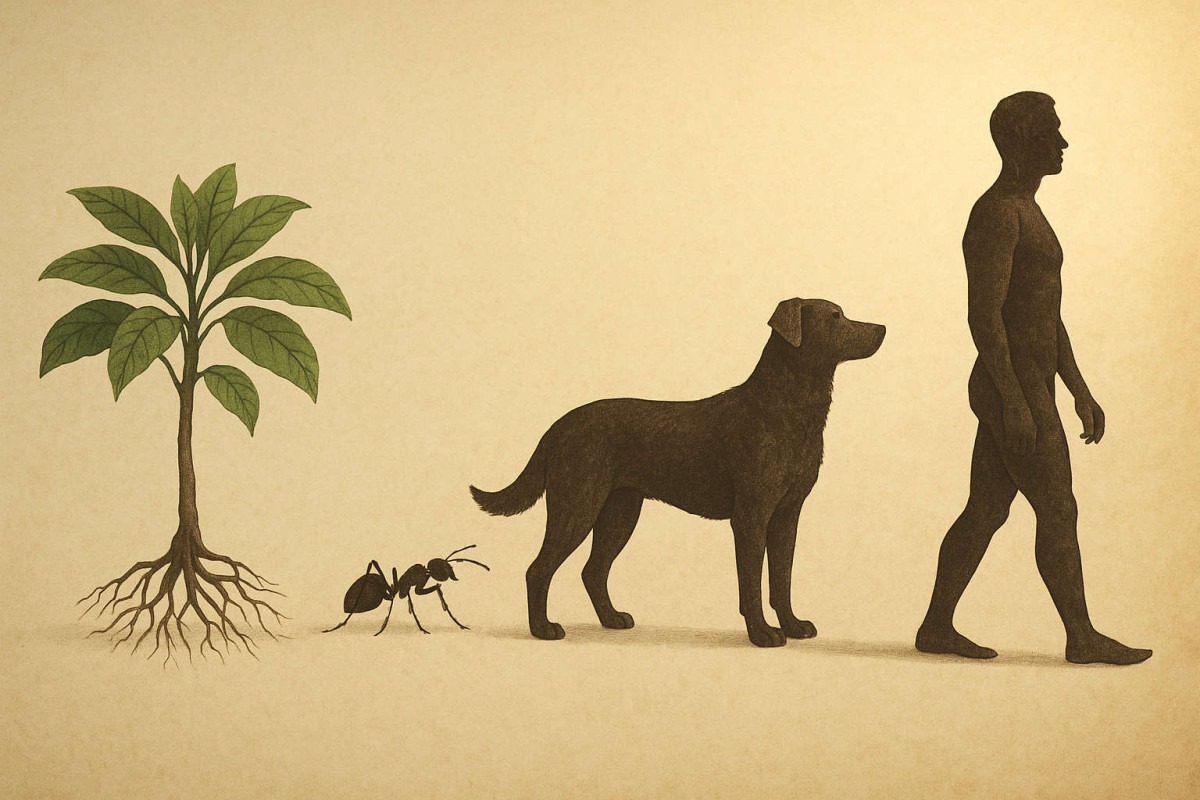
In TST, the Mindscape Framework offers a way to explore the different aspects of experiencing reality. It organizes consciousness into four broad categories: none, preconscious, simple, and complex. From there, it explores cognitive ability, memory, sentience, self-awareness, and intelligence. Intelligence itself is explored through general, emotional, and transcendental intelligence. These useful abstractions allow us to explore how a plant, worm, dog, human, or potentially an AI might interact with reality in very different ways, without making human consciousness the standard.

The framework also explores the experience of the “now.” Our present experience is shaped by live impressions, memories, attention, expectations, and emotions. Some impressions fade, while others influence future thinking. Over time, our experiences shape our knowledge, heuristics, worldview, and identity.
— map / TST —

TST Tracker
✓ Reading recorded.
Experience is using cognitive abilities along with senses to interact with the material world. Consciousness is experiencing reality, and the human experience is only one possible way of doing so. Thinking well means recognizing that our experience is limited and not necessarily universal. Living well means appreciating the experience of the now, making thoughtful choices, and respecting that other minds may experience the same reality very differently.
Michael Alan Prestwood
Natural Philosopher & Author
Prestwood explores science-first philosophy, with particular attention to the convergence of disciplines. Drawing on his TST Philosophy, his work emphasizes rational inquiry grounded in empirical observation while engaging questions at the edges of established knowledge. With TouchstoneTruth positioned as a living touchstone, this work aims to contribute reliable, evolving analysis in an emerging AI era where the credibility of information is increasingly contested.
The Prestwood Column
Menu
October 2026
Column Research….
1. Timeline Story
The Great Quaker Debates!
2. Linked Quote
“All men are prone to differ. It is no new thing in all former ages, in all parts. Each party is most right in his own eyes.”
3. Science FAQ »
Do facts actually change minds?
4. Philosophy FAQ »
When does persuasion become manipulation?
5. Critical Thinking FAQ »
How can you tell when a debate has stopped being productive?
6. History FAQ!
What is the history of debate?
Bonus Deep-Dive Article
Roger Williams Biography and Dedication to the Freedom of Conscience

Comments

Join the Conversation! Currently logged out.
NEW BOOK! NOW AVAILABLE!!

30 Philosophers: A New Look at Timeless Ideas

by Michael Alan Prestwood
The story of the history of our best ideas!
Scroll to Top