

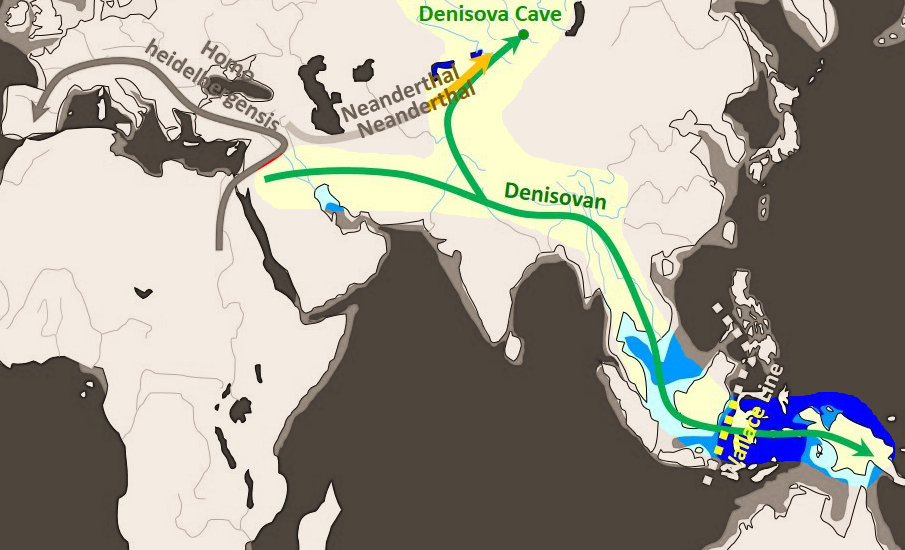
Neanderthals and denisovans in the genus Homo had a common ancestor about 370,000 BCE (current estimates range from 250,000 to 500,000 BCE). Though neanderthals, denisovans, and sapiens share a common ancestor, they didn’t evolve directly from each other. That common ancestor from which all three evolved from was likely a later Homo heidelbergensis. Although some research suggest Denisovans branched from an early neanderthal. If Denisovans branched from an earlier Homo heidelbergensis, it suggests modern cognitive abilities like symbolic thought may have emerged much earlier than previously believed, which aligns with discoveries of early art currently under investigation. Some suggest denisovans branched from Homo erectus, if that’s true but I don’t think it is, that pushes the evolution of our modern brains back to about 1 million years ago. Either way, it’s clear our current anthropomorphic bias has painted a cloudy picture. It’s much more likely that many of these species were roaming around with similar cognitive abilities. Occam’s Razor suggests that’s more likely than all these species evolving “intelligence” in such a short time.
Long after the three species were on Earth, they interbred from time to time. Through DNA testing we can identify DNA that came from interbreeding with both. The highest percent of denisovan DNA in modern humans is in Melanesian population ranges; it ranges from 4 to 6 percent, lower in other Southeast Asian and Pacific Islander populations, and nearly undetectable elsewhere in the world.
Denisovans became extinct about 40,000 BCE, the last surviving in Siberia. They built shelters, wore clothes, used tools, and spoke. Late Homo heidelbergensis, neanderthals, denisovans, and sapiens all likely looked very similar: a combination of the wide variety seen in modern humans.

