
Phil • Cr. Think • Science • Hist •

The Philosophy Website

STORY

Friedrich Nietzsche

☐ Read
☑ Read
You’ve read this 0 times.
You’ve listened to this 0 times.

By Michael Alan Prestwood

Wed 10 Apr 2024
Published 2 years ago.
Updated 2 weeks ago.
Related Stories
A Unified Origin Story
Holistic Eudaimonia
Eternal Recurrence
Open Viewpoint Method (OVM)
Epicurus
Ontology
Share :
Chapter 30 in "30 Philosophers" explores Nietzsche's story and philosophy.

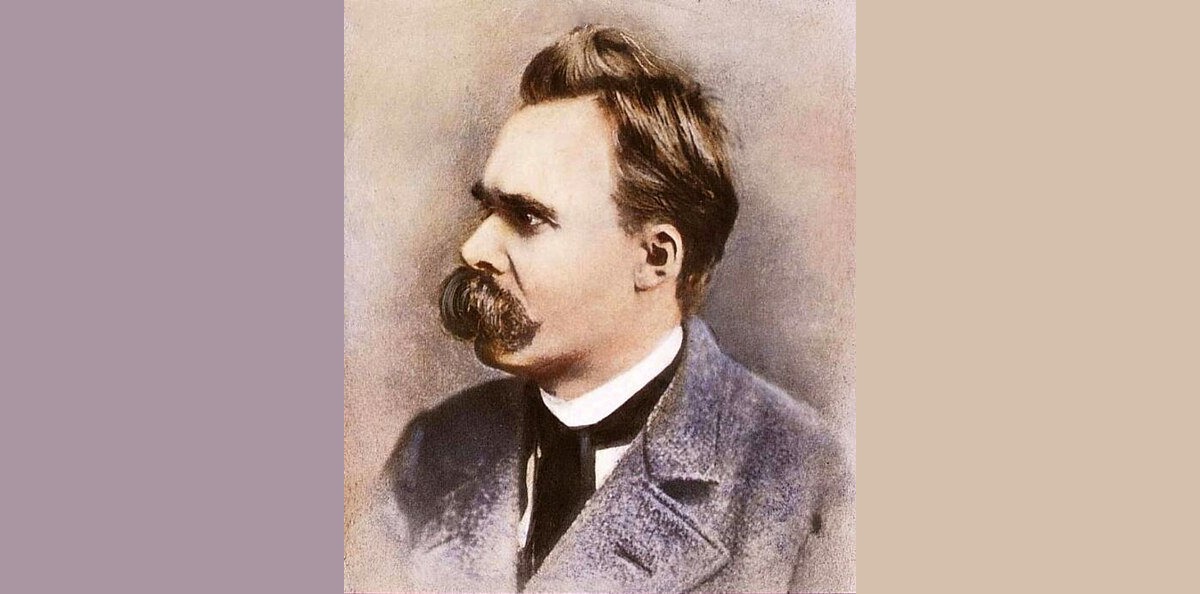
Friedrich Nietzsche

Born 1844.
Born 7 Generations Ago in 1844, lived until 1900.

30 Philosophers, Chapter 30: Nietzsche and Nihilism. 
Friedrich was born on October 15, 1844, on the 49th birthday of the Prussian King, after whom he was named. In 1869, at the age of 24, Nietzsche was appointed as a professor of classical philology at the University of Basel in Switzerland. The mustachioed-musician-philosopher Nietzsche shows us that his life was not solely confined to the rigor of intellectual quests; it also embraced the landscapes of creative artistry and a fervor for living a life well-lived.

Nietzsche was not asking everyone to throw away tradition merely because it was inherited. If you enjoy going to church every Sunday, if the rituals, people, and beliefs enrich your life, keep going. Those values may have started as your parents’ values, but that does not mean they cannot become authentically yours. His challenge is for the person quietly suffering beneath borrowed expectations. If the life handed to you feels false, empty, or unbearable, you have a responsibility to examine it. Keep what works. Challenge what does not. Then begin the difficult work of becoming.

This brings us to one of Nietzsche’s most powerful thought experiments: Eternal Recurrence. Imagine being told that you must live this exact life again and again, forever. The same joys, sorrows, routines, choices, and regrets. Would that news crush you, or would you embrace it? Nietzsche is not asking you to blow up a life you already love. He is asking you to notice the parts you would dread repeating. If something in your life makes eternity feel unbearable, change it. Live your life in a way you are willing to live forever.

Where Søren Kierkegaard taught us to take guidance from our angst—treating anxiety not as an illness but as a signal that demands a response—Nietzsche offers a different starting move. Kierkegaard’s anguish drives the leap of faith: a decision made when certainty runs out. Nietzsche, by contrast, urges us to first challenge inherited norms, traditions, and moral assumptions, clearing the ground so that any decision we make is truly our own.

For Nietzsche, the collapse of inherited meaning is not a tragedy but an opening. With “God dead,” humanity is no longer bound to borrowed values, inherited morals, or cultural scripts written by others. Meaning does not vanish—it changes hands. It becomes something we must create, through strength, intellectual honesty, and the difficult work of becoming rather than obeying.

This is why Nietzsche’s philosophy is not a descent into despair but a call to responsibility. If the old meanings have fallen, then living authentically means daring to create new ones—and having the courage to stand behind them. His challenge is simple, but demanding: before you leap, make sure the ground beneath you is truly yours.

— map / TST —

TST Tracker
✓ Reading recorded.
Michael Alan Prestwood
Author & Natural Philosopher
Prestwood writes on science-first philosophy, with particular attention to the convergence of disciplines. Drawing on his TST Framework, his work emphasizes rational inquiry grounded in empirical observation while engaging questions at the edges of established knowledge. With TouchstoneTruth positioned as a living touchstone, this work aims to contribute reliable, evolving analysis in an emerging AI era where the credibility of information is increasingly contested.
Email
Print
The Prestwood Column
Menu
August 2026
»COLUMN ARCHIVE
--COLUMN--
Column Research….
1. Timeline Story
Ethical Roadmap
2. Linked Quote
“The greatest weapon against stress is our ability to choose one thought over another.”
3. Science FAQ »
Did morality evolve?
4. Philosophy FAQ »
Is the Me Too movement consistent with TST Ethics?
5. Critical Thinking FAQ »
When should you stop following the crowd?
6. History FAQ!
What did the Nuremberg Trials clarify about moral agents?
Bonus Deep-Dive Article
TST Ethical Roadmap: A Process Model for Ethical Guidance and Moral Choice

Comments

Join the Conversation! Currently logged out.

Leave a Reply

NEW BOOK! NOW AVAILABLE!!

30 Philosophers: A New Look at Timeless Ideas

by Michael Alan Prestwood
The story of the history of our best ideas!
Scroll to Top