
Phil • Cr. Think • Science • Hist •

The Philosophy Website

FAQ

Is the universe infinite?

☐ Read
☑ Read
You’ve read this 0 times.
You’ve listened to this 0 times.
Sun 5 May 2024
Published 2 years ago.
Updated 3 weeks ago.
Related FAQs
What is the history behind quantum mechanics?
Can you explain the Big Freeze, Big Rip, and Big Crunch Ideas?
How many planets does our solar system have: 8, 9, or 13?
Is the Fermi Paradox still relevant?
Can humans breathe the air of other planets?
Trivia: How many moons does the solar system have: less than or more than 200?
Share :
Email
Print

Is the universe infinite?

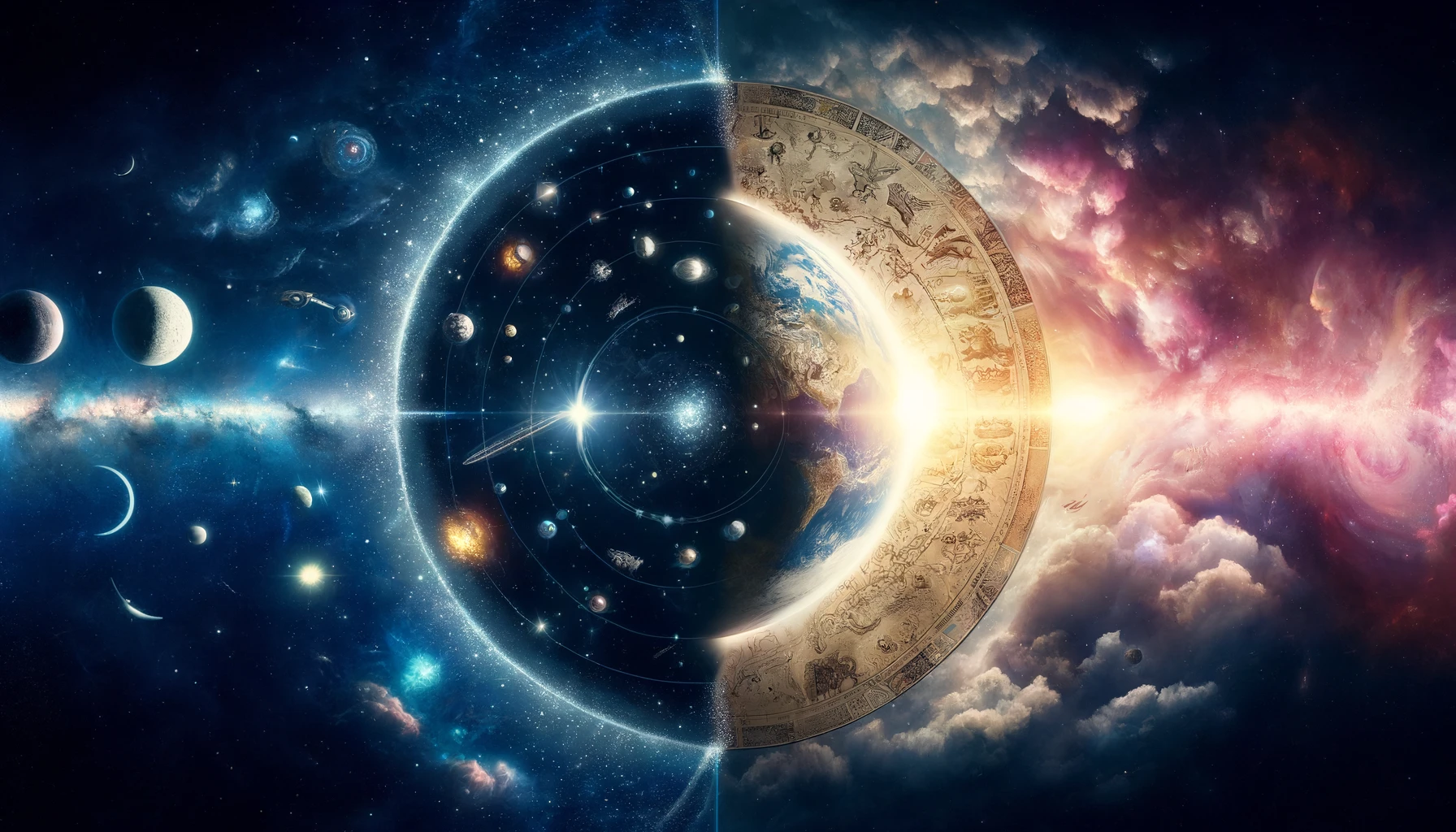
While we just don’t know, most physicists say no, especially if the Lambda model continues to hold up. If it were infinite and filled with galaxies and the universe is old enough for light to get here, then the night sky would be as bright as day time, but it’s not. This is summed up in what’s known as Olbers’ Paradox, which highlights the limitations in brightness and visibility due to the universe’s age and the speed of light. This also relates to whether the universe has a center in the conventional sense, and it appears to does not.

Reflecting on the concept of an infinite universe, it’s essential to consider the historical context of human understanding. Long before the recognition of Earth as a spherical planet, our ancestors perceived their world as a flat expanse that possibly stretched into infinity. The idea of the Earth having any sort of edge was beyond the realm of imagination for many. Today, we face a similar challenge in understanding the universe’s structure. Current theories suggest that the large-scale geometry of the universe might be curved, much like the Earth, but the full nature of this curvature and its implications remain elusive. Just as early explorers gradually pieced together the shape and limits of our planet through observation and exploration, we too continue to probe the cosmos, observing, exploring, and speculating with the tools and knowledge at our disposal. Our journey to understand the universe echoes the ancient journey to understand our Earth, reminding us that our perceptions of reality are often just the beginning of deeper discoveries.
— map / TST —

TST Tracker
✓ Reading recorded.
Deep-Dive Article: The Expanding Universe Explained
If the universe were infinite, eternally old, and uniformly filled with stars, the night sky would be bright everywhere. That it isn’t is captured by Heinrich Olbers’ insight known as Olbers’ Paradox. Expansion, finite age, and light-speed limits all point away from a naïvely infinite universe.
Michael Alan Prestwood
Author & Natural Philosopher
Prestwood writes on science-first philosophy, with particular attention to the convergence of disciplines. Drawing on his TST Framework, his work emphasizes rational inquiry grounded in empirical observation while engaging questions at the edges of established knowledge. With TouchstoneTruth positioned as a living touchstone, this work aims to contribute reliable, evolving analysis in an emerging AI era where the credibility of information is increasingly contested.
The Prestwood Column
Menu
August 2026
»COLUMN ARCHIVE
--COLUMN--
Column Research….
1. Timeline Story
Ethical Roadmap
2. Linked Quote
“The greatest weapon against stress is our ability to choose one thought over another.”
3. Science FAQ »
Did morality evolve?
4. Philosophy FAQ »
Is the Me Too movement consistent with TST Ethics?
5. Critical Thinking FAQ »
When should you stop following the crowd?
6. History FAQ!
What did the Nuremberg Trials clarify about moral agents?
Bonus Deep-Dive Article
TST Ethical Roadmap: A Process Model for Ethical Guidance and Moral Choice

Comments

Join the Conversation! Currently logged out.
NEW BOOK! NOW AVAILABLE!!

30 Philosophers: A New Look at Timeless Ideas

by Michael Alan Prestwood
The story of the history of our best ideas!
Scroll to Top