
Phil • Cr. Think • Science • Hist •
TST PRACTICE

The Philosophy Website

FAQ

How many planets does our solar system have: 8, 9, or 13?

☐ Read
☑ Read
You’ve read this 0 times.
You’ve listened to this 0 times.
Sun 26 May 2024
Published 2 years ago.
Updated 2 months ago.
Related FAQs
Does the Fermi paradox lack good thinking?
What is the farthest object in space?
Why hasn’t Voyager been damaged by space dust?
Did Copernicus prove that Earth moves around the Sun?
Share :
Email
Print

How many planets does our solar system have: 8, 9, or 13?

The solar system has 8 planets, not 9, because Pluto is classified as a dwarf planet, and we currently have 5 named dwarf planets for a total of 13. Let me explain.

Before Neil deGrasse Tyson, our personal astrophysicist, decided to “hate on” Pluto, we had 9 planets. That’s how many we had my whole life, and we were just waiting to see if the tenth, Planet X, would ever be spotted. Well, in 2006, in a fit of power, Neil independently decided Pluto was no longer a planet! Well, not really, but his fame as a great communicator did play a role, and he does get too much of the blame. What actually happened was that the International Astronomical Union (IAU), responsible for classifying celestial bodies, decided in 2006 to redefine the criteria for what constitutes a planet.

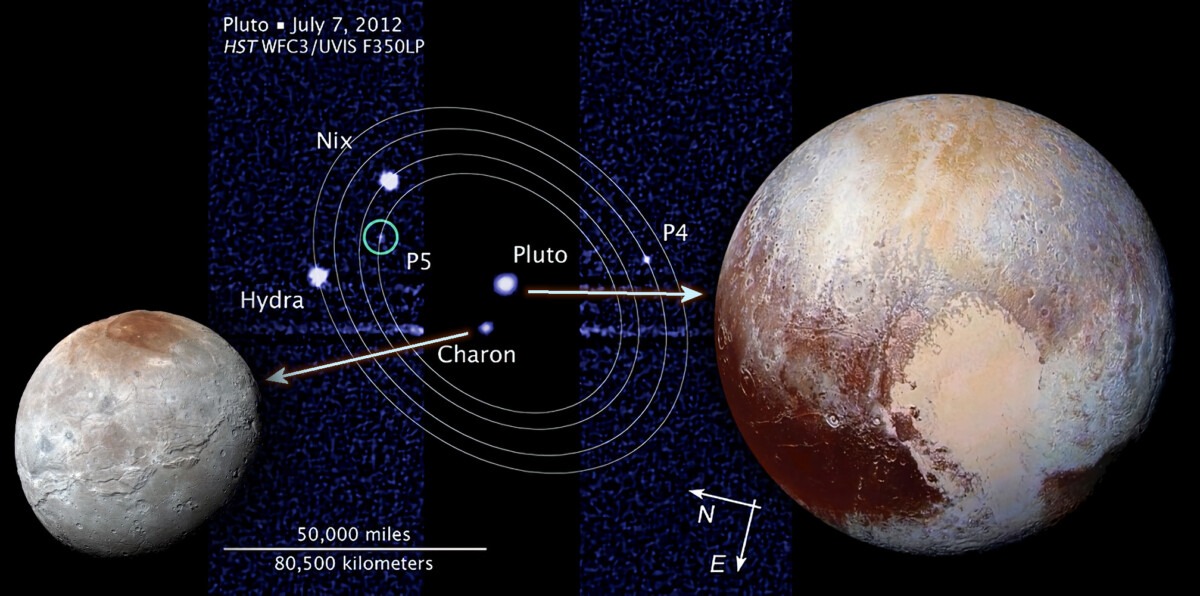
To be considered a planet, a celestial body must meet three criteria: it must orbit the Sun, be spherical due to its own gravity, and have cleared its orbit of other debris. Pluto meets the first two criteria but fails the third because it shares its orbit with other objects in the Kuiper Belt. Interestingly, Pluto actually has 5 moons! 

If the IAU didn’t reclassify Pluto, we’d likely be talking about 12 planets right now. In the years leading up to 2006, no less than three more planets were discovered: Haumea, Eris, and Makemake. Haumea even has two moons, and Eris and Makemake have one moon each. So, for the sake of a future trivia game, remember that we “currently” have 8 planets, and 4 dwarf planets in our solar system.
— map / TST —

TST Tracker
✓ Reading recorded.
Image: New Horizons captured Charon and Pluto in 2015. The background image was captured in 2012.
Michael Alan Prestwood
Author & Natural Philosopher
Prestwood writes on science-first philosophy, with particular attention to the convergence of disciplines. Drawing on his TST Framework, his work emphasizes rational inquiry grounded in empirical observation while engaging questions at the edges of established knowledge. With TouchstoneTruth positioned as a living touchstone, this work aims to contribute reliable, evolving analysis in an emerging AI era where the credibility of information is increasingly contested.
The Prestwood Column
Menu
August 2026
»COLUMN ARCHIVE
--COLUMN--
Column Research….
1. Timeline Story
Ethical Roadmap
2. Linked Quote
“The greatest weapon against stress is our ability to choose one thought over another.”
3. Science FAQ »
Did morality evolve?
4. Philosophy FAQ »
Is the Me Too movement consistent with TST Ethics?
5. Critical Thinking FAQ »
When should you stop following the crowd?
6. History FAQ!
What did the Nuremberg Trials clarify about moral agents?
Bonus Deep-Dive Article
TST Ethical Roadmap: A Process Model for Ethical Guidance and Moral Choice

Comments

Join the Conversation! Currently logged out.
NEW BOOK! NOW AVAILABLE!!

30 Philosophers: A New Look at Timeless Ideas

by Michael Alan Prestwood
The story of the history of our best ideas!
Scroll to Top