

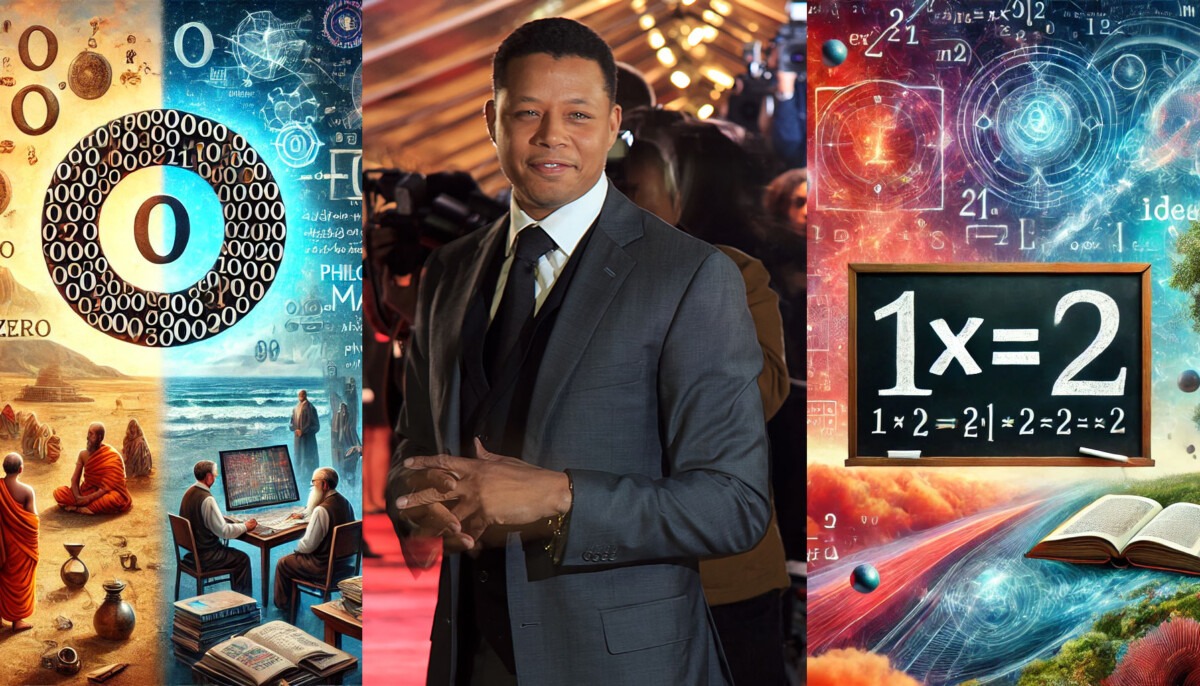
Terryology: Why traditional math holds firm.
In June 2024, I published two 1-minute hot topics addressing what Terrence Howard calls “Terryology.” As his public comments brought attention to questions about zero and multiplication, they also created an opportunity to apply something central to TST philosophy: Idea Evaluation.
The issues raised here are not fundamentally mathematical disputes. They are disputes about definitions, abstraction, and the relationship between rational constructs and the material world.
Let’s explore.
Terryology: An Overview
To evaluate an idea fairly, we must first present it clearly.
Terryology asserts that traditional mathematics is flawed. Howard claims that 1 × 1 should equal 2, arguing that multiplication must always increase value. He also dismisses zero, suggesting it represents metaphysical “nothingness,” which cannot exist — and therefore should not exist in mathematics.
He proposes that these corrections would revolutionize arithmetic and uncover deeper truths about the universe.
Innovation often begins with redefinition. So the first step in Idea Evaluation is not dismissal — it is examination.
The second step is calibration.
The Number Zero
Howard argues that zero cannot exist because “nothingness” cannot exist.
This is an ancient philosophical tension.
In 30 Philosophers, zero is treated as a narrative pivot — a conceptual breakthrough that reshaped human thought. Aristotle struggled with it. Ancient systems lacked it. Calendars still lack a year zero.
The absence of zero is first represented in the telling of the story of ancient Eastern philosophy using the earliest well-known female philosopher, Gargi Vachaknavi from around 800 BCE. The book tells the story of human thought from 2600 BCE to today and it’s true that the concept of zero is a strange concept.
Later, in chapter 9 which is set in time about 350 BCE, Aristotle is used to frame how the ancients thought about such topics.
“I think a key concept in how Aristotle approached life is demonstrated by his thoughts on zero and infinity. Aristotle was an empiricist, a “show me” guy. So, math concepts like zero and negative numbers just did not register with him—humanity had yet to define our modern concepts of them, sure, but beyond that he was pragmatic. And yes, he knew what “nothing” was, but it was a matter of logic, not mathematics. And he knew what it meant when one person owed another person two chickens, but that wasn’t a negative number in his world, it was a positive two chickens owed. When paid, the debt didn’t go to zero, the debt just went away.”
In a sense, Terryology is suggesting we return to thinking of zero as a logic problem, not a math one.
In the next chapter on skepticism, I talk about the use of zero as a placeholder pivot from positive to negative like this:
“Why didn’t we have a year zero, and why don’t we have one now? The short answer is we should. In our society, the concept of 0 is well understood, but it is indeed an odd concept – counting nothing as a step. It wasn’t common in Europe until around the 12th century, when it was introduced through the works of scholars who translated Arabic mathematical texts. The adoption of the Arabic numeral system, which included the concept of zero, eventually replaced the Roman numeral system. To be precise, the Roman numeral system today still does not have a character for zero. It was never added.
All calendars today still lack a zero year with the exception of the astronomical year numbering system, which includes a year 0 to facilitate calculations across the BCE divide.”
Later, in chapter 16, the story of the Islamic Golden Age is told. The story of how a few centuries earlier in India, circa the 5th century, the modern concept of zero was discovered. That part of the story is told like this:
“Imagine a world without zero: you show anyone three rocks and take two away, they know you now have one rock. You take that rock away and you have nothing. They know it, it’s not hard. Now let’s have an ancient mathematician keep track. The first calculation, “3-2=1″ is easy. But when you take the last rock away, they understand the absence, but to them it shifts to a logic problem. The rocks are no longer something of concern.”
A few paragraphs later I define it like this:
“Zero is both a number that represents the absence of quantity, and it is the point between positive and negative. It also serves as a placeholder in our numbering system, allowing us to distinguish between numbers like 10 and 100. It’s also a fulcrum around mathematical operations. It opened up the door for the development of negative numbers, which were scattered in some cultures but became coherent with the advent of zero. Before zero, number systems, and calendars, started at 1. If the number 0 had been available to the ancients, we would have the much-needed “year zero” in our calendars today. Zero opened the door to new realms of thought. It’s a poignant reminder that sometimes, the most transformative ideas are those that fill a void we didn’t even know was there.”
Zero is both a number that represents the absence of quantity, and it is the point between positive and negative. It also serves as a placeholder in our numbering system, allowing us to distinguish between numbers like 10 and 100…
Zero did not emerge because humans were confused. It emerged because abstraction matured.
TST makes a critical distinction here:
Metaphysical nothingness is a philosophical problem.
Numerical zero is a structural tool.
Zero does not claim that “nothing exists.” It encodes absence relative to a defined quantity.
If you remove a bowl from someone, they possess zero bowls. That does not mean reality vanished. It means the measurable quantity is absent.
The question is not whether zero is “physically real.”
The question is whether zero preserves coherence in arithmetic, algebra, measurement, and engineering.
It does.
Multiplication: 1 x 1=1 (not 2)
Howard claims that 1 × 1 should equal 2 because multiplication should always increase value.
Here we see the key philosophical issue: redefining a term based on intuition.
Speculation is the first step of innovation. Many breakthroughs begin by asking, “What if we’ve defined this wrong?”
But the second step is structural testing.
Multiplication is formally defined as scaling — applying a factor to a quantity.
Scaling can:
- Preserve magnitude (×1)
- Eliminate magnitude (×0)
- Reduce magnitude (×0.5)
- Increase magnitude (×2)
If 1 × 1 were 2, arithmetic collapses. Counting fails. Engineering equations fail. The distributive law fails. The system no longer aligns with the material world.
In TST terms, this is not a failure of creativity. It is a failure of calibration.
Fundamentally, there is a relationship between ideas and the world around us. In chapter 18 of my 30 Philosophers book, this relationship is introduced with the Idea of Ideas. In it, rational ideas about our empirical observations, is put like this:
“Take, for example, math and geometry: they provide frameworks to describe objects. Picture two rocks and two shells on a beach. You might recognize “equivalence,” a Rational Idea, between the two rocks and the two shells. If these items form a pattern resembling a square, the Rational Idea of “square” emerges. Similarly, if they form an “L,” an “L shape” becomes relevant.”
Later in the same chapter, the the realm of the possible is presented:
“The idea of equivalence in our mind is possible only because the physical universe can be configured in a way that brings meaning to the idea. The idea that two shells is equal to two rocks in number was around, and possible, long before humans saw equality. “
Our ideas stem from provable empirical data. While anyone can have an idea, it cannot ignore the empirical world we live in.
Howard’s error likely stems from a misunderstanding or misapplication of arithmetic operations and possibly a rigid personal-use of terminology. He insists words mean one thing when they actually have several meanings. While debunking Terryology is needed for the review process of science, it also reinforces the importance of adhering to established mathematical definitions and principles. By doing both questioning and reinforcing, we uphold the integrity of mathematical truths and ensure clear, accurate understanding of fundamental concepts.
The Deeper Issue: Idea Evaluation
Terryology is not primarily a mathematical challenge. It is a philosophical one.
The tension lies here:
- Can we redefine foundational terms?
- What happens after we do?
TST encourages bold ideas. It does not discourage speculation.
But speculation must pass three filters:
- Structural coherence (Does the system remain internally consistent?)
- Empirical alignment (Does it correspond with the material world?)
- Explanatory power (Does it clarify more than it obscures?)
When definitions are altered without preserving those three constraints, the result is not revolution — it is instability.
On Fame and Authority
Fame amplifies ideas. It does not validate them.
Appeals to authority, linguistic reframing, and semantic shifts can create the appearance of depth. But philosophy and science rely on disciplined evaluation, not rhetorical force.
The goal is not to dismiss unconventional thinking. The goal is to test it.
Terrence tends to use many logical fallacies in his attempts to persuade. While he employs the appeal to authority fallacy by using his fame and referencing historical figures like Pythagoras and Einstein, he primarily relies on what I categorize as linguistic trickery. Specifically, Howard’s arguments often hinge on redefining terms and using convoluted explanations to make his ideas appear more plausible than they are, distracting from the lack of empirical evidence and logical coherence.
How TST Evaluates Radical Redefinitions
Radical ideas are not dismissed. They are tested. When someone proposes redefining a foundational concept, TST applies a three-stage filter:
- Structural Coherence: Does the new definition preserve logical consistency across the system? Or does it create contradictions in arithmetic, algebra, geometry, or applied domains?
- Empirical Alignment: Do the results still correspond to measurable reality? Can the framework still model counting, scaling, engineering, or physics accurately?
- Explanatory Gain: Does the redefinition clarify more than it obscures? Does it increase predictive power? Or merely reframe language?
If the new idea passes these tests, it strengthens the system. If it fails, the original structure stands. TST welcomes speculation. It simply insists that speculation be calibrated.
Conclusion: Terryology as a Case Study in TST
Terryology is useful — not as mathematics, but as a teaching moment.
It illustrates:
- The difference between intuition and definition.
- The difference between metaphysical speculation and mathematical abstraction.
- The necessity of calibration between rational ideas and empirical structure.
Innovation begins with bold questioning.
It survives only when it aligns with reality.
That is not hostility to creativity.
It is respect for coherence.


2 thoughts on “Terrence Howard: Debunking Terryology”
Howard makes numerous errors. Many are linguistic. He relies on the meaning of words not relate to math and his intuitive senses which lead him to incorrect results.
One mis-statement is “an action times an action is a reaction” This is not a thing. He may have derived it from Newton’s third law, which is stated “for every action there is an equal and opposite reaction.
This is really about a balance of forces.
In a baloon, the pressure of the air pushing out is balanced by the baloon pressing in.
The baloon stays the same size because the forces are balanced.
The force of a boat moving forward is equal to the force of the water pushed backward by the propeller.
Howard has apparently taken some of the wording from Newton’s third law and created a new unproven concept related to math.
Well said. You raise an excellent point about the linguistic and conceptual errors, particularly Howard’s misinterpretation of Newton’s third law. Howard’s statement that “an action times an action is a reaction” appears to be a poetic reinterpretation presented as an academic idea. But lacking any scientific and mathematical foundation.