
Explore Science-first Philosophy

FAQ

What’s the minimum change needed to breathe air on Mars?

Wed 13 Nov 2024
Published 1 year ago.
Updated 2 weeks ago.
Related FAQs
Was King Shuruppak the father of Noah?
What does superposition tell us about metaphysics?
Did Berger and Luckmann really say reality is just made up?
Is Philo’s interpretation related to the split in the Idea of Ideas?
Who were the first Socratic philosophers?
What are holism and reductionism?
Share :
Email
Print

What’s the minimum change needed to breathe air on Mars?

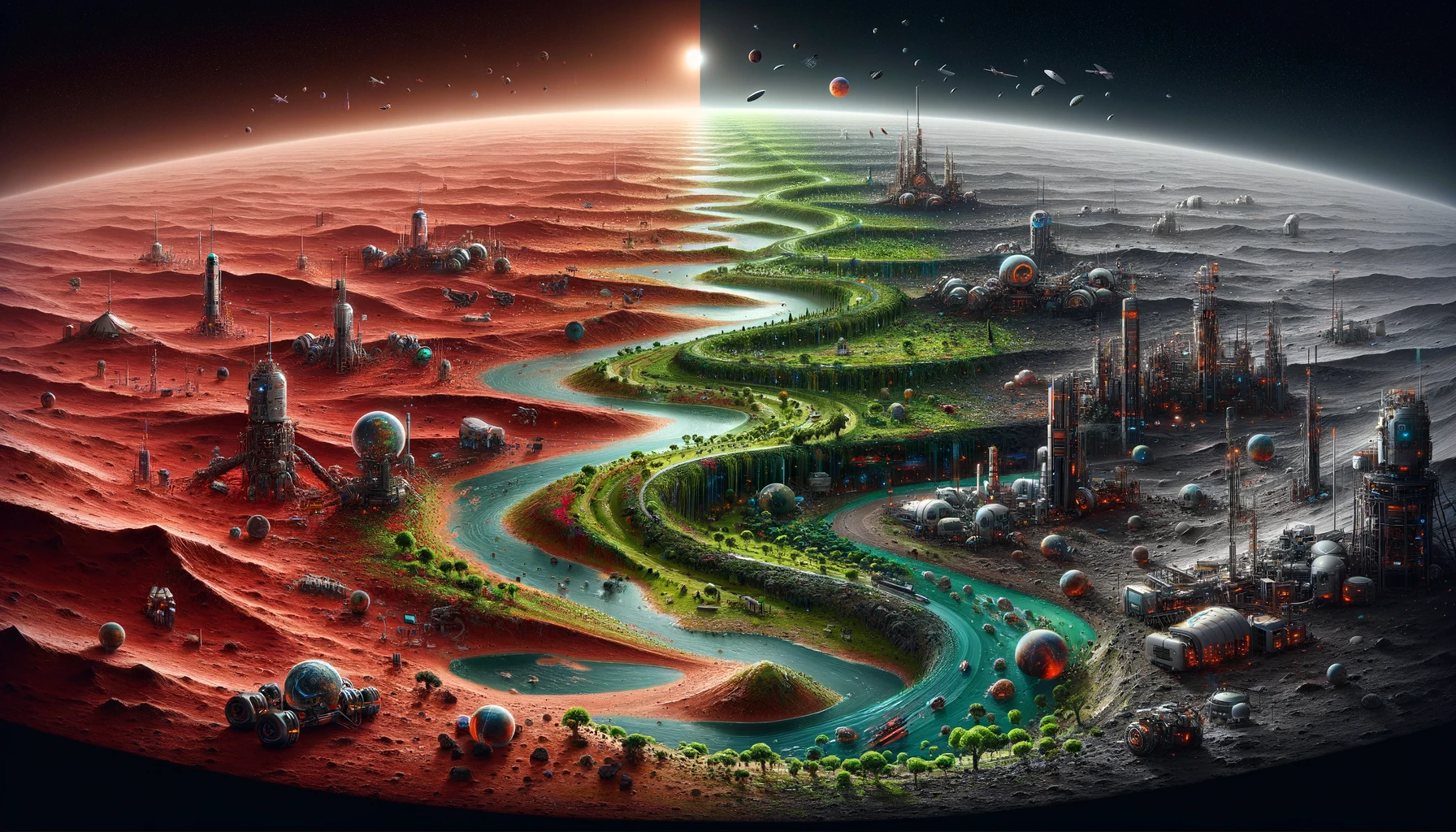
First, the direct answer: because air pressure is so low and gravity so weak on Mars, it’s a challenge but doable. We need to remove toxins from the air and increase the percent of oxygen. While Earth has a solid 21% oxygen, on Mars we’ll likely need a higher percent of oxygen due to the thinner air. So, the minimum needed is likely more than 21%, perhaps around 35%. To add atmosphere to Mars, there are two ways: we can add it externally or release it from Mars itself. The easiest way might be with plants that convert external Sun energy.

On Earth, we have 21% oxygen and 78% nitrogen, with a psi ranging from 14.7 at sea level to 7.93 at La Rinconada. People can acclimatize to these extremes well. On Mars, the air pressure on the ground is only 0.085 psi, which is 173 times thinner, and 95% carbon dioxide, which is toxic to us. The oxygen level is only 0.13%. The first step is to unlock the oxygen from the CO2, which both removes toxic carbon dioxide and increases oxygen. However, the biggest problem is the atmospheric pressure.

The gravity on Mars is only 38% that of Earth, meaning gases escape more easily. This means we’ll need to add an ozone layer and a magnetic field.

When we add atmosphere, we have to strive for above 21% oxygen with carbon dioxide levels below 1%. Over time, the Martian air might end up being something like 33% oxygen, 50% nitrogen, and 17% argon, giving it a slightly metallic scent. It might become common to say things like, “You like the smell of Earth, but I actually prefer Martian air.”
 

— map / TST —

Michael Alan Prestwood
Author & Natural Philosopher
Prestwood writes on science-first philosophy, with particular attention to the convergence of disciplines. Drawing on his TST Framework, his work emphasizes rational inquiry grounded in empirical observation while engaging questions at the edges of established knowledge. With TouchstoneTruth positioned as a living touchstone, this work aims to contribute reliable, evolving analysis in an emerging AI era where the credibility of information is increasingly contested.
This Week @ TST
April 15, 2026
»Column Archive
WWB Research….
1. Story of the Week
John Snow and the Broad Street Pump
2. Quote of the Week
“A wise man proportions his belief to the evidence.”
3. Science FAQ »
Were dinosaurs Jurassic movie smart?
4. Philosophy FAQ »
How does the idea of Identity in Christ fit within TST?
5. Critical Thinking FAQ »
What is the difference between Public Truth and Public Belief?
6. History FAQ!
Did Einstein’s driver really give one of his early talks?
Bonus Deep-Dive Article
TST Epistemic Calibration: Credence and Degrees of Belief

Comments

Join the Conversation! Currently logged out.
NEW BOOK! NOW AVAILABLE!!

30 Philosophers: A New Look at Timeless Ideas

by Michael Alan Prestwood
The story of the history of our best ideas!
Scroll to Top