
Phil • Cr. Think • Science • Hist • …
TST PRACTICE

By Philosopher Michael Alan Prestwood

FAQ

Can AI be a moral agent?

☐ Read
☑ Read
You’ve read this 0 times.
You’ve listened to this 0 times.
Sun 8 Nov 2026
Published 1 hour ago.
Updated 35 minutes ago.
Related FAQs
How does TST handle the Gettier-Type counterexamples?
Why does awareness increase moral responsibility?
Can the Venus Flytrap count?
How did writing first evolve?
Can science prove flourishing should be our goal?
Can our perception of size and scale be trusted?
Share :
Email
Print

Can AI be a moral agent?

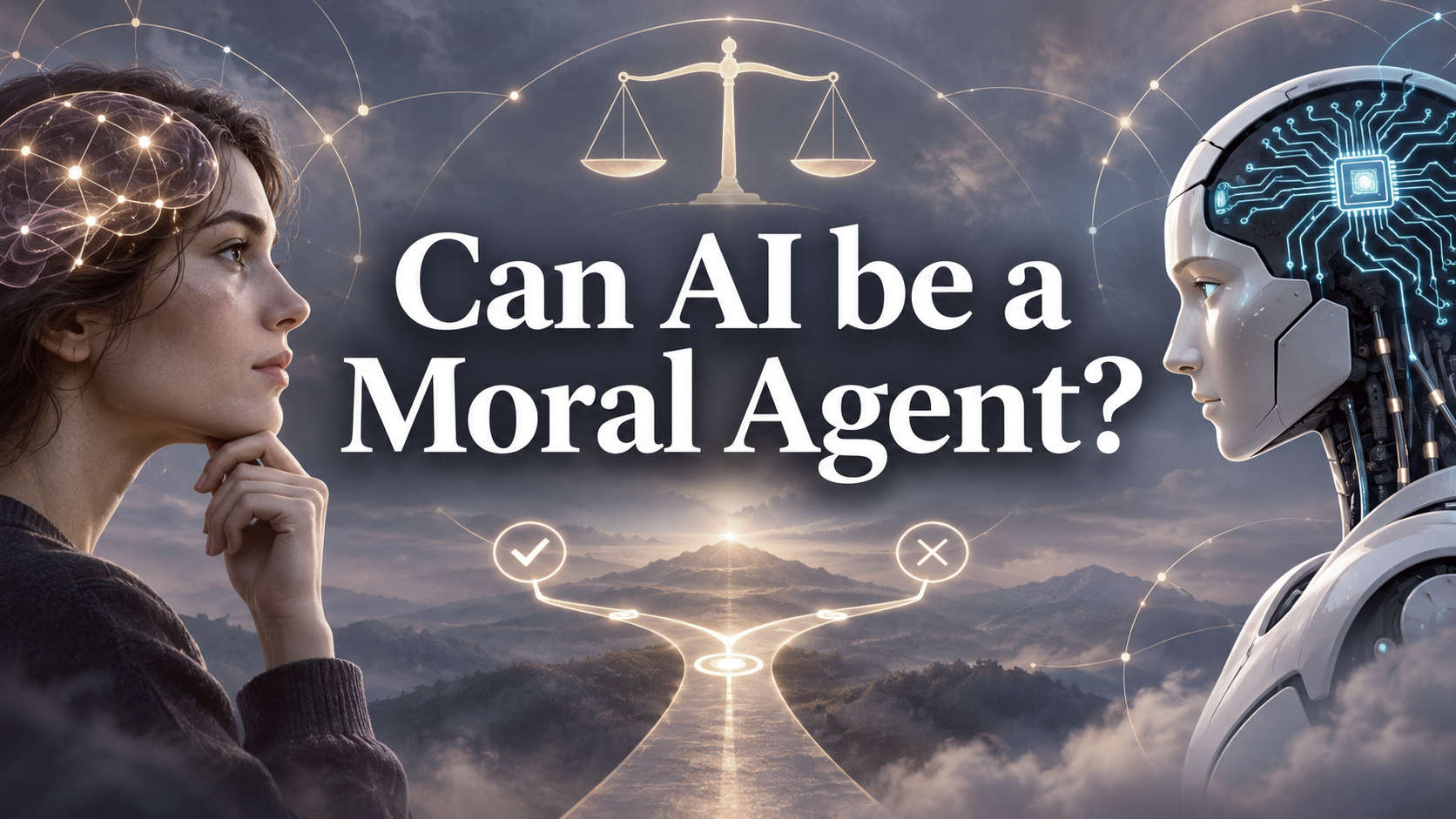
Absolutely, AI minds can be moral agents. But the nuance depends on programming: the source of nature for AI. Nature is where morality is born. Moral agents are minds capable of understanding right and wrong and being responsible for their choices. To me, the central question is when a mind’s nature rises to the level of complex moral agency. The ability to define and follow an ethical roadmap.

Moral agency is not about being human or even biological. It’s about the cognitive. Minds remember the past, experience the present, and anticipate the future. And cognitive ability varies enormously by species. A tiger has its nature, just as humans do. A tiger can learn and make decisions, but it lacks complex moral cognition. We judge tiger actions differently. We also judge a child’s mind differently because human moral cognition develops over time. We judge people with cognitive limitations differently too.

So, what cognitive abilities make a moral agent? It’s the capacity of a mind to understand and evaluate morally relevant considerations, use them to guide choices, and revise its behavior in light of reasons and consequences. Such a mind can define and follow an ethical roadmap.

However, an AI programmed to follow fixed instructions that produces harmful outcomes is not the moral agent. The responsibility shifts to the programmers. An AI mind with complex moral agency is different. It is capable of defining and following a roadmap and can be judged against it. And future adjustments do not require the ability to change its underlying programming, just as we do not require DNA changes. It’s about capacity. The capacity to evaluate and adjust actions.

Moral agency is about cognitive capacity. Moral responsibility is about how that capacity is exercised.
— map / TST —

TST Tracker
✓ Reading recorded.
A wise mind understands that the nature of a mind determines what it is capable of. Each animal species has its own nature. An AI mind's nature comes from its code and training. Moral agency emerges when a mind's capabilities include complex moral cognition: the capacity to understand, evaluate, and follow an ethical roadmap.
Michael Alan Prestwood
Natural Philosopher & Author
Prestwood explores science-first philosophy, with particular attention to the convergence of disciplines. Drawing on his TST Philosophy, his work emphasizes rational inquiry grounded in empirical observation while engaging questions at the edges of established knowledge. With TouchstoneTruth positioned as a living touchstone, this work aims to contribute reliable, evolving analysis in an emerging AI era where the credibility of information is increasingly contested.
The Prestwood Column
Menu
November 2026
Column Research….
1. Timeline Story
Fear-Based Ethics
2. Linked Quote
“A person is a person through other persons; you can’t be human in isolation; you are human only in relationships.”
3. Science FAQ »
Why do complex systems fail when proportionality is removed?
4. Philosophy FAQ »
How does TST Ethics handle the trolley problem?
5. Critical Thinking FAQ »
Why do people confuse rule-following with moral reasoning?
6. History FAQ!
How are original Daoism, Mohism, Confucianism, and Legalism related?
Bonus Deep-Dive Article
TST Moral Calibration: Legal, Moral, and Fair

Comments

Join the Conversation! Currently logged out.
NEW BOOK! NOW AVAILABLE!!

30 Philosophers: A New Look at Timeless Ideas

by Michael Alan Prestwood
The story of the history of our best ideas!
Scroll to Top