
Explore Natural Philosophy

Phil • Cr. Think • Science • Hist •

FAQ

Did a Canadian discover the Big Bang’s afterglow 25 years early?

Thu 6 Aug 2026
Published 4 hours ago.
Updated 2 months ago.
Related FAQs
How do I know what is true and what is just an opinion?
Who is famous for questioning cause and effect?
Who is the father of numerology?
Did Einstein’s driver really give one of his early talks?
What is Deception Research?
Why do we rely on authority figures for information?
Share :
Email
Print

Did a Canadian discover the Big Bang’s afterglow 25 years early?

Yes—but he didn’t know it.

Here’s that story.

In 1941, Canadian astronomer Andrew McKellar made a strange discovery. Studying the light from interstellar gas—specifically cyanogen molecules—he calculated that this cold material was absorbing energy as if bathed in radiation just 2.3 degrees above absolute zero.

That number should sound familiar: the modern measurement of the cosmic microwave background (CMB) is 2.725 K.

In other words, McKellar heard the whisper of the Big Bang—but didn’t know what he was hearing. The idea of a hot, expanding universe was still fringe. Lemaître had floated the “primeval atom,” but few paid attention. So McKellar noted the oddity, published it quietly, and moved on.

Fast forward to 1965.

At Bell Labs, radio engineers Arno Penzias and Robert Wilson were just trying to get rid of a mysterious hiss in their antenna. They cleaned it. Rewired it. Even cleared out the pigeons. But the hiss stayed. Eventually, they connected with a team at Princeton—Robert Dicke’s group—who were looking for the Big Bang’s afterglow.

And just like that, the cosmic whisper became a cosmic shout.

Here’s the twist: Penzias and Wilson won the Nobel Prize in 1978. McKellar got nothing. Even though his data had already measured the universe’s background radiation, he didn’t know what it meant—and no one else connected the dots.

He was one insight—one conversation—away from a Nobel.

And that’s the real lesson. Science isn’t just about seeing something strange. It’s about seeing it and knowing what it means.

Science does not always begin the same way. Sometimes it begins with a a new way to imagine reality. Other times, it begins with a new observation: a number that does not fit, a signal that will not go away, a whisper in the data. Scientific progress happens when the two finally meet.
— map / TST —

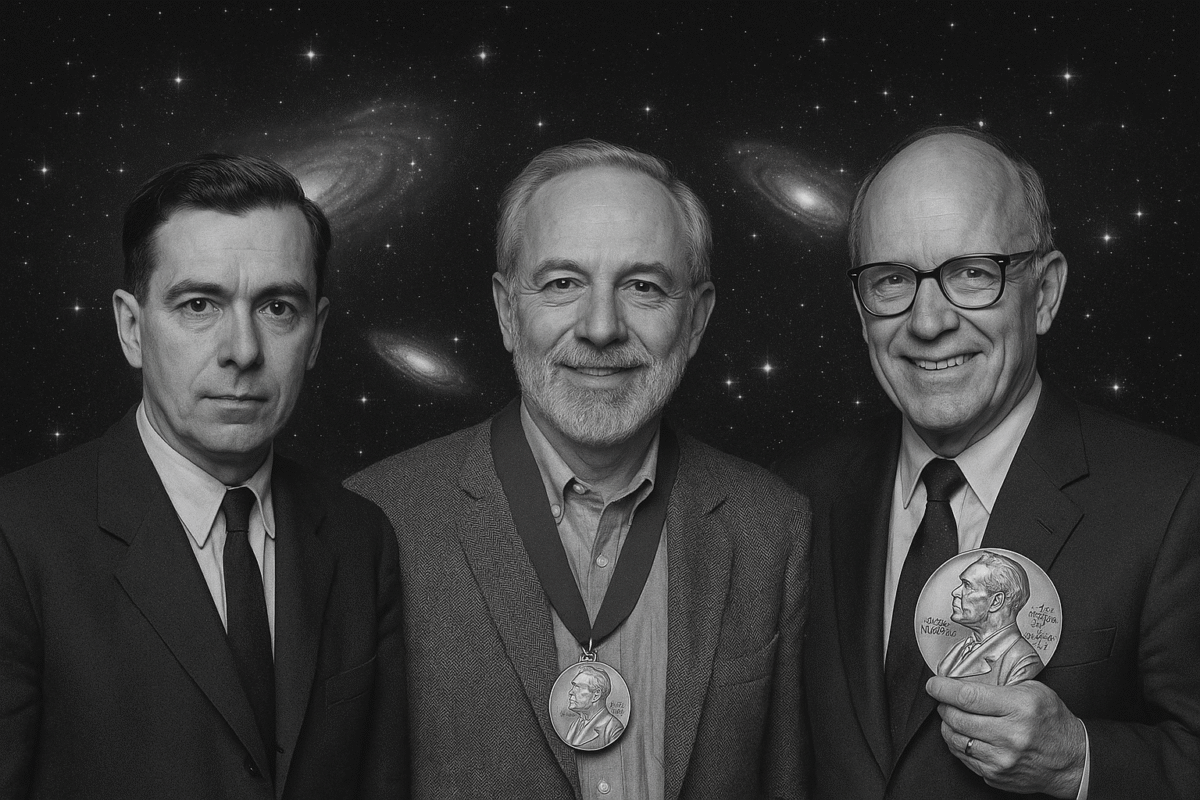
Andrew McKellar (1910–1960) was a Canadian astrophysicist. Arno Penzias (b. 1933, Germany → USA) and Robert Wilson (b. 1936, USA).
Michael Alan Prestwood
Author & Natural Philosopher
Prestwood writes on science-first philosophy, with particular attention to the convergence of disciplines. Drawing on his TST Framework, his work emphasizes rational inquiry grounded in empirical observation while engaging questions at the edges of established knowledge. With TouchstoneTruth positioned as a living touchstone, this work aims to contribute reliable, evolving analysis in an emerging AI era where the credibility of information is increasingly contested.
The Prestwood Column
Menu
August 2026
»COLUMN ARCHIVE
--COLUMN--
Column Research….
1. Timeline Story
Ethical Roadmap
2. Linked Quote
“The greatest weapon against stress is our ability to choose one thought over another.”
3. Science FAQ »
Did morality evolve?
4. Philosophy FAQ »
Is the Me Too movement consistent with TST Ethics?
5. Critical Thinking FAQ »
When should you stop following the crowd?
6. History FAQ!
What did the Nuremberg Trials clarify about moral agents?
Bonus Deep-Dive Article
TST Ethical Roadmap: A Process Model for Ethical Guidance and Moral Choice

Comments

Join the Conversation! Currently logged out.
NEW BOOK! NOW AVAILABLE!!

30 Philosophers: A New Look at Timeless Ideas

by Michael Alan Prestwood
The story of the history of our best ideas!
Scroll to Top