
Phil • Cr. Think • Science • Hist • …
TST PRACTICE

By Philosopher Michael Alan Prestwood

FAQ

OVM Viewpoints

☐ Read
☑ Read
You’ve read this 0 times.
You’ve listened to this 0 times.
Sun 25 Oct 2026
Published 18 minutes ago.
Updated 23 seconds ago.
Related FAQs
What is a straw man fallacy and how can I avoid it?
Is history a Truth Hammer?
Why is “inductive” reasoning not as reliable as deductive?
Does antimatter travel backward?
When should you stop following the crowd?
How is TST Theory of Truth different than verisimilitude?
Share :
Email
Print

OVM Viewpoints

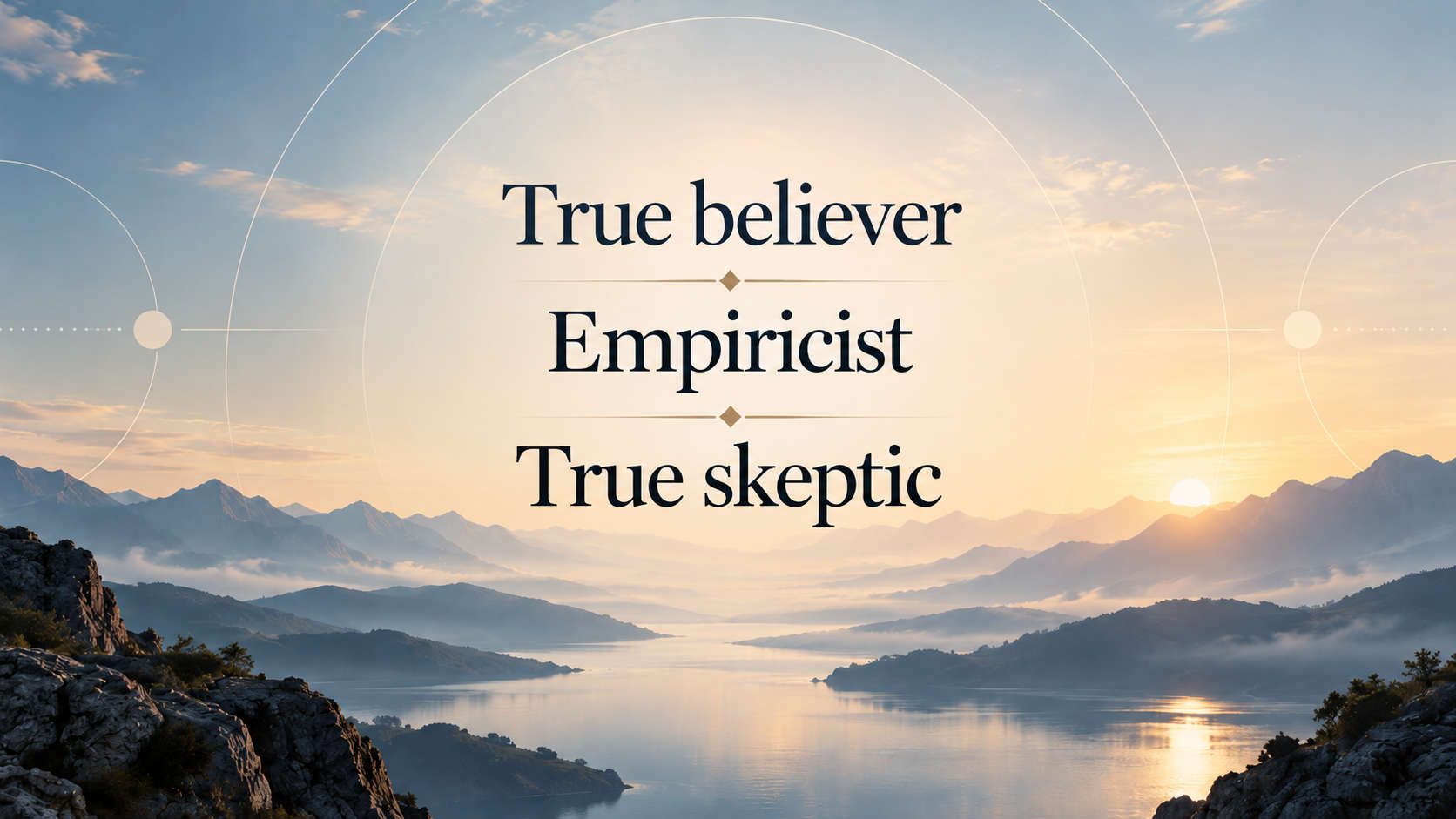
The three OVM Viewpoints are defined thinking tools used to understand belief, evidence, and doubt: true believer, empiricist, and true skeptic.

In ordinary usage, the term viewpoint often overlaps with perspective or even lens, but not in TST. In TST, a viewpoint is a thinking position available for any mind to consider, a perspective is the position of a mind on a specific topic, and a lens is an available worldview approach to things like truth, belief, and ethics.

OVM Viewpoints is a specific TST term.

The Open Viewpoint Method uses three viewpoints to explore steelman arguments of a topic. The True Believer viewpoint represents the strongest available argument in favor of a topic. The Empiricist viewpoint represents the evidence-based inquiry where science and reason are put above all else. The True Skeptic viewpoint represents the strongest available argument against a topic. These are not labels for entire people. They are tools for exploring how an idea looks from different positions. Take evolution. If you believe evolution, before engaging with a creationist, or better yet, to evaluate the strongest points against evolution, you steelman either an argument against evolution or an argument for creationism; or both. And vice versa, if you are a creationist who has not looked honestly at evolution, create the best steelman argument you can for evolution, open your mind, and evaluate each point.

By examining at least the opposing view of your own, you can better understand disagreements, avoid rigid thinking, and evaluate ideas without confusing a person’s beliefs with the whole person.
— map / TST —

TST Tracker
✓ Reading recorded.
Thinking well means learning to see an idea from more than one viewpoint. OVM's True Believer, Empiricist, and True Skeptic viewpoints help you explore topics. The surface evidence, conviction, and doubt. By considering at least two of the three, you can challenge your own perspective and raise your dialogue with others to something more productive than yelling.
Michael Alan Prestwood
Natural Philosopher & Author
Prestwood explores science-first philosophy, with particular attention to the convergence of disciplines. Drawing on his TST Philosophy, his work emphasizes rational inquiry grounded in empirical observation while engaging questions at the edges of established knowledge. With TouchstoneTruth positioned as a living touchstone, this work aims to contribute reliable, evolving analysis in an emerging AI era where the credibility of information is increasingly contested.
The Prestwood Column
Menu
October 2026
Column Research….
1. Timeline Story
The Great Quaker Debates!
2. Linked Quote
“All men are prone to differ. It is no new thing in all former ages, in all parts. Each party is most right in his own eyes.”
3. Science FAQ »
Do facts actually change minds?
4. Philosophy FAQ »
When does persuasion become manipulation?
5. Critical Thinking FAQ »
How can you tell when a debate has stopped being productive?
6. History FAQ!
What is the history of debate?
Bonus Deep-Dive Article
Roger Williams Biography and Dedication to the Freedom of Conscience

Comments

Join the Conversation! Currently logged out.
NEW BOOK! NOW AVAILABLE!!

30 Philosophers: A New Look at Timeless Ideas

by Michael Alan Prestwood
The story of the history of our best ideas!
Scroll to Top