
Phil • Cr. Think • Science • Hist • …
TST PRACTICE

By Philosopher Michael Alan Prestwood

STORY

Albert Einstein (1879 to 1955)

☐ Read
☑ Read
You’ve read this 0 times.
You’ve listened to this 0 times.

By Michael Alan Prestwood

Sat 2 May 2026
Published 5 months ago.
Updated 5 months ago.
Related Stories
Book: Christenings Make Not Christians
Max Planck
Doppler Effect for Sound and Light
R.W. Registers at Pembroke College
The First Providence Government
Bartholomew Legate Burned at the Stake
Share :
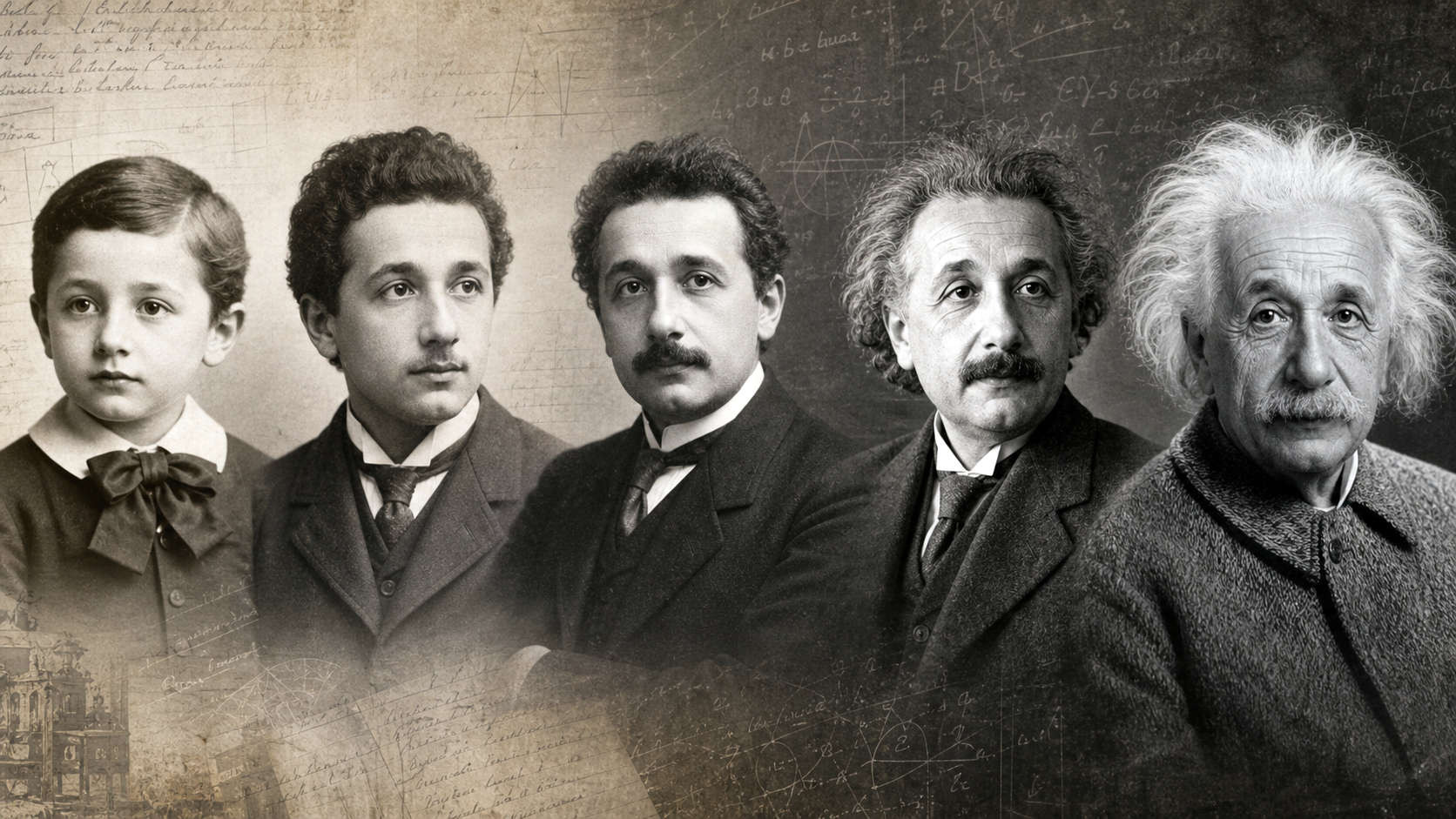
Albert Einstein (1879–1955) was born in Ulm, Germany, and died in Princeton, New Jersey, at age 76. He married Mileva Marić in 1903; they had three children: Lieserl, whose fate is uncertain, Hans Albert, and Eduard. After their divorce in 1919, Einstein married Elsa Löwenthal, who died in 1936. Einstein died on April 18, 1955, survived by his sons Hans Albert and Eduard, his stepdaughter Margot, and a legacy that still bends how we see reality.

Albert Einstein (1879 to 1955)

born 1879
Lived 1879 to 1955, aged 76.

Albert Einstein was born in 1879 in Ulm, Germany. As a child, he was curious, independent, and not especially impressed by rigid schooling. Meaning, he did not always do well in school. He loved puzzles, music, and thought experiments—the kind of questions you can carry around in your mind for years. After studying physics in Switzerland, he struggled to find an academic post and took a job as a patent clerk in Bern. That quiet job gave him time to think. In 1905, still outside the university world, he published the papers that would change physics.

His rise was remarkable. In that one year, Einstein explained the photoelectric effect, helped prove atoms were real through Brownian motion, introduced special relativity, and gave us the famous relationship between mass and energy: E = mc². Before long, the unknown patent clerk became one of the most important scientists in Europe. In 1921, he received the Nobel Prize in Physics, not for relativity, but for explaining the photoelectric effect—work that helped open the door to quantum physics.

Einstein’s greatest achievement came with general relativity. In 1915, he reframed gravity itself. It was no longer just a force pulling objects together, but the curvature of spacetime guiding how things move. That idea transformed cosmology and gave us a new way to understand the universe. His work also helped shape modern particle physics and quantum theory, even though he later resisted some of its stranger implications. Still, his early insights helped launch the age of photons, quanta, atoms, and the deeper structure of matter.

In 1933, Einstein left Europe as the Nazis rose to power and settled in the United States. He spent his final decades at Princeton, famous not only as a scientist but as a public intellectual, humanitarian, and moral voice. Yet scientifically, he became increasingly isolated. He searched for a unified theory that could bring gravity and electromagnetism into one grand framework, but he never found it. Even so, the quest fit the man. Einstein spent his life looking for the deeper unity beneath the surface of reality.

— map / TST —

TST Tracker
✓ Reading recorded.
Michael Alan Prestwood
Author & Natural Philosopher
Prestwood writes on science-first philosophy, with particular attention to the convergence of disciplines. Drawing on his TST Framework, his work emphasizes rational inquiry grounded in empirical observation while engaging questions at the edges of established knowledge. With TouchstoneTruth positioned as a living touchstone, this work aims to contribute reliable, evolving analysis in an emerging AI era where the credibility of information is increasingly contested.
Email
Print
The Prestwood Column
Menu
October 2026
Column Research….
1. Timeline Story
The Great Quaker Debates!
2. Linked Quote
“All men are prone to differ. It is no new thing in all former ages, in all parts. Each party is most right in his own eyes.”
3. Science FAQ »
Do facts actually change minds?
4. Philosophy FAQ »
When does persuasion become manipulation?
5. Critical Thinking FAQ »
How can you tell when a debate has stopped being productive?
6. History FAQ!
What is the history of debate?
Bonus Deep-Dive Article
Roger Williams Biography and Dedication to the Freedom of Conscience

Comments

Join the Conversation! Currently logged out.

NEW BOOK! NOW AVAILABLE!!

30 Philosophers: A New Look at Timeless Ideas

by Michael Alan Prestwood
The story of the history of our best ideas!
Scroll to Top