
Phil • Cr. Think • Science • Hist •

Explore Natural Philosophy

STORY

Rudolf Steiner

By Michael Alan Prestwood

Thu 4 Jun 2026
Published 2 months ago.
Updated 3 months ago.
Related Stories
Agnosticism
Gautama Buddha
Self & Non-Self; Atman & Anatman
Sunghir Burial Site
David Hume
Angkor Wat
Share :
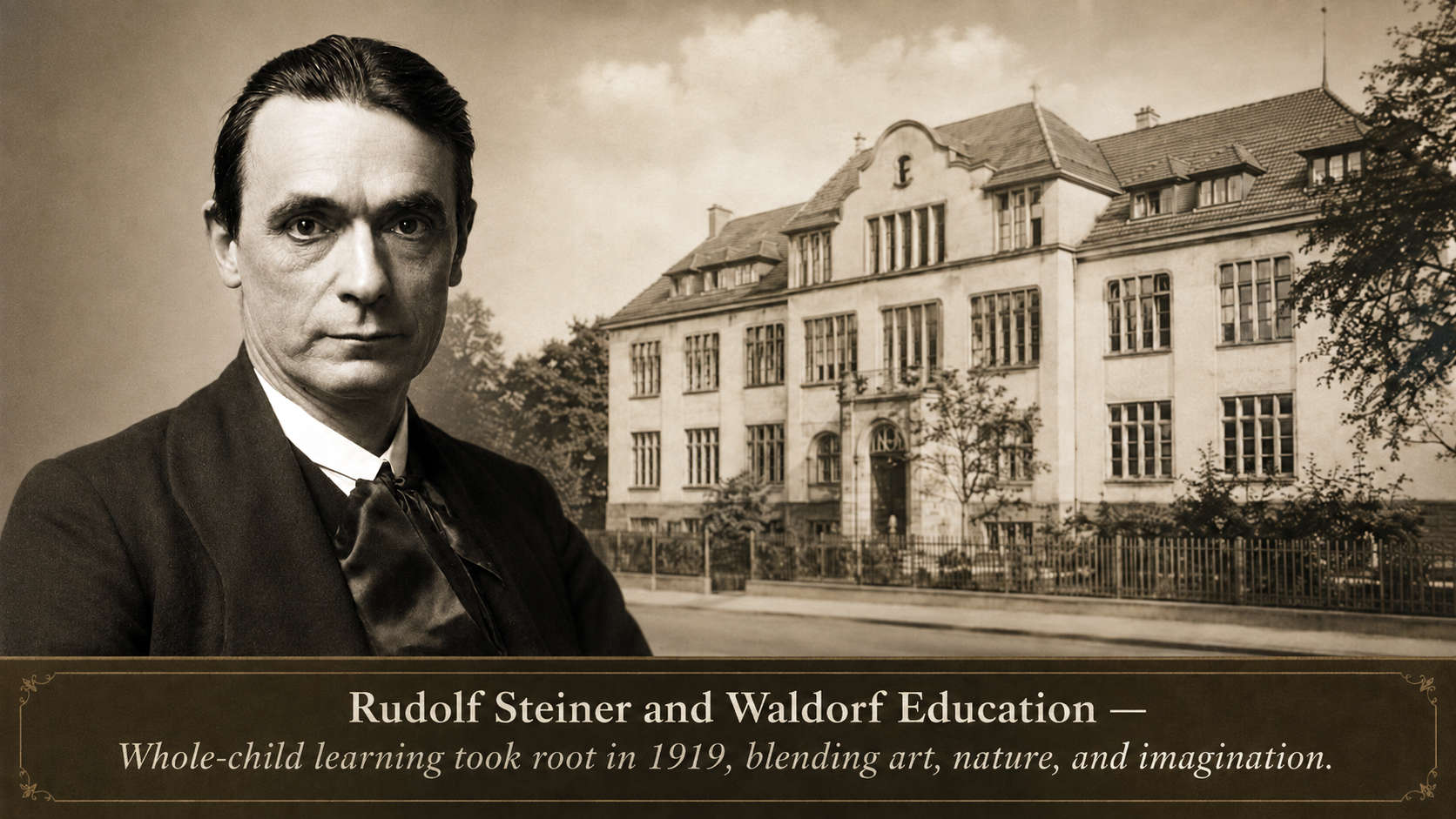
Waldorf education carries both Steiner’s gift and his complication. The gift: children are whole beings who need art, nature, story, movement, and wonder. The complication: anthroposophy adds spiritual claims that must be held carefully, not mistaken for science.

Rudolf Steiner

Lived from 1861 to 1925, aged 64.
Anthroposophy and Spiritual Science

Steiner was born in 1861, at a time when science was rising, religion was wobbling, psychology was emerging, and many were looking to keep meaning alive. Into that moment stepped Steiner: philosopher, lecturer,  and spiritual thinker. As the founder of anthroposophy, his influence founded Waldorf education, biodynamic agriculture, and influenced architecture, medicine, and theater. His spiritual philosophy was not merely a mystic hiding from the modern world. He was trying to answer a modern crisis: how can human beings live with science and still feel spiritually whole?

At his best, Steiner’s spirituality was an attempt to treat the human being as more than a machine. He wanted education to nourish the whole child. He wanted farming to respect the living system. He wanted art, movement, and imagination to influence human development. From my view, that impulse is reasonable and even valuable. Humans do not live by data alone. We also live through meaning, ritual, and wonder. Steiner’s gift was seeing that modern life could become spiritually thin if it reduced everything to mechanism.

But we must place Steiner carefully. We can place his ethical, educational, artistic, and ecological ideas as rational frameworks. But his stronger claims about spiritual worlds, clairvoyant knowledge, cosmic forces, and “spiritual science” remain speculative. Don’t reject Steiner, just sort his ideas. His grounded insights support flourishing, but his unverifiable claims must not be promoted into public truth.

Rudolf Steiner was born in 1861, in the Austrian Empire, now Croatia. He studied in Vienna, worked as a writer, editor, lecturer, and Goethe scholar (holistic knowing). He later became a major figure in the Theosophical movement before founding the Anthroposophical Society. He married twice, but had no kids. Steiner died in 1925, in Switzerland, at age 64.

— map / TST —

Michael Alan Prestwood
Author & Natural Philosopher
Prestwood writes on science-first philosophy, with particular attention to the convergence of disciplines. Drawing on his TST Framework, his work emphasizes rational inquiry grounded in empirical observation while engaging questions at the edges of established knowledge. With TouchstoneTruth positioned as a living touchstone, this work aims to contribute reliable, evolving analysis in an emerging AI era where the credibility of information is increasingly contested.
Email
Print
The Prestwood Column
Menu
August 2026
»COLUMN ARCHIVE
--COLUMN--
Column Research….
1. Timeline Story
Ethical Roadmap
2. Linked Quote
“The greatest weapon against stress is our ability to choose one thought over another.”
3. Science FAQ »
Did morality evolve?
4. Philosophy FAQ »
Is the Me Too movement consistent with TST Ethics?
5. Critical Thinking FAQ »
When should you stop following the crowd?
6. History FAQ!
What did the Nuremberg Trials clarify about moral agents?
Bonus Deep-Dive Article
TST Ethical Roadmap: A Process Model for Ethical Guidance and Moral Choice

Comments

Join the Conversation! Currently logged out.

Leave a Reply

NEW BOOK! NOW AVAILABLE!!

30 Philosophers: A New Look at Timeless Ideas

by Michael Alan Prestwood
The story of the history of our best ideas!
Scroll to Top