

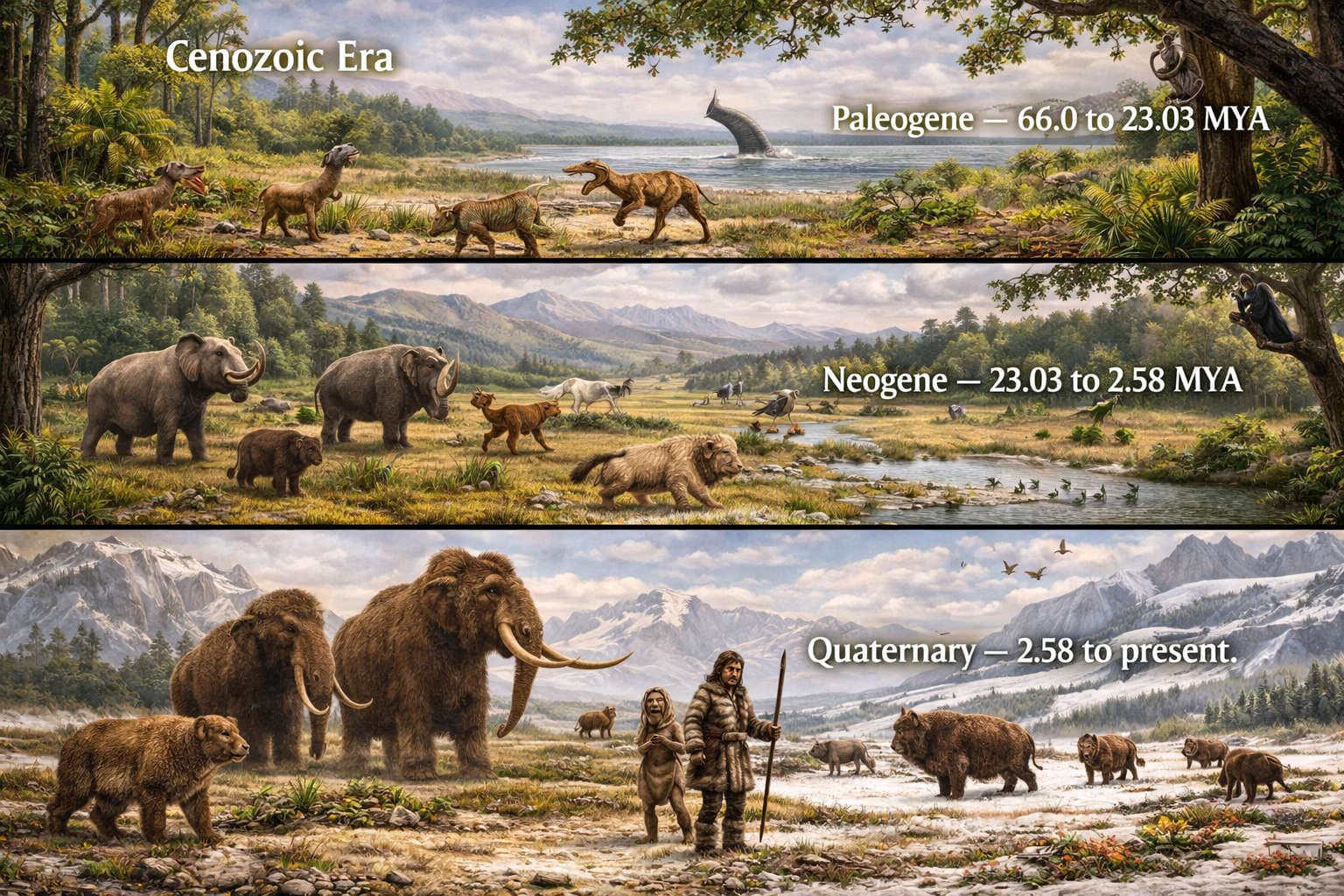
The Cenozoic Era begins 66 million years ago, at the Cretaceous-Paleogene boundary, after one of the most famous mass extinctions in Earth history. This event wiped out the non-avian dinosaurs, the flying pterosaurs, many marine reptiles, and roughly 75 to 80 percent of all species. What followed was not just the end of the dinosaur-dominated world, but the opening of a new age. So when we mark the start of the Cenozoic, we are looking at both a formal rock boundary and a dramatic biological turning point that cleared the stage for the modern world.
Life during the Cenozoic is why it is often called the Age of Mammals, but like the Mesozoic, the label only tells part of the story. Mammals diversified into an astonishing range of forms on land, in the sea, and even in the air, while birds also expanded into many modern roles. Flowering plants spread widely, grasslands became increasingly important, insects continued their deep partnership with plants, and many of the ecosystems we would recognize today gradually emerged. In many ways, this is the era in which Earth becomes fully modern in its living cast.
To frame its 66 million years, it helps to think of the Cenozoic in three broad acts. First comes the Paleogene, when the world recovers from the dinosaur extinction and mammals, birds, and flowering-plant ecosystems expand rapidly. Then comes the Neogene, when grasslands spread, climates continue cooling, and many familiar mammal groups, including apes, become more prominent. Finally comes the Quaternary, the age of repeated ice ages, large mammals, and eventually humans. These three periods—Paleogene, Neogene, and Quaternary—give the Cenozoic its rhythm: recovery, expansion, and the rise of the modern world.
Unlike the Paleozoic and Mesozoic, the Cenozoic does not end with a mass extinction boundary in the geologic timescale because it is our current era. Its “end” is the present. That makes it a little different in tone from the earlier eras. We are still living inside its story: a world shaped by cooling climates, ice ages, modern continents, modern ecosystems, and, very late in the era, human beings. So the Cenozoic begins with the fall of the non-avian dinosaurs and continues into the living world around us now.
