

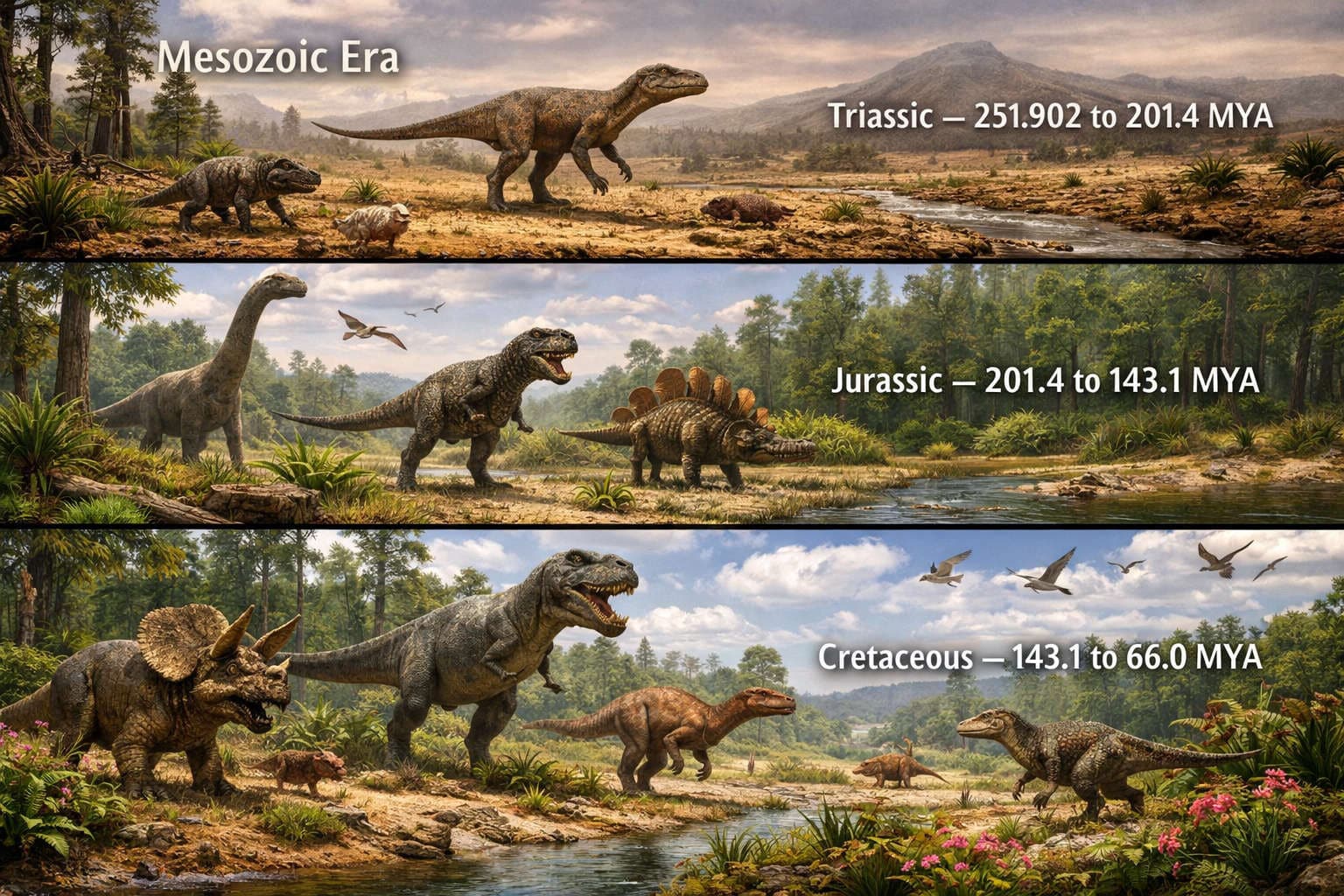
The Mesozoic Era begins 251.9 million years ago, at the start of the Triassic Period, right after the catastrophic end-Permian extinction that closed the Paleozoic. The largest mass extinction in Earth history, it wiped out roughly 90 percent of marine species and devastated life on land. The boundary matters because it marks not just a change in rock layers, but a biological reset of the planet after extraordinary volcanic upheaval, greenhouse warming, and environmental collapse. So when we speak of the start of the Mesozoic, we are looking at a world recovering from devastation, with the first chapter of the era defined by survival, rebuilding, and the opening of ecological space that new lineages would eventually fill.
Life during the Mesozoic is why people call it the Age of Dinosaurs, but the era was broader than dinosaurs alone. Dinosaurs rose to dominance on land, while marine reptiles ruled many seas and flying reptiles took to the skies. This was also the era when the first true mammals appeared, birds emerged from theropod dinosaur ancestry, and major plant communities changed over time, with conifers and cycads common early on and flowering plants spreading especially late in the era. In other words, the Mesozoic was not just the age of giant reptiles. It was one of Earth’s great ages of biological innovation.
To frame its roughly 186 million years, it helps to think of the Mesozoic in three grand acts. First comes the Triassic, a recovery world in which ecosystems were still rebuilding and the earliest dinosaurs appeared. Then comes the Jurassic, when dinosaurs expanded into many of their most famous forms and Pangaea began to break apart more clearly. Finally comes the Cretaceous, when dinosaurs remained dominant, birds and mammals continued developing, and flowering plants spread across much of the planet. These three periods—Triassic, Jurassic, and Cretaceous—give the Mesozoic its basic rhythm: rise, expansion, and final flourishing.
