

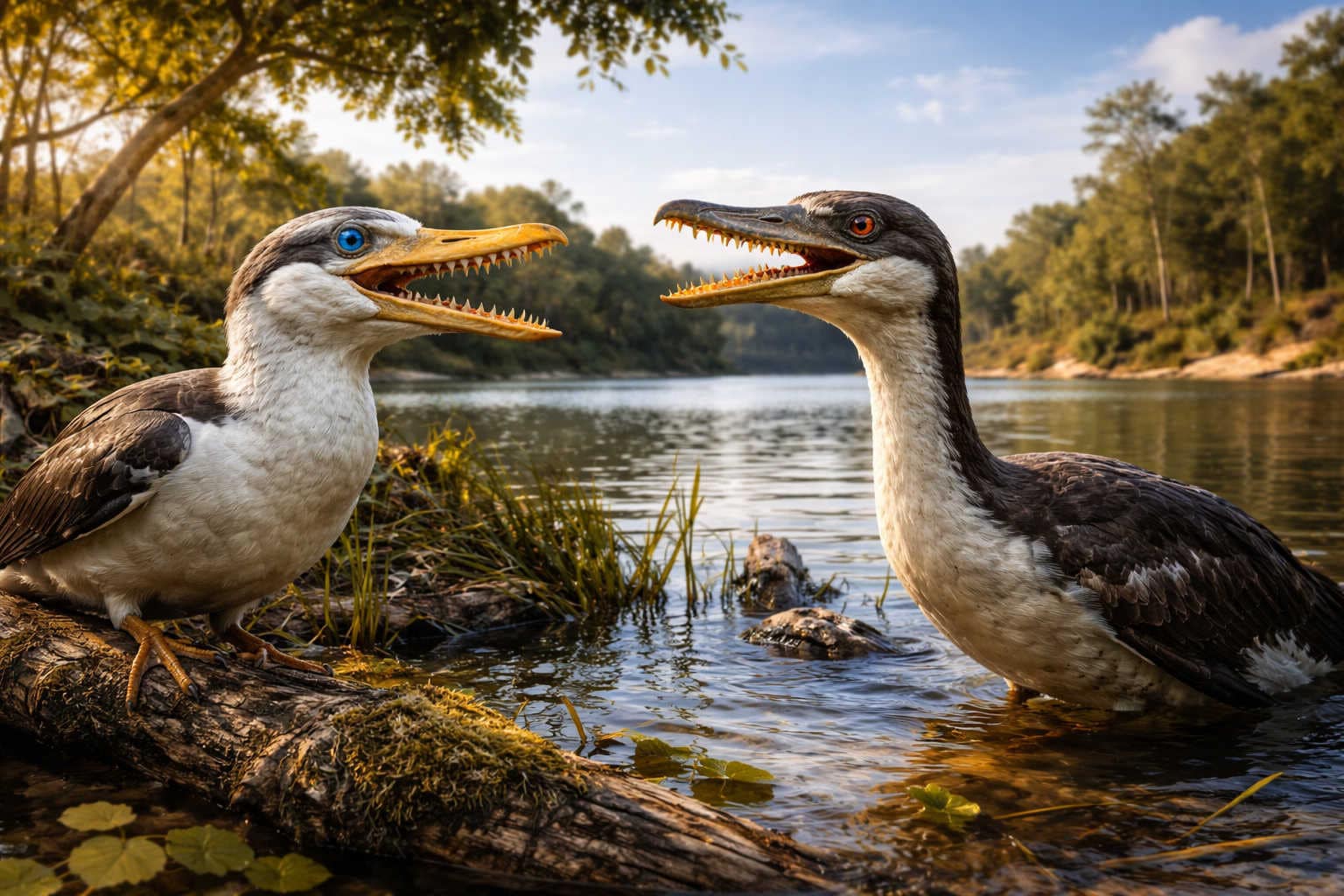
By the final stretch of the Cretaceous, the last toothed birds still came in more than one form. Some were Ichthyornis-like, strong-flying coastal birds with teeth set farther back in the jaws, giving them a strange mix of modern bird body and ancient reptilian mouth. Others were Hesperornis-like, large diving birds that had also kept teeth but had taken a very different path, becoming specialized swimmers rather than strong fliers. Alongside them were other archaic bird groups, including enantiornithines, some of which were hawk-sized and likely predatory or at least strongly grasping-footed. So the last toothed birds were not one fading little remnant. They were part of a broader, still-varied Late Cretaceous bird world.
And the birds that vanished were not only the toothed ones. Many toothless birds also disappeared at 66 million years ago. The great Mesozoic bird branch Enantiornithes went extinct, even though many of them looked surprisingly birdlike to modern eyes, and at least some had already evolved beaks and reduced or absent teeth. Latest Cretaceous bird faunas also included a wider mix of small archaic forms than the few famous names suggest. In other words, the extinction did not just prune away “primitive toothed birds.” It erased a much richer avian experiment, including many toothless birds that simply belonged to the wrong branches.
The future story is both bleak and hopeful. As far as current evidence shows, no toothed bird lineage made it through the K–Pg extinction, and the survivors belonged to crown birds, the branch that leads to living birds. We can say with confidence that at least one crown-bird lineage survived, because birds are still here. Beyond that, the strongest current picture is that the ancestors of the three great modern bird divisions—Palaeognathae, Galloanserae, and Neoaves—were already present or took shape very near that boundary, making it very likely that three major surviving branches crossed into the Paleogene. Researchers also argue that the impact devastated forests globally, so the survivors were probably small, mostly ground-dwelling or shore-associated birds rather than tree specialists. We are still looking, and the fossils are frustratingly sparse, but the broad story is now fairly clear: most bird branches died, and a small crown-bird remnant inherited the Earth.
