
Phil • Cr. Think • Science • Hist •
TST PRACTICE

The Philosophy Website

STORY

Conifers branch off

☐ Read
☑ Read
You’ve read this 0 times.
You’ve listened to this 0 times.

By Michael Alan Prestwood

Sat 21 Feb 2026
Published 7 months ago.
Updated 4 months ago.
Related Stories
LECA: Likely Sexual Reproduction
Archaea Diverge
Modern Trees: Modern Leaves
Triassic–Jurassic Extinction: Volcanoes Open the Age of Dinosaurs
Bacterial Endosymbiosis: Origin of Eukaryotes
Diatoms Emerge
Share :
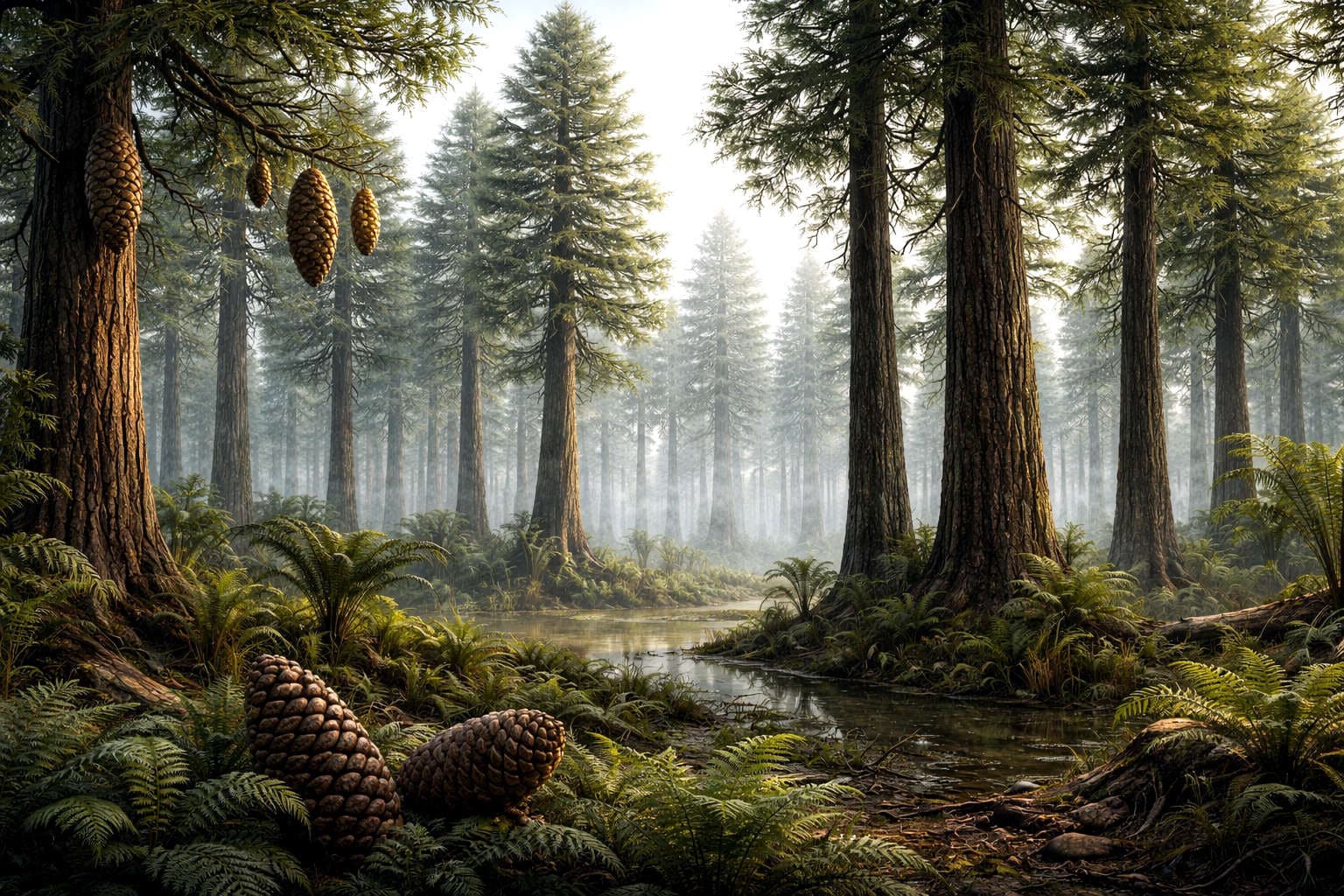
Early Conifers (Late Carboniferous, ~308 ± 5 mya). Woody gymnosperms with organized cones and drought adaptations.

Conifers branch off

~308 million years ago (+/- 5 million)
Naked seeds in cones (gymnosperm reproduction)

Conifers branch off during the late Carboniferous about 300 million years ago. This is when Earth’s vast coal swamps began to contract. Climates shifted. Regions became drier and more seasonal. Earlier seed plants already possessed the revolutionary advantage of seeds — embryos packaged with protection and stored food. But a new lineage refined survival on dry land even further.

Conifers emerged as specialists of aridity. They strengthened their trunks through robust secondary growth, producing dense wood that allowed greater height and long-term stability. This woody architecture supported long-lived trees capable of outlasting harsh cycles of drought and fire.

They also evolved extensive resin production — a chemical defense system that sealed wounds, repelled insects, and inhibited fungal invasion. Resin was not merely sticky sap; it was an evolutionary shield, preserving vascular integrity in an unforgiving environment.

Finally, conifers reduced water loss through narrow needle-like or scale-like leaves with thick cuticles and sunken stomata. These leaves minimized surface area while maintaining photosynthetic efficiency, allowing conifers to thrive where broad-leafed plants would wither.

Earlier seed plants cracked the code of reproduction away from water. Conifers perfected survival away from moisture.

— map / TST —

TST Tracker
✓ Reading recorded.
Michael Alan Prestwood
Author & Natural Philosopher
Prestwood writes on science-first philosophy, with particular attention to the convergence of disciplines. Drawing on his TST Framework, his work emphasizes rational inquiry grounded in empirical observation while engaging questions at the edges of established knowledge. With TouchstoneTruth positioned as a living touchstone, this work aims to contribute reliable, evolving analysis in an emerging AI era where the credibility of information is increasingly contested.
Email
Print
The Prestwood Column
Menu
September 2026
Column Research….
1. Timeline Story
Hume’s Is–Ought Problem
2. Linked Quote
“I meet with no proposition that is not connected with an ought, or an ought not.”
3. Science FAQ »
Can science prove flourishing should be our goal?
4. Philosophy FAQ »
What is the difference between a normative aim and a normative directive?
5. Critical Thinking FAQ »
Is flourishing for all just utilitarianism?
6. History FAQ!
What is the history of the idea of flourishing in philosophy?
Bonus Deep-Dive Article
TST Normative Ethics: Flourishing as a Philosophical Goal

Comments

Join the Conversation! Currently logged out.

Leave a Reply

NEW BOOK! NOW AVAILABLE!!

30 Philosophers: A New Look at Timeless Ideas

by Michael Alan Prestwood
The story of the history of our best ideas!
Scroll to Top