

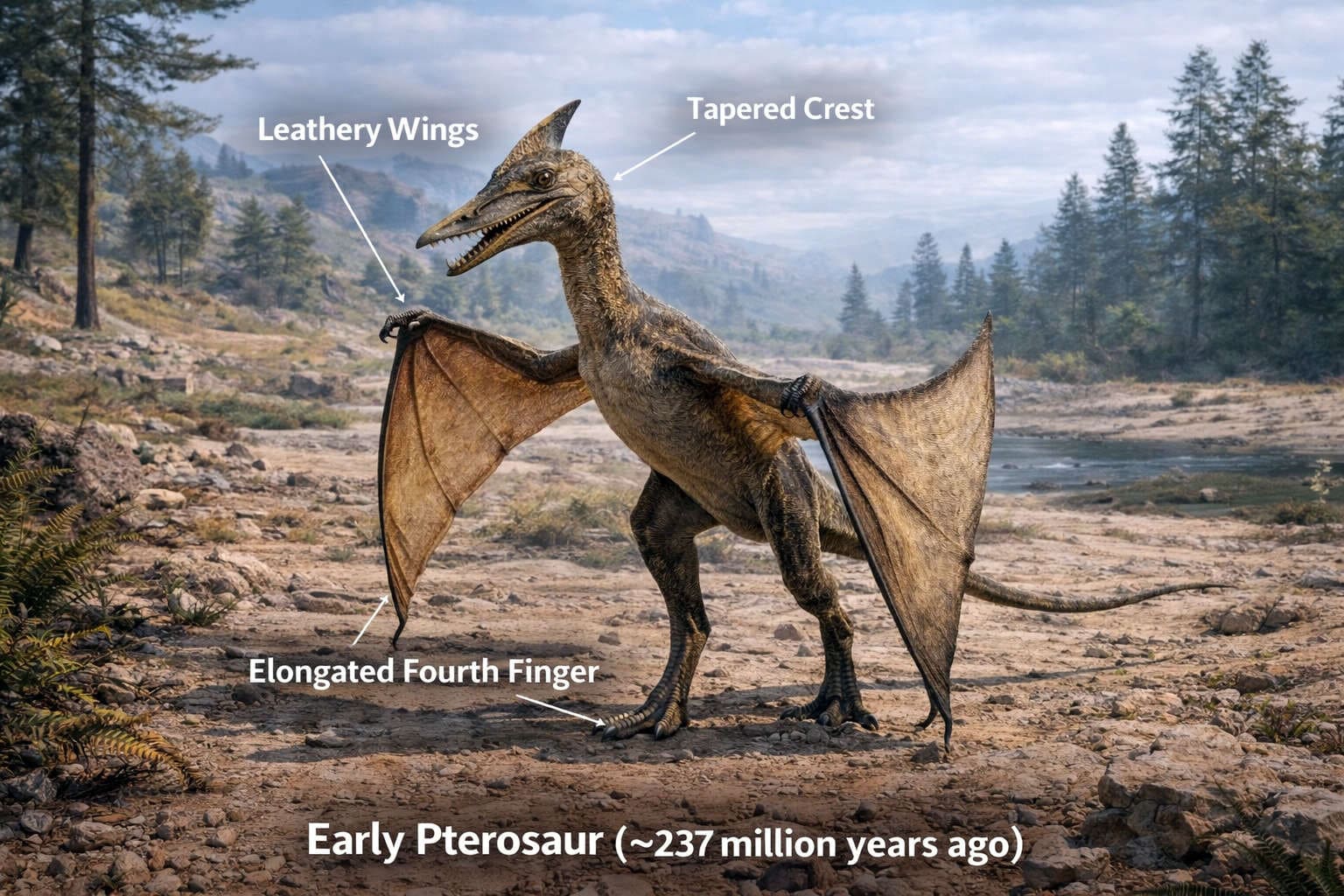
While they lived alongside the dinosaurs, pterosaurs were a distinct evolutionary experiment that mastered the air long before the first bird took flight. They emerged from the Ornithodira, a major branch of the archosaur family tree that also produced the dinosaurs. This divergence created two sister groups: one destined to dominate the land, and the other—the pterosaurs—destined to conquer the vertical frontier. They were the first vertebrates to achieve true powered flight, evolving a biological architecture unlike anything seen before or since.
The defining feature of the pterosaur was a wing membrane (patagium) supported by an incredibly elongated fourth finger. Unlike the feathered wings of birds or the hand-wings of bats, the pterosaur wing was a sophisticated structural sail made of skin, muscle, and reinforcing fibers. To stay airborne, they evolved ultralight, hollow bones—some with walls as thin as a playing card—and a specialized respiratory system that pumped oxygen with high efficiency. From the sparrow-sized Anurognathus to the giraffe-tall Quetzalcoatlus, their bodies were fine-tuned for a life of soaring, skimming, and high-speed aerial maneuvers.
The legacy of the pterosaurs is one of supreme aerial dominance that lasted for over 160 million years. They filled every conceivable niche, from coastal fish-eaters to inland scavengers, and developed elaborate bony crests likely used for display and temperature regulation. Though they vanished entirely during the K-Pg mass extinction, leaving no living descendants, they remain a testament to the versatility of the archosaurian line. They proved that the “ruling reptiles” were not merely earth-bound giants, but were capable of transcending the terrestrial world to own the very air itself.

