

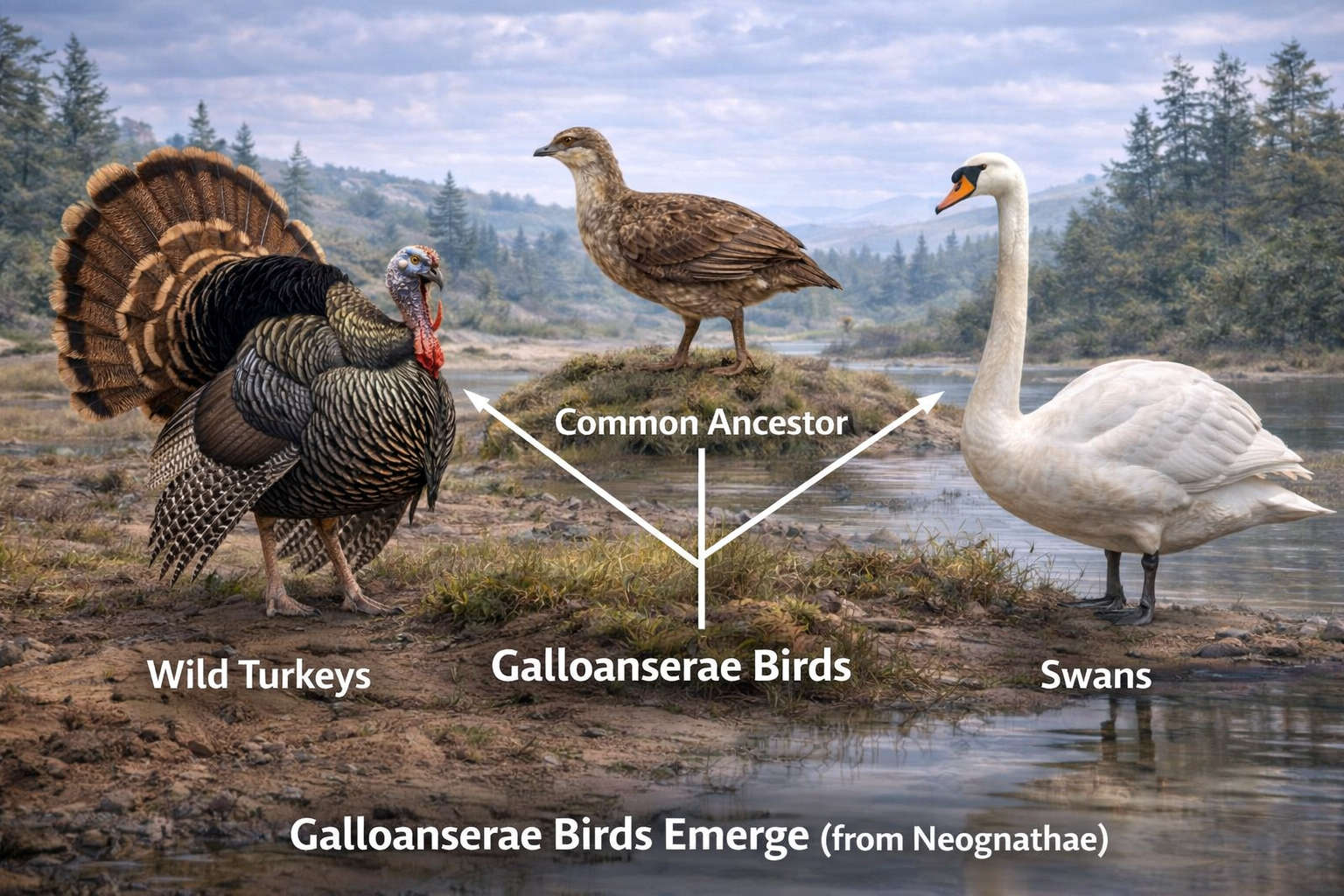
Galloanserae is the living bird branch that includes landfowl and waterfowl—in everyday terms, birds such as chickens, turkeys, pheasants, ducks, geese, and swans. Of the three great modern bird divisions, this is the one that often feels most familiar to people because it includes so many domesticated and commonly recognized birds. In the living bird tree, Galloanserae sits as one of the earliest major branches within Neognathae, distinct from both the ostrich-tinamou line of Palaeognathae and the vast catch-all diversity of Neoaves.
The genetic clock has long hinted that this branch is older than its earliest clear fossils alone would suggest. DNA-based studies commonly place the split that leads to Galloanserae deep in the Late Cretaceous, often in roughly the low-80s to high-80s million years ago range, which makes a representative timeline date of ~80 mya (±8 million years) a fair, DNA-leaning choice. That kind of estimate does not claim that modern chickens and ducks already existed then. Rather, it suggests that the ancestral line leading to the landfowl-waterfowl branch had likely already separated from other modern-bird lines before the end-Cretaceous extinction.
The fossil record is what makes Galloanserae especially interesting in the rocks-vs.-clocks debate. The K–Pg extinction event occurred about 66 million years ago, and Galloanserae is one of the strongest candidate modern-bird branches to show up right near that boundary. Asteriornis, dated to about 66.8–66.7 million years ago, lies close to the last common ancestor of Galloanserae, while Vegavis, from about 69.2–68.4 million years ago, is now strongly supported as an early waterfowl-line bird within crown birds. Together, those fossils make Galloanserae one of the clearest cases for a modern-bird lineage surviving across the K–Pg boundary, even as the broader timing debate over crown-bird origins continues.

