

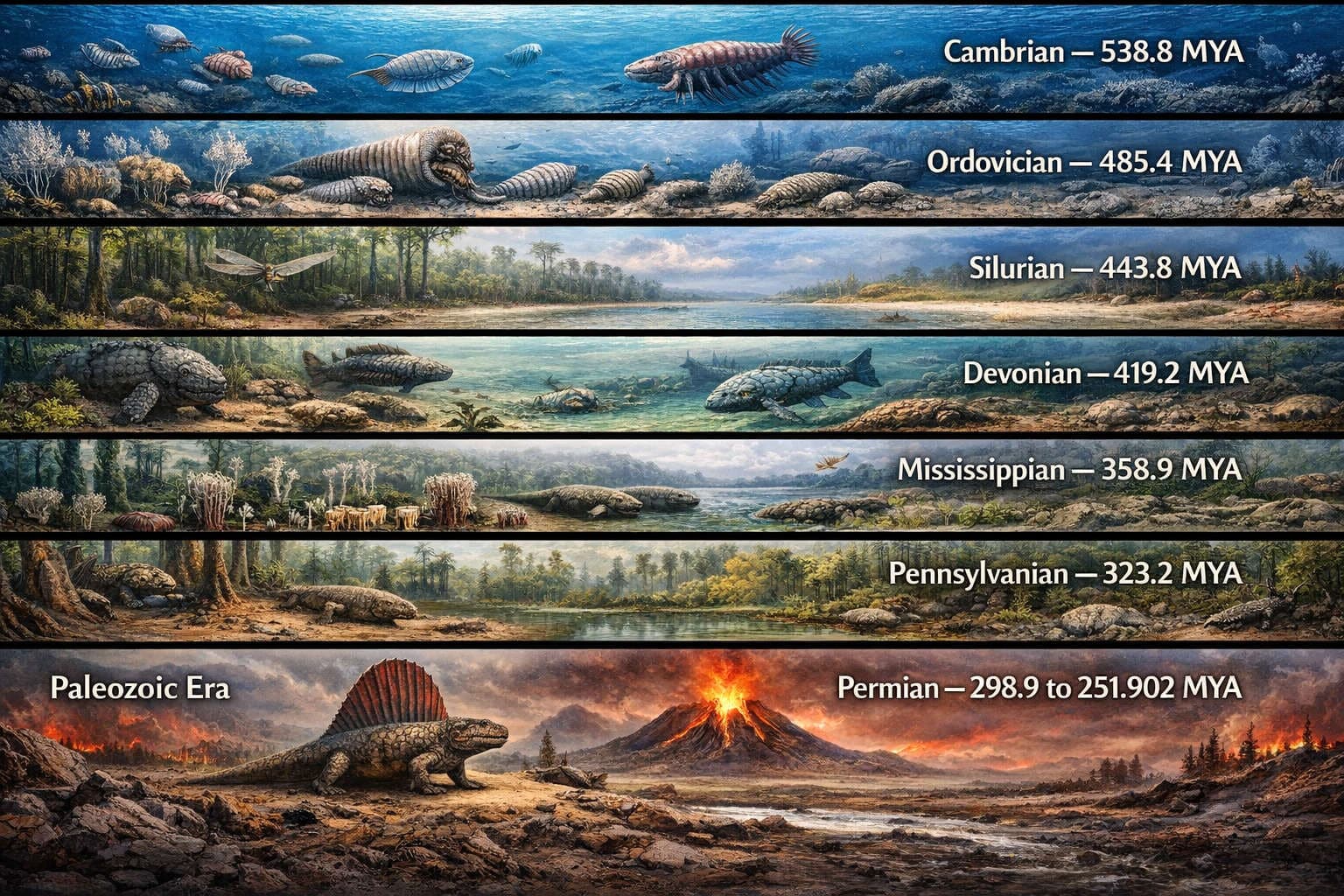
The Paleozoic Era begins 538.8 million years ago, at the start of the Cambrian Period, and that number is so precise because geologists tie it to a formal boundary in the rocks, not just a general biological shift. The official marker is associated with the first appearance of the trace fossil Treptichnus pedum, a distinctive burrow pattern that signals a new level of animal activity in the sediment. So when we mark the start of the Paleozoic, we are pointing to the beginning of the Cambrian world, where complex animal life suddenly becomes much more visible in the fossil record.
Life during the Paleozoic was, above all, the story of ancient life becoming bold, diverse, and increasingly complex. Early on, the seas dominated the planet, and marine life flourished in astonishing variety during and after the Cambrian explosion. Trilobites, brachiopods, mollusks, reef communities, early fishes, and many other marine forms filled warm shallow seas. Later, the great long-term shift of the era was life’s movement onto land: first plants, then more complex terrestrial ecosystems, then amphibians, and eventually reptiles and synapsids by the late Paleozoic. In many ways, this was the era when Earth first began to look biologically familiar.
To frame its roughly 287 million years, it helps to think of the Paleozoic in three broad acts. First comes the early Paleozoic—Cambrian, Ordovician, and Silurian—when marine life explodes, seas spread widely, and the first land plants begin to appear. Then comes the middle Paleozoic, especially the Devonian, often called the “Age of Fishes,” when vertebrate diversity expands and land ecosystems grow more ambitious. Finally comes the late Paleozoic—the Carboniferous and Permian—when great swamp forests, giant insects, amphibians, and increasingly successful reptile and synapsid lineages reshape the land. These six formal periods are Cambrian, Ordovician, Silurian, Devonian, Carboniferous, and Permian.
The synapsids, which evolve into mammals, us, were the first to really stake their claim, ruling the Permian landscape as the undisputed “kings of the hill” until the Great Dying nearly wiped the slate clean. We barely scraped through that disaster, leaving an empty world where the archosaurs seized the advantage, evolving upright stances and superior stamina to push our mammalian ancestors into the shadows for over 160 million years. It took a second global reset—the K-Pg extinction—to finally knock the dinosaurs off their pedestal and give us the opening to move from scurrying in the dark to taking over the planet. A 250-million-year relay race where we lost the lead, specialized to survive the drought, and only managed to reclaim the title because the environment shifted back in our favor.
The Paleozoic ends at 251.902 million years ago, at the boundary between the Permian and Triassic, and that ending is one of the most dramatic transitions in Earth history. Rather than a gentle fade, it closes with the end-Permian extinction, the largest known mass extinction event in the fossil record. Vast numbers of marine species disappeared, many land ecosystems collapsed, and the biological world was reset in a way that opened the door to the Mesozoic Era that followed. So the Paleozoic begins with the rise of visible complex animal life and ends with the greatest extinction Earth has ever known.

