
Phil • Cr. Think • Science • Hist •
TST PRACTICE

The Philosophy Website

FAQ

In what way did Rudolf Steiner influence Waldorf education?

☐ Read
☑ Read
You’ve read this 0 times.
You’ve listened to this 0 times.
Sun 31 May 2026
Published 3 months ago.
Updated 1 month ago.
Related FAQs
When was punctuation invented?
Did Aristotle believe in a soul?
What is Eastern “chee,” or qi?
Who was the first female philosopher?
What is fear-based ethics?
What inspired Orwell’s 1984 and Orwellian thought?
Share :
Email
Print

In what way did Rudolf Steiner influence Waldorf education?

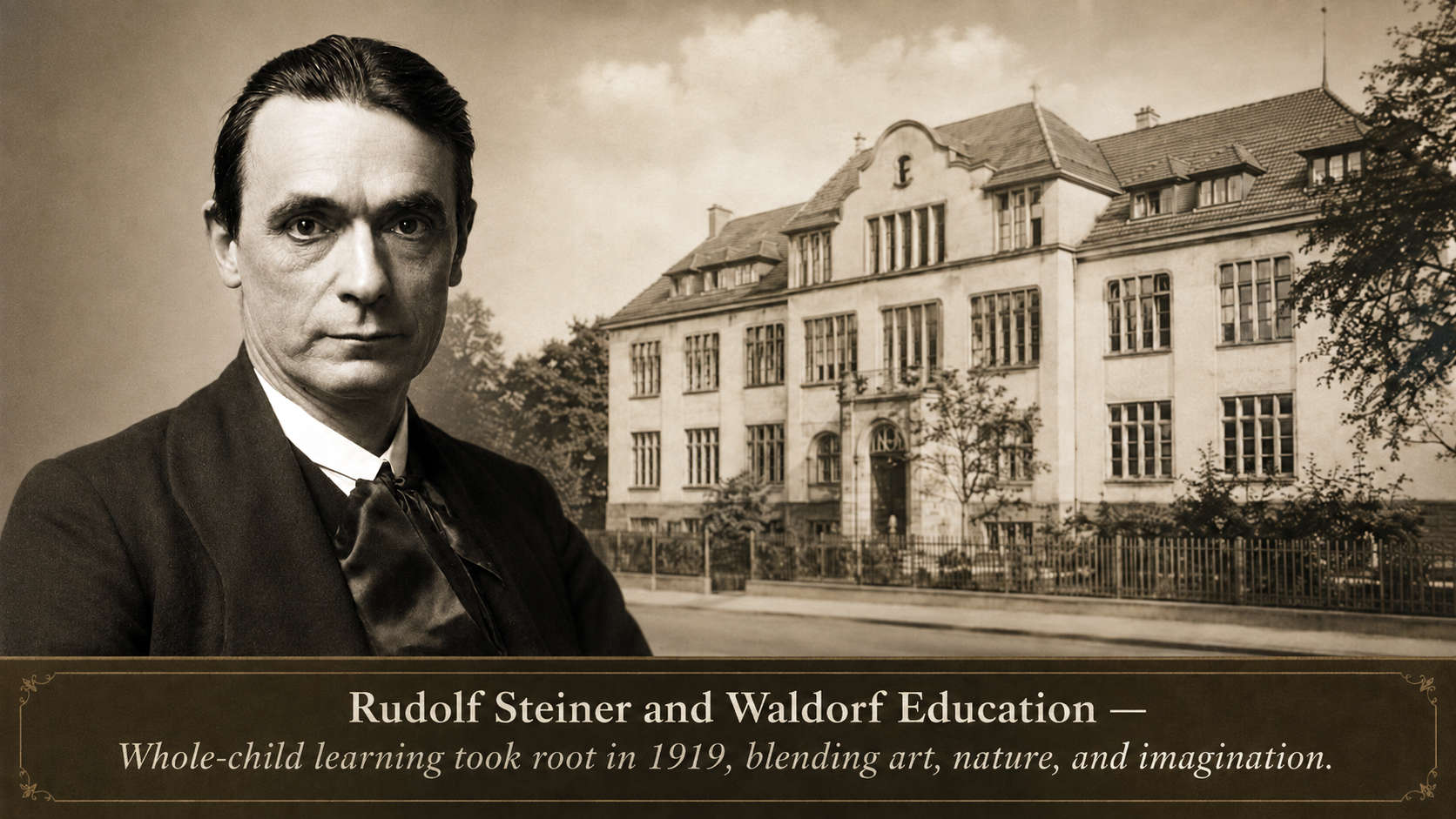
Born in 1861, Rudolf Steiner opened the first Waldorf school in Stuttgart, Germany, in 1919. After the owner of the Waldorf-Astoria cigarette factory asked Steiner to help, they created a school for the children of factory workers. That is where the name “Waldorf” comes from. The school was born in the aftermath of World War I, when many were looking for a better way to educate children.

At its best, Waldorf education offers much. It treats children as whole human beings, not just test-taking machines. It values imagination, art,  and movement. It values nature, hands-on learning, and moral development. From my view, those ideas are easy to support when they are grounded in child development, practical outcomes, and human flourishing. Children need knowledge, but they also need rhythm, beauty, and curiosity. They thrive with emotional steadiness, and meaningful engagement with the world.

The problem is anthroposophy, Steiner’s larger spiritual worldview. Anthroposophy includes claims about spiritual development, unseen forces, and spiritual knowledge beyond ordinary sense experience. His ideas that are speculative are not publicly testable. Some have been criticized as pseudoscientific, and some of Steiner’s racial and cultural ideas are rightly rejected today. From my view, this does not require dismissing every Waldorf practice, but it does require careful sorting.

Today, Waldorf schools usually do not teach anthroposophy to students as doctrine. But anthroposophy still lives in the bones of Waldorf education. It informs teacher training, developmental theory, and classroom rhythm. So, I think it’s fair to say that Steiner gave Waldorf education both its strengths and its complications. An impressive educational system, but the spiritual claims should be held humbly, if at all.
— map / TST —

TST Tracker
✓ Reading recorded.

Annotated References:

Sources behind the factual framing:

Waldorf 100 describes the first school’s 1919 Stuttgart origin and its connection to Emil and Berta Molt and the Waldorf-Astoria Cigarette Company.

AWSNA says Waldorf education is based on Steiner’s teachings and anthroposophy.

Waldorf UK says anthroposophy is not taught in schools as a worldview, while still discussing its role in the curriculum foundation.

Britannica notes that anthroposophy-related issues, including Steiner’s racial and cultural ideas, are central to critiques of Waldorf schools.

Waldorf education carries both Steiner’s gift and his complication. The gift: children are whole beings who need art, nature, story, movement, and wonder. The complication: anthroposophy adds spiritual claims that must be held carefully, not mistaken for science.
Michael Alan Prestwood
Author & Natural Philosopher
Prestwood writes on science-first philosophy, with particular attention to the convergence of disciplines. Drawing on his TST Framework, his work emphasizes rational inquiry grounded in empirical observation while engaging questions at the edges of established knowledge. With TouchstoneTruth positioned as a living touchstone, this work aims to contribute reliable, evolving analysis in an emerging AI era where the credibility of information is increasingly contested.
The Prestwood Column
Menu
August 2026
»COLUMN ARCHIVE
--COLUMN--
Column Research….
1. Timeline Story
Ethical Roadmap
2. Linked Quote
“The greatest weapon against stress is our ability to choose one thought over another.”
3. Science FAQ »
Did morality evolve?
4. Philosophy FAQ »
Is the Me Too movement consistent with TST Ethics?
5. Critical Thinking FAQ »
When should you stop following the crowd?
6. History FAQ!
What did the Nuremberg Trials clarify about moral agents?
Bonus Deep-Dive Article
TST Ethical Roadmap: A Process Model for Ethical Guidance and Moral Choice

Comments

Join the Conversation! Currently logged out.
NEW BOOK! NOW AVAILABLE!!

30 Philosophers: A New Look at Timeless Ideas

by Michael Alan Prestwood
The story of the history of our best ideas!
Scroll to Top