
Phil • Cr. Think • Science • Hist • …
TST PRACTICE

By Philosopher Michael Alan Prestwood

FAQ

How does the Idea of Ideas handle Dawkins memes?

☐ Read
☑ Read
You’ve read this 0 times.
You’ve listened to this 0 times.
Fri 16 Oct 2026
Published 5 minutes ago.
Updated 13 seconds ago.
Related FAQs
Did morality evolve?
Does AI already possess physical agency?
How does the Idea of Ideas handle commands?
Debunking Myth: Do bananas and humans share 60% of their genes?
Did talking our way through life drive a million years of brain growth?
How is TST Theory of Truth different than verisimilitude?
Share :
Email
Print

How does the Idea of Ideas handle Dawkins memes?

An idea is a mental construct, a thought about something. In my Idea of Ideas framework, an idea forms when the mind performs a cognitive operation on an impression or connects two impressions. For example, hearing a rustling sound is an impression. Recognizing it as danger is an idea. This distinction reaches back into our evolutionary past, before language and reflective thought. 

Ideas come in many forms. A single word can represent an idea, while vocabulary gives us a collection of ideas. Philosophy tends to focus on questions, statements, and claims, but a story is also an idea. So is a theory. Some ideas are grouped into interesting categories like paradoxes and counterfactuals. Some ideas are simple, like recognizing something as food. Others combine ideas into something complex, like the theory of evolution.

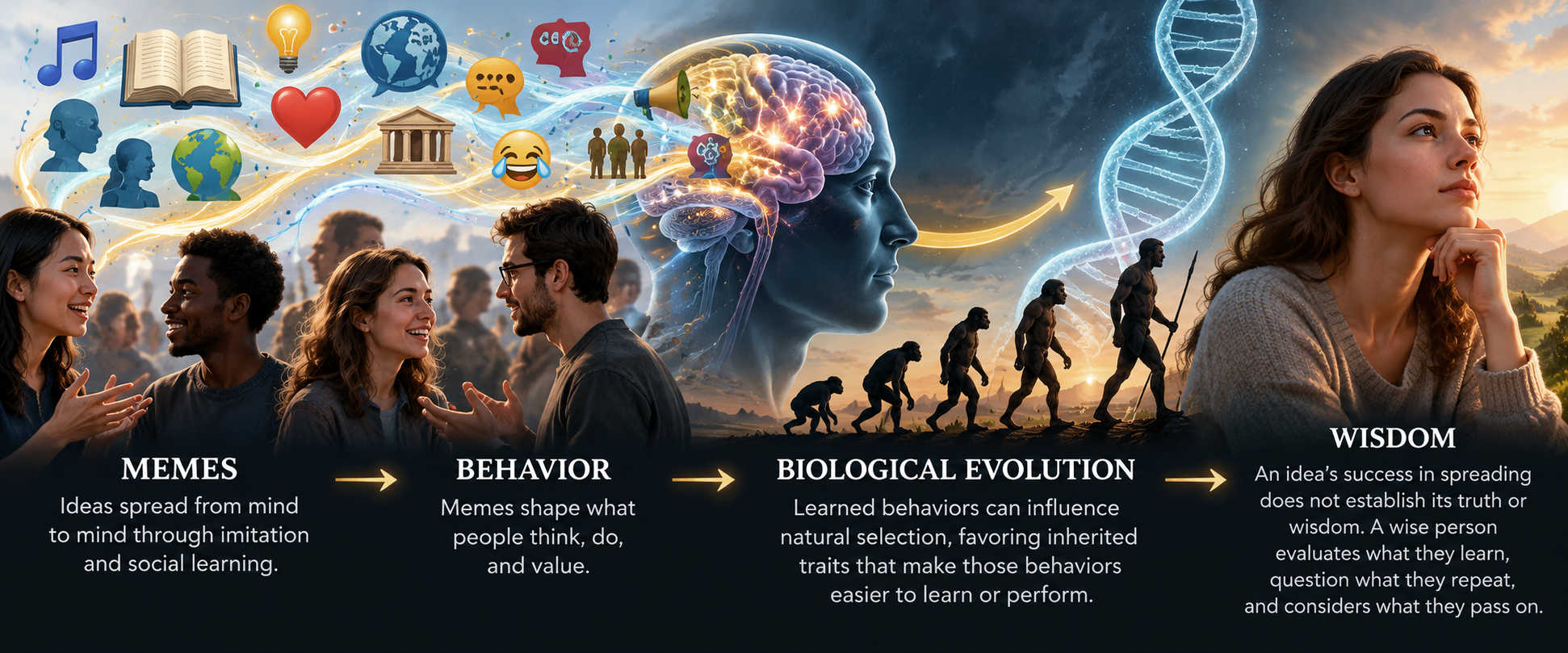
In 1976, Richard Dawkins introduced the term meme in The Selfish Gene. A meme is a type of idea, a unit of cultural transmission. It’s something that spreads from one mind to another through experience. Examples include melodies, catchphrases, and beliefs. Dawkins suggested memes impact biological evolution. Not straight inheritance, more complicated, and debated, but an important idea of the 1970s. Philosopher Daniel Dennett later connected this discussion to the Baldwin effect, first proposed in 1896: it’s the idea that learned behaviors can influence natural selection, favoring inherited traits that favor memes. In other words, from the genetic side, nature can favor inherited traits based on learned behavior! Learning doesn’t rewrite genes, but learning can help determine which genes succeed.

Within the Idea of Ideas, Dawkins’s memes fit naturally alongside other types of ideas. Nothing about Dawkins’s concept conflicts with the Idea of Ideas. In fact, it adds another useful dimension: how ideas spread and evolve through societies.
— map / TST —

TST Tracker
✓ Reading recorded.
Wisdom means looking beyond whether an idea survives and spreads. Memes can carry knowledge, prejudice, cooperation, or harm. Some learned behaviors may even influence natural selection over generations. Understanding this reminds us that ideas have consequences. A wise person evaluates what they learn, questions what they repeat, and considers what they pass on.
Michael Alan Prestwood
Natural Philosopher & Author
Prestwood explores science-first philosophy, with particular attention to the convergence of disciplines. Drawing on his TST Philosophy, his work emphasizes rational inquiry grounded in empirical observation while engaging questions at the edges of established knowledge. With TouchstoneTruth positioned as a living touchstone, this work aims to contribute reliable, evolving analysis in an emerging AI era where the credibility of information is increasingly contested.
The Prestwood Column
Menu
October 2026
Column Research….
1. Timeline Story
The Great Quaker Debates!
2. Linked Quote
“All men are prone to differ. It is no new thing in all former ages, in all parts. Each party is most right in his own eyes.”
3. Science FAQ »
Do facts actually change minds?
4. Philosophy FAQ »
When does persuasion become manipulation?
5. Critical Thinking FAQ »
How can you tell when a debate has stopped being productive?
6. History FAQ!
What is the history of debate?
Bonus Deep-Dive Article
Roger Williams Biography and Dedication to the Freedom of Conscience

Comments

Join the Conversation! Currently logged out.
NEW BOOK! NOW AVAILABLE!!

30 Philosophers: A New Look at Timeless Ideas

by Michael Alan Prestwood
The story of the history of our best ideas!
Scroll to Top