
Explore Science-first Philosophy

FAQ

How did writing first evolve?

Wed 14 Aug 2024
Published 2 years ago.
Updated 2 weeks ago.
Related FAQs
What is the Ebbinghaus Illusion?
What is consciousness?
What ancient human species first realized it was going to die?
Do cats see humans as another cat?
Do my people and culture help or harm my critical thinking?
Do brain chemicals relate to the “Hard Problem of Consciousness”?
Share :
Email
Print

How did writing first evolve?

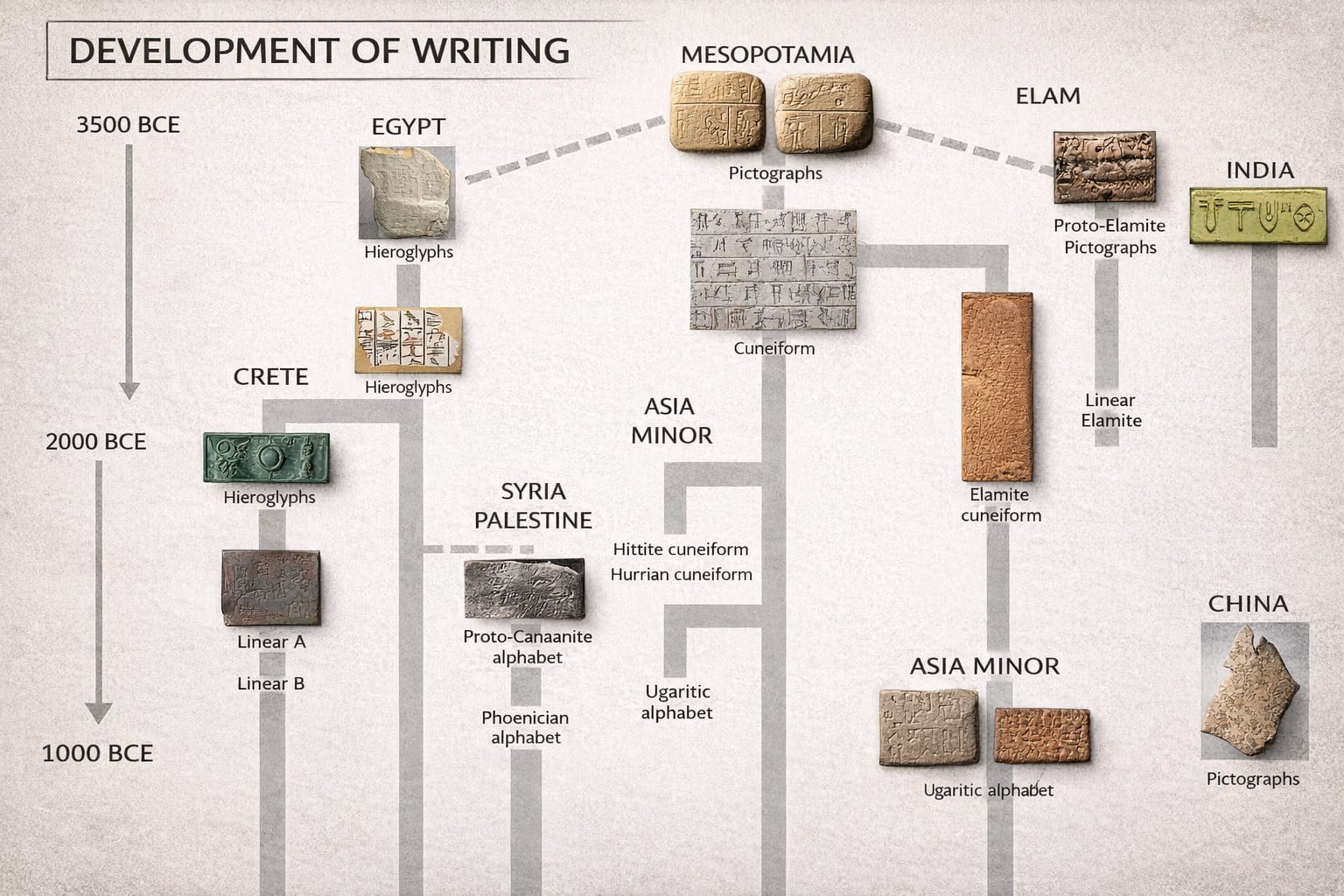
The development of writing was gradual. It likely started up many times, had some success, only to be lost to the sands of time. We know about a few going back about 5,000 years, but earlier attempts almost certainly existed, though we have to focus on what we find.

There are essentially three main types of written language: logographic, syllabic, and alphabetic. Logographic systems use pictures to represent words. For example, Chinese characters, ancient Sumerian cuneiform, and Egyptian hieroglyphics are all logographic systems. Syllabic systems use symbols to represent syllables, reproducing the audible bits of a spoken language. An example of this is the Japanese kana scripts, where each character represents a syllable. Finally, alphabetic systems use symbols to represent individual sounds (phonemes), not whole syllables. Examples include the Latin alphabet.

So, why did we start writing? There are various theories, and one clear reason is the desire to preserve spoken language. Beyond this general reason, specific theories include record-keeping and labeling. In ancient Mesopotamia, for instance, clay tokens were used to keep track of goods and transactions. Over time, these tokens evolved into cuneiform. This suggests that cuneiform writing, and perhaps others, developed to manage economic transactions and inventories. Another idea says that writing began with the need to label and identify objects and places. Hieroglyphics, for example, may have started this way. Perhaps it started by marking things–perhaps an “X” for areas to watch out for or symbols for places like bathrooms.
— map / TST —

Deep-Dive Article: The Evolution of Vocabulary in Ancient Humans
Michael Alan Prestwood
Author & Natural Philosopher
Prestwood writes on science-first philosophy, with particular attention to the convergence of disciplines. Drawing on his TST Framework, his work emphasizes rational inquiry grounded in empirical observation while engaging questions at the edges of established knowledge. With TouchstoneTruth positioned as a living touchstone, this work aims to contribute reliable, evolving analysis in an emerging AI era where the credibility of information is increasingly contested.
TST Weekly Column
April 15, 2026
»Column Archive
WWB Research….
1. Story of the Week
John Snow and the Broad Street Pump
2. Quote of the Week
“A wise man proportions his belief to the evidence.”
3. Science FAQ »
Were dinosaurs Jurassic movie smart?
4. Philosophy FAQ »
How does the idea of Identity in Christ fit within TST?
5. Critical Thinking FAQ »
What is the difference between Public Truth and Public Belief?
6. History FAQ!
Did Einstein’s driver really give one of his early talks?
Bonus Deep-Dive Article
TST Epistemic Calibration: Credence and Degrees of Belief

Comments

Join the Conversation! Currently logged out.
NEW BOOK! NOW AVAILABLE!!

30 Philosophers: A New Look at Timeless Ideas

by Michael Alan Prestwood
The story of the history of our best ideas!
Scroll to Top