
Weekly Insights for Thinkers

FAQ

Is “the speed of light” really the best name for the universe’s maximum speed?

Wed 31 Dec 2025
Published 2 months ago.
Updated 2 months ago.
Relativity
Related FAQs
Can you explain the Big Freeze, Big Rip, and Big Crunch Ideas?
Why do scientific models work if they aren’t literally true?
Who is famous for questioning cause and effect?
Was math discovered or invented?
How is TST Ethics different from utilitarianism?
What is Deception Research?
Share :

Is “the speed of light” really the best name for the universe’s maximum speed?

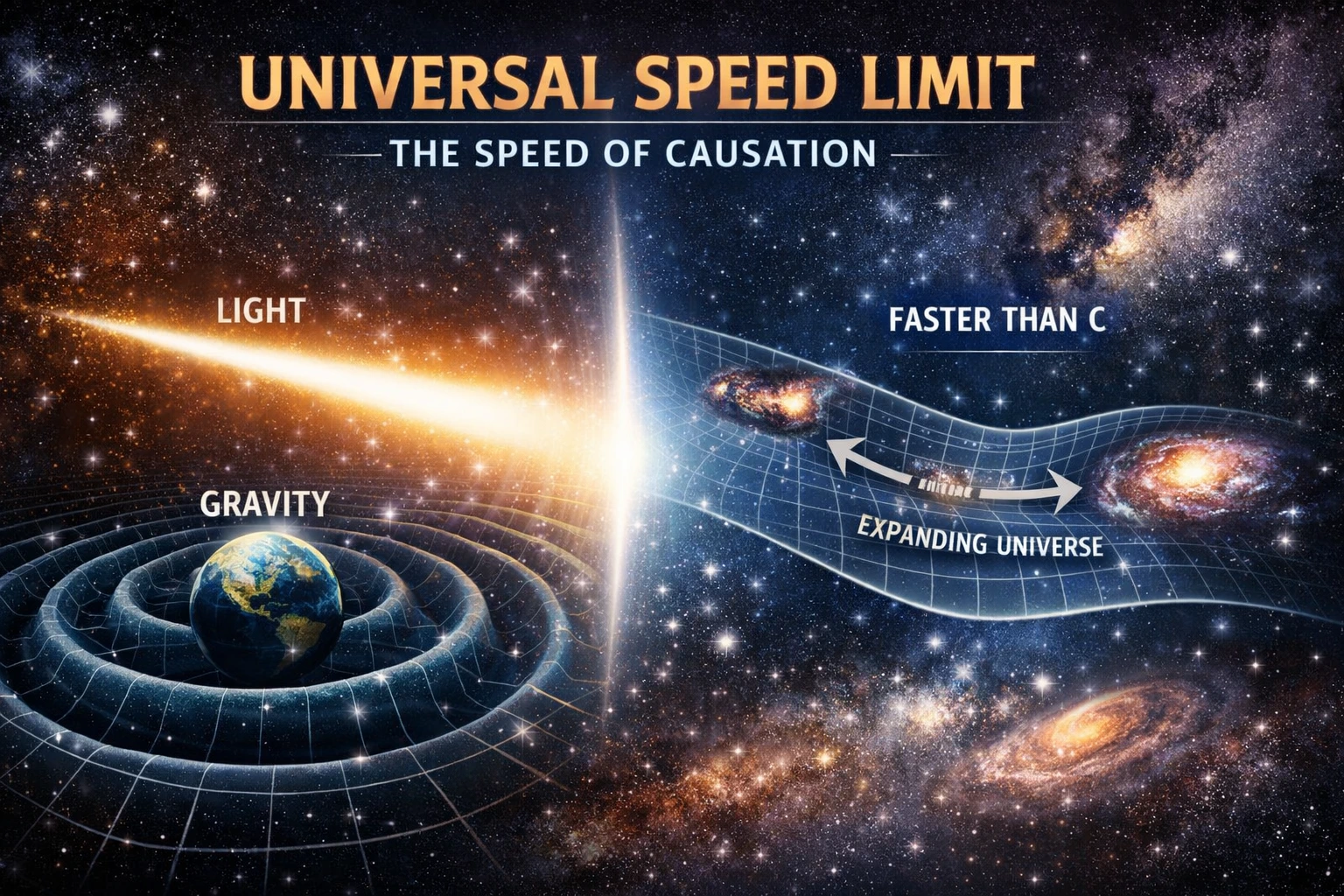
The true meaning behind the “speed of light.” While light and gravity both propagate at the universal speed limit, spacetime itself can expand faster than this limit, causing distant regions to separate without transmitting information.

It’s the c in Einstein’s equation:

E =  mc2

We call it the speed of light, but that name hides what the constant really is. Light is just one thing that travels at this speed, and it does this only in a vacuum. Other things travel at this speed too, for example, the effects of gravity. The constant isn’t about light—it’s about limits.

The so-called “speed of light” isn’t really about light at all. It’s the speed of causation, a fundamental limit built into spacetime itself as seen “within” our universe.

In modern physics, this constant defines the spacetime speed limit: the fastest rate at which cause and effect can propagate. It’s the speed of causality. Nothing carrying information, influence, or change can outrun it.

Light can appear slower because it interacts with matter. Glass, water, and plasma delay light. Gravity doesn’t interact that way, so its effects can arrive sooner. Light sometimes waits. Gravity does not.

This reveals a language problem. “Speed of light” is historically accurate but conceptually misleading. A better mental model is speed of causality, the maximum rate at which the universe allows events to affect other events.

There’s one more wrinkle: space itself is expanding, and that expansion can exceed the spacetime speed limit without violating it. No information travels faster than causality, but distances can grow faster than signals can cross. Any future unified theory will need to account for that distinction.

Since “speed of light” is clearly not the best term, how about we use “universal speed limit,” and many do now. And, define it as “the speed of causation.”

— map / TST —

Michael Alan Prestwood
Author & Natural Philosopher
Prestwood writes on science-first philosophy, with particular attention to the convergence of disciplines. Drawing on his TST Framework, his work emphasizes rational inquiry grounded in empirical observation while engaging questions at the edges of established knowledge. With TouchstoneTruth positioned as a living touchstone, this work aims to contribute reliable, evolving analysis in an emerging AI era where the credibility of information is increasingly contested.
This Week @ TST
March 11, 2026
»Edition Archive
WWB Research….
1. Story of the Week
Galileo: Observation Corrects the Map
2. Quote of the Week
“The Dao that can be told is not the eternal Dao; The name that can be named is not the eternal name.”
3. Science FAQ »
Is red an empirical idea?
4. Philosophy FAQ »
Does infinity exist?
5. Critical Thinking FAQ »
Was math discovered or invented?
6. History FAQ!
Is Philo’s interpretation related to the split in the Idea of Ideas?
Bonus Deep-Dive Article
TST Metaphysical Position: The Split

Comments

Join the Conversation! Currently logged out.
NEW BOOK! NOW AVAILABLE!!

30 Philosophers: A New Look at Timeless Ideas

by Michael Alan Prestwood
The story of the history of our best ideas!
Scroll to Top