

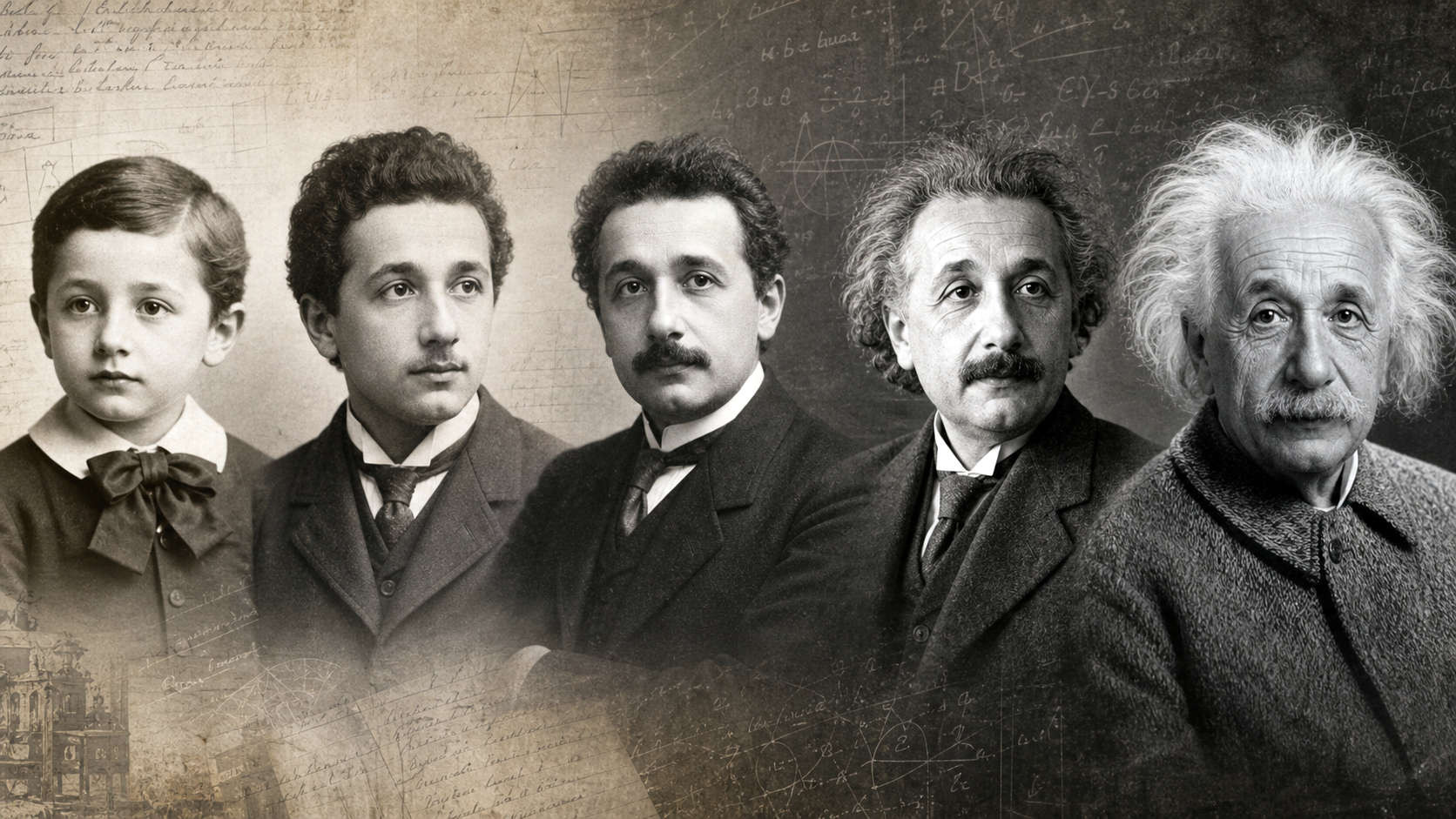
Albert Einstein was born in 1879 in Ulm, Germany. As a child, he was curious, independent, and not especially impressed by rigid schooling. Meaning, he did not always do well in school. He loved puzzles, music, and thought experiments—the kind of questions you can carry around in your mind for years. After studying physics in Switzerland, he struggled to find an academic post and took a job as a patent clerk in Bern. That quiet job gave him time to think. In 1905, still outside the university world, he published the papers that would change physics.
His rise was remarkable. In that one year, Einstein explained the photoelectric effect, helped prove atoms were real through Brownian motion, introduced special relativity, and gave us the famous relationship between mass and energy: E = mc². Before long, the unknown patent clerk became one of the most important scientists in Europe. In 1921, he received the Nobel Prize in Physics, not for relativity, but for explaining the photoelectric effect—work that helped open the door to quantum physics.
Einstein’s greatest achievement came with general relativity. In 1915, he reframed gravity itself. It was no longer just a force pulling objects together, but the curvature of spacetime guiding how things move. That idea transformed cosmology and gave us a new way to understand the universe. His work also helped shape modern particle physics and quantum theory, even though he later resisted some of its stranger implications. Still, his early insights helped launch the age of photons, quanta, atoms, and the deeper structure of matter.
In 1933, Einstein left Europe as the Nazis rose to power and settled in the United States. He spent his final decades at Princeton, famous not only as a scientist but as a public intellectual, humanitarian, and moral voice. Yet scientifically, he became increasingly isolated. He searched for a unified theory that could bring gravity and electromagnetism into one grand framework, but he never found it. Even so, the quest fit the man. Einstein spent his life looking for the deeper unity beneath the surface of reality.

